

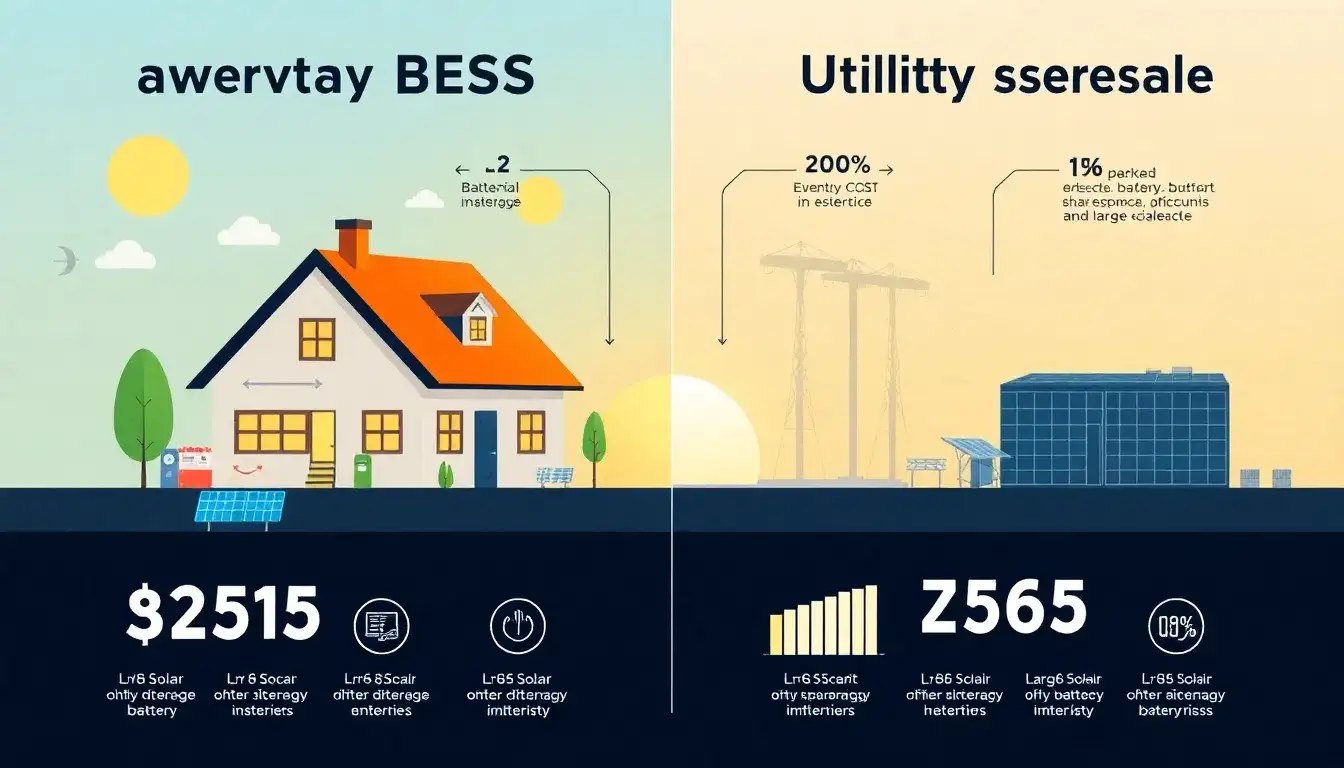
When comparing the average costs of residential and utility-scale battery energy storage systems (BESS), several factors come into play. Here’s a general breakdown of the cost differences:
Residential Battery Storage Systems
- Cost Range: Residential battery systems typically cost between $500 to $1,000 per kilowatt-hour (kWh) of capacity, depending on the provider and specific system features. These costs are significantly higher per kWh than utility-scale systems because they are smaller and lack the economies of scale.
- Installation Costs: Installation costs for residential systems are generally included in the overall cost but can vary widely depending on the installer and specific site conditions.
- Technology and Size: Residential systems usually use lithium-ion batteries and are much smaller than utility-scale systems, often ranging from a few kWh to a few dozen kWh in capacity.
Utility-Scale Battery Energy Storage Systems
- Cost Range: Utility-scale BESS costs have been decreasing and can range from approximately $100 to $300 per kWh, depending on the technology and specific system configurations. For example, costs for a 4-hour lithium-ion system might be around $245 to $403 per kWh by 2030.
- Installation and Balance of System (BOS) Costs: For larger systems, installation costs are typically lower per kW due to economies of scale but are still significant. BOS components add substantial costs, often increasing the total cost by 20% to 30%. For a 50MW system, installation costs alone might range from $2.5 million to $5 million.
- Size and Technology: Utility-scale systems are designed for large capacities (e.g., tens to hundreds of megawatts) and frequently use lithium-ion batteries among other technologies.
Key Differences
- Economies of Scale: Utility-scale systems benefit from economies of scale, significantly reducing costs per kWh compared to residential systems.
- Technological Variety: Utility-scale systems can employ a variety of technologies besides lithium-ion, including redox flow batteries and others, whereas residential systems predominantly use lithium-ion.
- System Complexity: Utility-scale installations require more complex systems integration and infrastructure, including power conversion systems and grid connection equipment, which adds to overall costs but supports larger energy storage needs.
In summary, the average cost per kWh for residential systems is notably higher than for utility-scale systems due to the smaller scale and lack of economies of scale. Utility-scale systems benefit from larger production volumes and more specialized technological options.
Original article by NenPower, If reposted, please credit the source: https://nenpower.com/blog/what-are-the-average-cost-differences-between-residential-and-utility-scale-bess-installations/

