

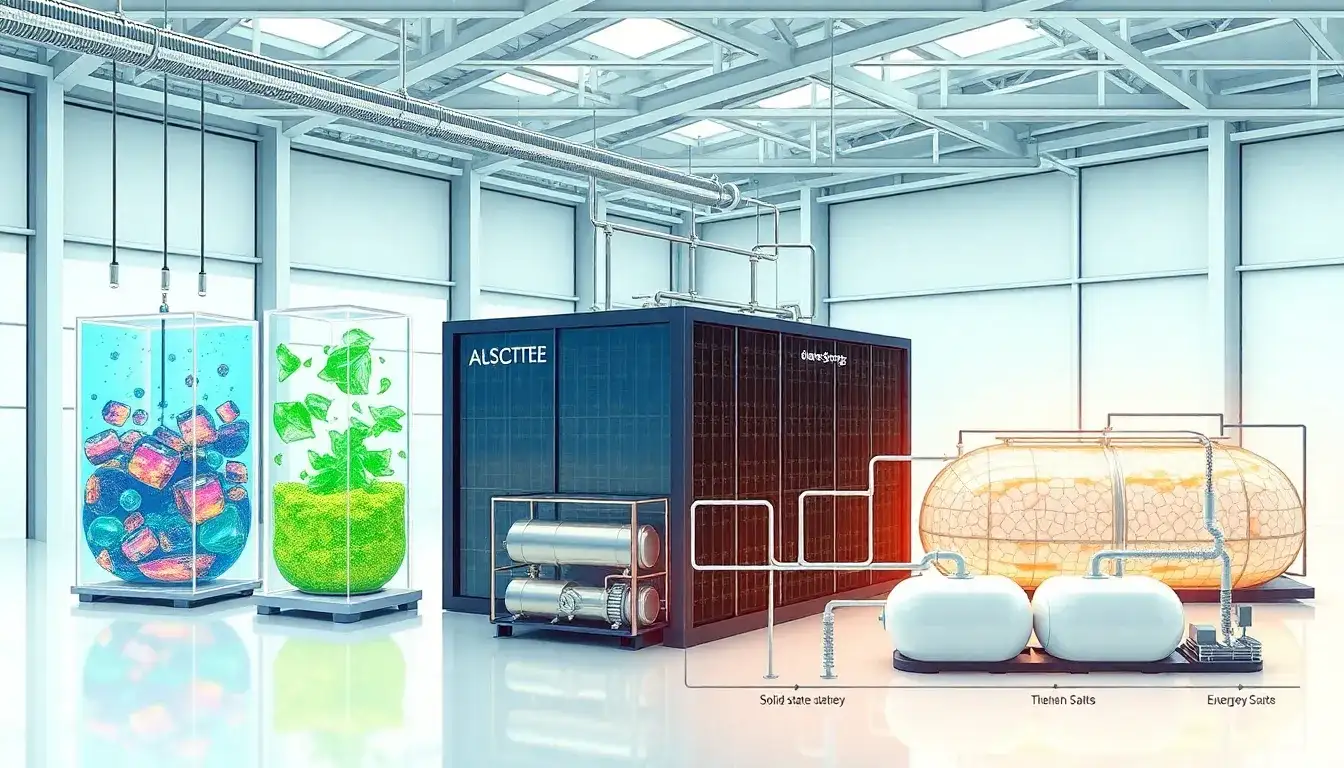
Alternatives to lithium-ion batteries for grid-scale energy storage include a range of technologies designed to provide longer-duration storage and better economic viability in some cases. Key alternatives are:
Liquid Air Energy Storage (LAES)
- LAES uses electricity to liquefy air, which is then stored in insulated tanks at very low temperature. When energy is needed, the liquid air is evaporated and expanded through a turbine to generate electricity.
- LAES systems can store vast amounts of electricity for days or longer and can be sited almost anywhere, making them flexible for grid-scale applications.
- Economic viability depends on location and subsidies, but modeling shows LAES costs could be lower than lithium-ion batteries and pumped hydro in some scenarios, especially for long-duration storage needs associated with renewable energy integration.
Flow Batteries (e.g., Vanadium Flow Batteries)
- Flow batteries store energy in liquid electrolytes that flow through electrochemical cells, allowing for flexible scalability and long cycle life.
- Vanadium redox flow batteries are prominent in large-scale applications due to their ability to provide steady power output and long-duration storage.
- They offer advantages in durability and safety compared to lithium-ion, suitable for daily and multi-hour storage needs.
Pumped Hydro Storage
- Although well-established and currently the largest form of grid storage capacity worldwide, pumped hydro relies on topographical conditions to operate, which limits site options.
- It stores energy by pumping water uphill to a reservoir during times of excess power, then releasing it through turbines to generate electricity when needed.
Compressed Air Energy Storage (CAES)
- CAES compresses air and stores it underground or in large containers; when electricity is demanded, compressed air is expanded through turbines to generate power.
- Like LAES, CAES can serve as long-duration storage but requires appropriate geological formations or large storage vessels.
Gravity-Based Storage
- Gravity energy storage systems store energy by lifting heavy masses and releasing them to generate power through gravitational force.
- Emerging as a novel solution, these systems offer potentially scalable and environmentally benign storage options, though they are less mature than other technologies.
Other Emerging or Complementary Technologies
- Integration of smart grid technologies and virtual power plants (VPPs) enhance the coordination of distributed energy resources including storage systems, improving grid stability.
- Innovations such as blockchain-enabled energy trading are enabling more decentralized management of energy resources and storage, contributing to grid resilience and efficiency.
Summary Table
| Technology | Storage Duration | Scalability | Site Requirements | Advantages | Challenges |
|---|---|---|---|---|---|
| Lithium-ion Batteries | Hours (typically <4) | Modular, scalable | Flexible | High energy density, fast response | Costly for long-duration |
| Liquid Air Energy Storage | Days or longer | Large scale | Minimal (flexible siting) | Long duration, clean, cost-effective potential | Economic viability still emerging |
| Flow Batteries | Hours to days | Scalable | Flexible | Long cycle life, safe, durable | Lower energy density |
| Pumped Hydro | Hours to days | Very large scale | Suitable topography | Established, cost effective | Site limited by geography |
| Compressed Air Storage | Hours to days | Large scale | Geological formations | Long duration | Limited suitable sites |
| Gravity Storage | Hours to days | Scalable | Space required | Environmentally benign | Technology less mature |
These alternatives provide diversified options for grid-scale energy storage beyond lithium-ion batteries, especially for long-duration and large-capacity applications critical to integrating intermittent renewable energy sources and decarbonizing power grids.
Original article by NenPower, If reposted, please credit the source: https://nenpower.com/blog/what-are-the-alternatives-to-lithium-ion-batteries-for-grid-scale-energy-storage/

