

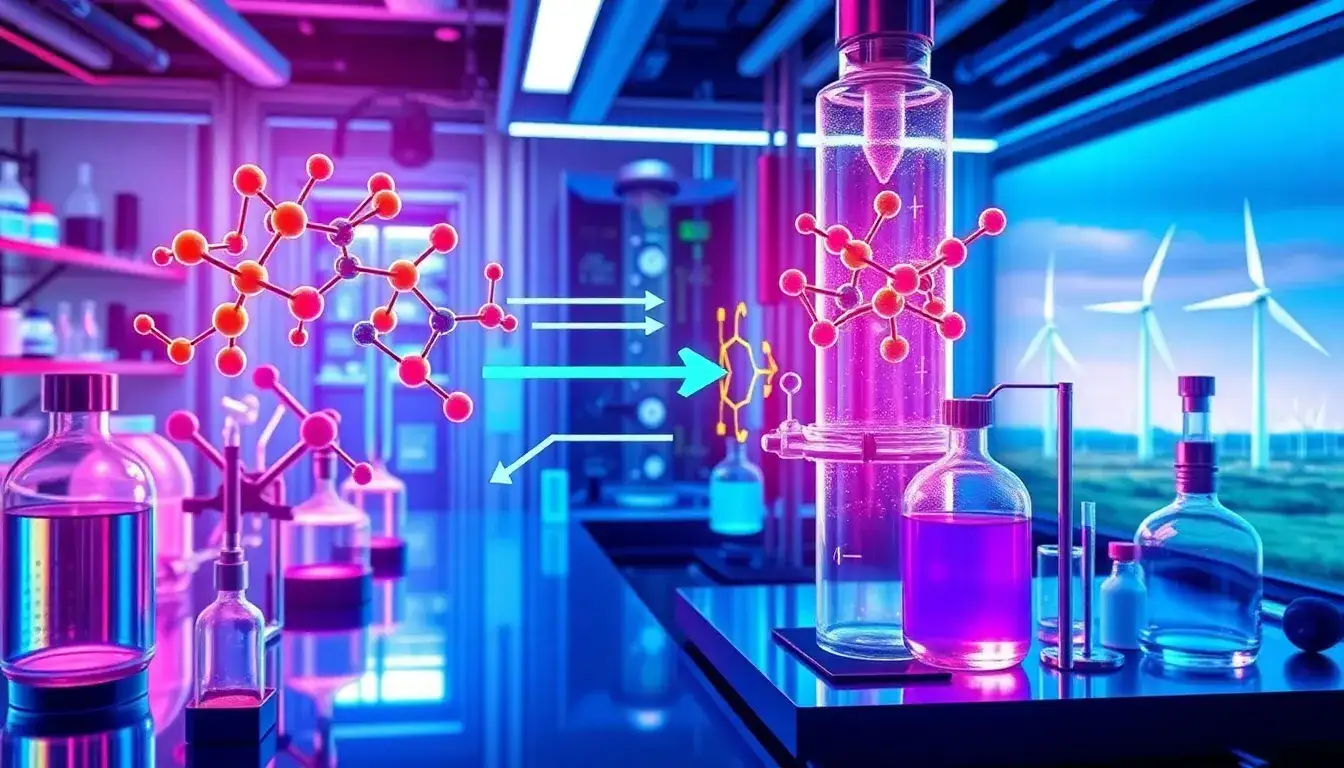
Advantages of Aromatic Heterocycles in Hydrogen Storage
- Lower Hydrogenation and Dehydrogenation Temperatures:
Compared to simple carbocycles (non-heterocyclic hydrocarbons), aromatic heterocycles, especially nitrogen-containing heterocycles (N-heterocycles), require significantly lower temperatures for hydrogenation and dehydrogenation processes. This makes the release and uptake of hydrogen more energy-efficient and practical for real-world applications. - High Hydrogen Content:
Certain pairs of saturated and unsaturated N-heterocycles, such as dodecahydro-N-ethylcarbazole (12H-NEC) and its parent NEC, offer high hydrogen storage capacities, exemplified by about 5.8 wt% hydrogen content. This substantial capacity is promising for effective hydrogen storage in compact forms. - Reversibility and Selectivity in Storage Cycles:
Hydrogenation and dehydrogenation reactions of aromatic heterocycles can be highly selective under appropriate catalyst conditions (e.g., ruthenium or rhodium catalysts for NEC hydrogenation) with up to 97% selectivity at moderate pressures (7 MPa) and temperatures (130–150 °C), supporting efficient and reversible hydrogen cycling. - Catalyst Compatibility and Enhancement:
The functional groups in aromatic heterocycles facilitate interaction with catalysts. Research shows that decorating heterocyclic aromatic rings (such as five-membered aromatic heterocyclic rings) with metals like Ag(I) and Au(I) enhances hydrogen trapping efficiency. This improves the material’s hydrogen storage characteristics at the molecular level. - Potential for Ionic Liquid-based Storage:
Aromatic heterocycles, especially imidazolium-based ionic liquids, can reversibly bind hydrogen atoms in the presence of suitable catalysts (Pd/C, Ir0 nanoparticles), enabling higher volumetric hydrogen storage densities (~30 g/L at atmospheric pressure) and offering potential storage alternatives beyond conventional solid or compressed hydrogen forms. - Improved Thermodynamic Properties Compared to Cycloalkanes:
Aromatic heterocycles optimize unfavorable thermodynamic properties seen in cycloalkanes, which also serve as LOHCs. This optimization improves storage efficiency and release kinetics.
Summary Table of Key Advantages
| Advantage | Explanation |
|---|---|
| Lower temperature operation | Reduced hydrogenation/dehydrogenation temperatures increase efficiency and safety. |
| High hydrogen storage capacity | Up to 5.8 wt% in N-heterocycles like 12H-NEC. |
| High selectivity and reversibility | Catalytic processes achieve ~97% selectivity, enabling repeat cycles. |
| Enhanced hydrogen trapping | Metal decoration (Ag/Au) of heterocycles improves H2 adsorption. |
| Ionic liquid variants for storage | Imidazolium salts reversibly store H2 at atmospheric pressure. |
| Better thermodynamics than cycloalkanes | Facilitates practical hydrogen storage and release. |
In essence, aromatic heterocycles offer improved hydrogen storage performance through lower operational temperatures, higher selectivity, and efficient reversible hydrogen uptake and release, supported by advanced catalyst interactions. These features make them highly promising materials for evolving hydrogen storage technologies.
Original article by NenPower, If reposted, please credit the source: https://nenpower.com/blog/what-are-the-advantages-of-using-aromatic-heterocycles-for-hydrogen-storage/

