

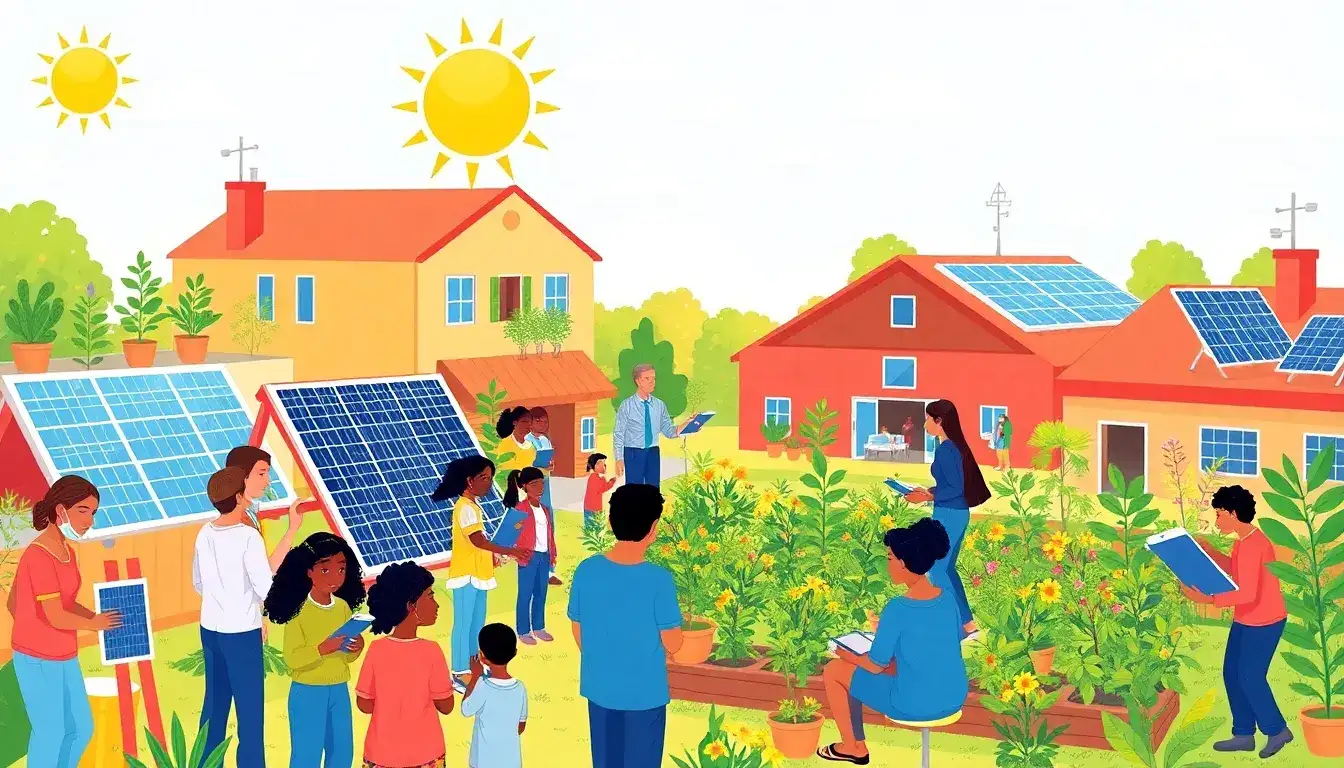
Several successful community partnerships in solar energy education exemplify how collaboration between organizations, schools, and industry stakeholders can effectively promote renewable energy understanding and career pathways:
Notable Examples of Successful Community Partnerships
1. Rockingham County Solar Competition & Educational Solar Tours
A community-wide collaboration involving Solar Tribe, Dominion Power, and the Center for the Advancement of Sustainable Energy (CASE) delivered hands-on learning through a Solar Tour and competition, exposing students to commercial solar installations. Teachers and mentors provided vital support to connect theoretical learning with real-world applications, fostering authentic engagement with renewable energy concepts and potential career paths in sustainability.
2. Student Freedom Initiative & Clearloop Partnership with HBCUs
This partnership focuses on expanding clean energy career pathways and workforce development by installing utility-scale solar farms near Historically Black Colleges and Universities (HBCUs). Clearloop constructs solar farms that supply thousands of homes, while SFI leverages its network of 60+ HBCU partners to develop diverse talent pipelines in the solar industry. This addresses equity issues in solar benefits and promotes economic mobility in marginalized communities through education and practical experience.
3. Standard Solar’s Educational Installations
Standard Solar has partnered with over two dozen educational institutions to install solar energy systems, making them a trusted collaborator in embedding solar technologies within schools. This hands-on exposure helps students and faculty better understand solar power’s role and operational aspects, providing a foundation for sustainability education.
4. Thomas Deacon Academy and Other Educational Solar Success Stories
Successful cases such as Thomas Deacon Academy and programs like Australia’s Advancing Clean Energy Schools highlight the integration of solar technology and education. These initiatives include installing solar panels on school campuses and incorporating solar energy knowledge into curricula, resulting in energy savings and enhanced environmental literacy among students.
5. Broad Solar Education Initiatives Across Communities
Solar education programs broadly transform communities by combining STEM education with environmental stewardship in diverse settings such as schools and community centers. These initiatives use interactive workshops, hands-on demonstrations, and real-world applications to build practical knowledge about solar energy, accelerating renewable adoption and fostering future green energy leaders.
Summary Table of Key Examples
| Partnership / Program | Key Features | Target Group | Impact |
|---|---|---|---|
| Rockingham County Solar Competition | Solar tours, competitions, educator-led mentorship | K-12 students, teachers | Real-world exposure, career pathway |
| Student Freedom Initiative + Clearloop | Solar farms near HBCUs, internships, workforce development | HBCU students, marginalized communities | Diverse talent pipeline, economic mobility |
| Standard Solar Educational Installations | Solar system installations at schools | Educational institutions | Hands-on solar education |
| Thomas Deacon Academy & Clean Energy Schools | Solar installations, curriculum integration | School students | Energy savings, environmental literacy |
| Community Solar Education Programs | Workshops, hands-on demos, STEM + environmental focus | Broad community members | Increased adoption, leadership development |
These examples demonstrate that effective solar energy education partnerships combine technical expertise, hands-on experiences, and community engagement to create sustainable learning outcomes and support broader renewable energy adoption.
Original article by NenPower, If reposted, please credit the source: https://nenpower.com/blog/what-are-some-successful-examples-of-community-partnerships-in-solar-energy-education/

