

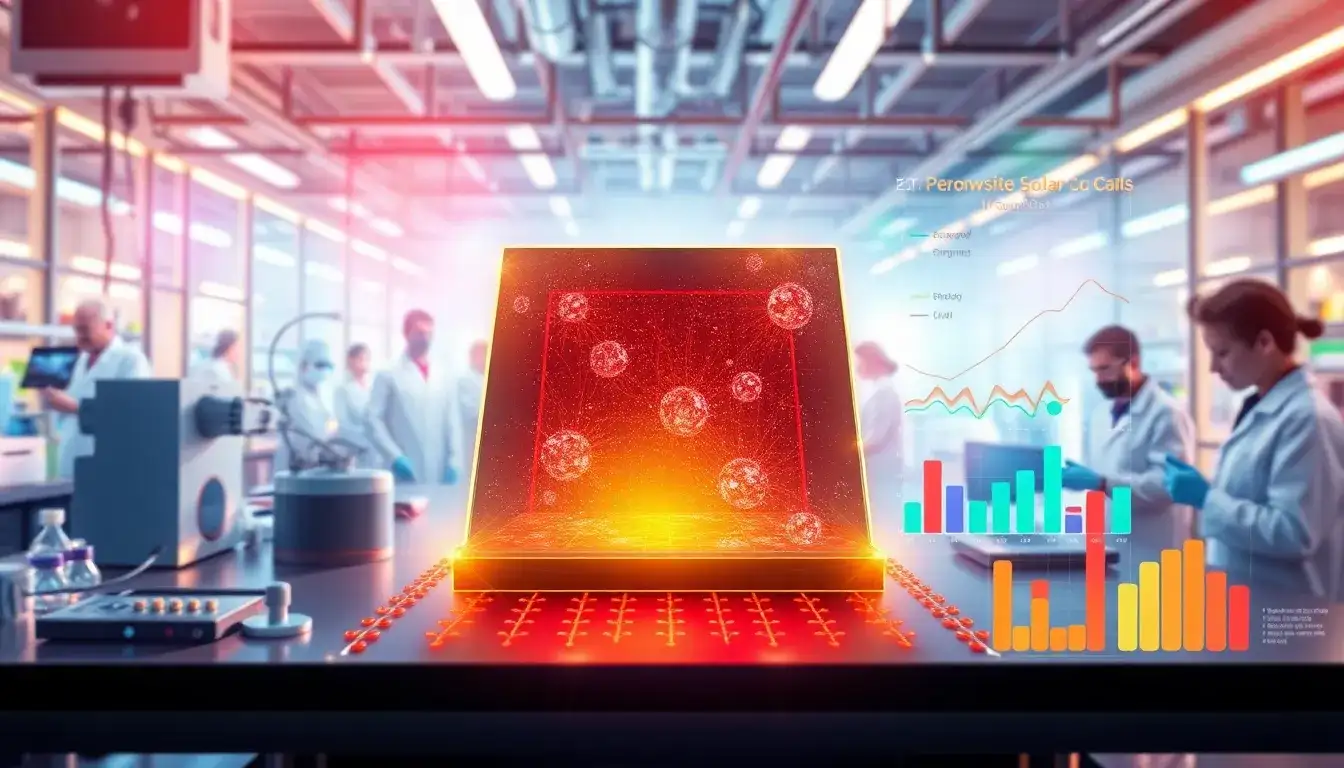
Significant advancements have been made recently to improve the durability of perovskite solar cells (PSCs), a key challenge limiting their commercial viability compared to traditional silicon solar panels.
Key Advances to Improve Durability
1. Chemical Surface Functionalization and Robust Barrier Layers
A major breakthrough involves the use of a surface functionalization technique that applies the compound 5-ammonium valeric acid iodide (5-AVAI). This allows the uniform growth of a dense aluminum oxide (Al₂O₃) layer via atomic layer deposition, creating a robust barrier that suppresses halide migration—a primary cause of PSC instability—by over an order of magnitude. This chemical barrier significantly enhances both the efficiency and stability of tin-lead mixed perovskites, making the cells last longer under operational conditions.
2. Encapsulation Techniques
To combat environmental factors such as moisture and oxygen that degrade perovskite materials, advanced encapsulation methods have been developed. These encapsulation layers help extend the operational lifespan of PSCs in real-world conditions, improving their longevity closer to that of silicon solar cells, though PSCs still generally have shorter lifetimes than silicon modules.
3. Mechanical Durability and Flexibility Enhancements
For flexible perovskite solar cells (F-PSCs), which are increasingly important for portable and wearable applications, progress has been made in improving mechanical robustness. Strategies include optimizing the perovskite composition, controlling crystal grain size and film quality, engineering interfaces more effectively, and using improved flexible transparent electrodes and substrates. These efforts enhance the mechanical resilience and durability of flexible devices, making them more viable for diverse and demanding applications.
4. Material and Interface Engineering
Ongoing research focuses on fine-tuning perovskite materials and their interfaces to reduce defect formation and ion migration, both critical factors in long-term degradation. Material innovations aim to stabilize the perovskite crystal structure and improve film uniformity, contributing to overall durability improvements.
Summary Table of Durability Improvements
| Advancement Area | Description | Impact on Durability |
|---|---|---|
| Surface Functionalization & Al₂O₃ Barrier | Chemical method using 5-AVAI for uniform oxide layers | Suppresses halide migration, greatly improves stability |
| Encapsulation Techniques | Protective layers against moisture and oxygen | Extends operational lifespan in real conditions |
| Mechanical Stability in F-PSCs | Material optimization, flexible electrodes, substrate selection | Enhances flexibility and mechanical robustness |
| Material & Interface Engineering | Crystal grain control, defect reduction | Reduces degradation, improves cell longevity |
These advancements collectively push perovskite solar technology closer to commercial reality by addressing its historic weakness in durability. Hybrid tandem cells combining perovskite with silicon also leverage the strengths of both, providing high efficiency and improved lifespan, which is currently seen as a promising near-term approach.
In conclusion, through chemical surface treatments, protective barriers, encapsulation, improved flexible materials, and interface engineering, researchers have made tangible progress in enhancing the durability of perovskite solar cells, bringing them closer to practical, long-lasting solar energy solutions.
Original article by NenPower, If reposted, please credit the source: https://nenpower.com/blog/what-advancements-have-been-made-to-improve-the-durability-of-perovskite-solar-cells/

