

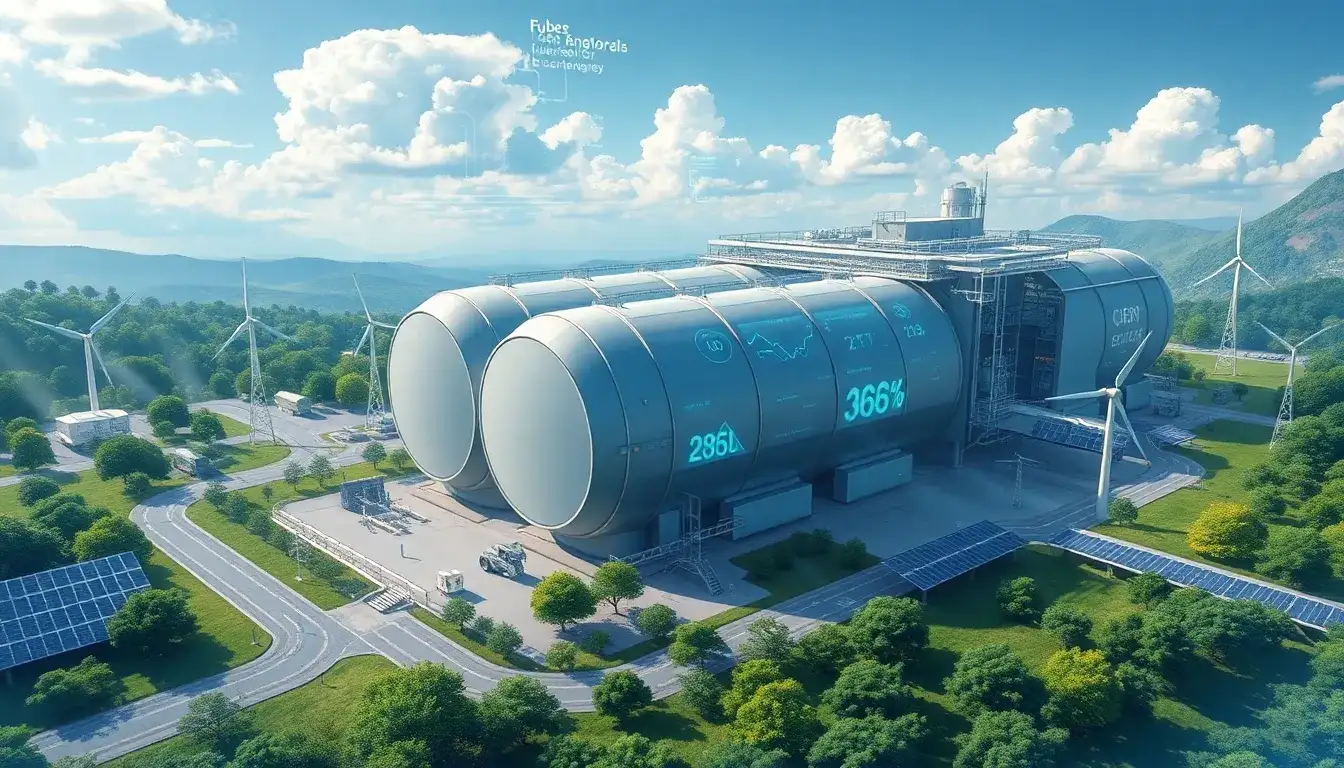
Advancements that could improve the efficiency of Compressed Air Energy Storage (CAES) include several technological and system design innovations:
1. Nearly-Isothermal Compression and Expansion
Traditional CAES systems suffer energy losses primarily because air heats up during compression and cools down during expansion, losing heat energy to the environment. Nearly-isothermal compressors and expanders are being developed to maintain air temperature more constant during these phases, significantly improving round-trip efficiency by reducing thermal losses.
2. Thermochemical Energy Storage (TCES)
Thermochemical approaches enhance efficiency by capturing and storing the heat generated during air compression chemically rather than letting it dissipate. This stored heat can later be released to reheat the air before expansion, reducing or eliminating the need for natural gas combustion and increasing round-trip efficiency from typical 40–50% up to higher levels. Moreover, TCES offers higher energy density storage by locking heat in chemical bonds.
3. Use of Water-Filled Reservoirs for Pressure Management
Implementing a system where compressed air is stored in underground reservoirs with water acting as a movable piston helps maintain constant air pressure during charge and discharge cycles, improving overall efficiency. The water displacement also recovers some mechanical energy, enhancing energy retention.
4. Hybrid CAES Systems
Integrating CAES with renewable energy sources such as wind or solar allows excess renewable generation to be stored efficiently. Hybrid systems, like the Apex CAES plant in Texas which combines wind energy with CAES, enable consistent power output and better grid stability while reducing reliance on fossil fuel-based heating during expansion.
5. Advanced Component Design and Multi-Stage Compression/Expansion
Using multi-stage compression and expansion with intermediate cooling and heating stages improves the thermodynamic efficiency of the system. Airblast venturi pumps with heat exchangers can preheat incoming air stages, recovering heat between stages and improving overall energy recovery.
6. Lowering Polytropic Index and Improved System Configurations
Adjusting system parameters such as lowering the polytropic index from 1.4 to 1.0 can increase the overall efficiency substantially (from about 24% to 72% in some models). Modifications in system architecture, including advanced adiabatic and isothermal CAES configurations, have been shown to reach up to 80% round-trip efficiency.
Summary Table of Key Advancements
| Advancement | Impact on Efficiency | Notes |
|---|---|---|
| Nearly-isothermal compressors | Reduces thermal losses during compression/expansion | Improves round-trip efficiency |
| Thermochemical energy storage | Captures lost heat chemically, reduces natural gas use | Higher energy density storage |
| Water-filled reservoirs | Maintains constant pressure, recovers mechanical energy | Improves energy retention |
| Hybrid CAES with renewables | Enables clean energy use, minimizes fossil fuel dependence | Stabilizes renewable power output |
| Multi-stage compression/expansion | Recovers heat between stages, improves thermodynamics | Enhances overall efficiency |
| Optimized polytropic index & designs | Up to ~80% round-trip efficiency achievable | Advanced system and operational tweaks |
These advancements collectively address the fundamental inefficiencies in CAES—mainly thermal energy loss and reliance on fossil fuel heating—paving the way for more sustainable and efficient large-scale energy storage solutions.
Original article by NenPower, If reposted, please credit the source: https://nenpower.com/blog/what-advancements-could-improve-the-efficiency-of-caes/

