

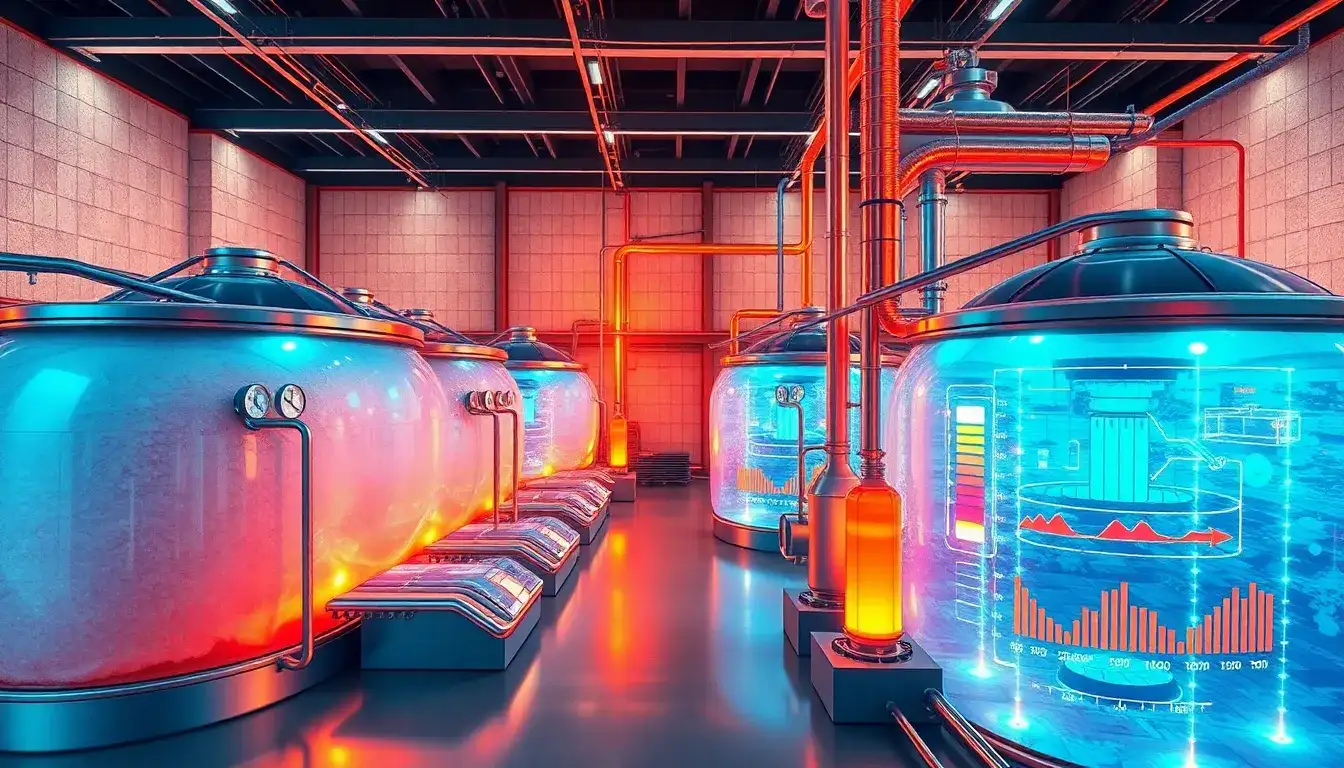
Advancements in thermal energy storage (TES) systems are focused on improving efficiency, cost-effectiveness, scalability, and applicability across various industries, especially renewable energy and building heating/cooling. Key developments include:
Innovative Materials
- Phase Change Materials (PCMs) and Molten Salts: New materials such as PCMs and molten salts significantly enhance TES efficiency and cost-effectiveness by improving heat storage capacity and thermal stability. Advanced PCMs with melting/freezing points tailored to ambient or building temperatures enable comfortable indoor climate control with reduced electricity use for HVAC systems. For example, materials that melt/freezes near room temperature enable passive heating and cooling in buildings.
- Thermochemical Materials: Emerging research focuses on thermochemical TES materials that can store more thermal energy than PCMs by chemically charging with solar or grid energy and later releasing that energy efficiently for space or water heating. These materials promise to reduce dependence on electrochemical batteries and increase overall energy storage system versatility in buildings.
Improved Storage Designs and Technologies
- Radial Flow Packed-Bed Systems: Researchers at KTH Sweden developed a highly efficient radial flow TES system using solar-heated air flowing through layers of pebbles or copper slags. This system achieves thermal efficiencies exceeding 90% while reducing pressure drops by 50% compared to traditional axial flow packed beds. Latest designs incorporate layers of pebbles of different sizes to optimize heat transfer and reduce energy losses, achieving pressure drop reductions over 70% compared to uniform radial designs with minimal efficiency loss.
- Two-Tank Molten Salt Systems: Innovations in two-tank TES systems store hot and cold molten salt separately, enabling operation at higher temperatures up to 700°C. This results in approximately 20% increased efficiency by allowing integration with advanced thermodynamic cycles. The separation reduces heat loss and provides better temperature control and storage flexibility, enhancing overall system performance.
Market and Application Growth
- The TES market is projected to soar beyond USD 1026 billion by 2034, driven by the adoption of these innovative materials and technologies. This growth is supported by the increased demand for scalable and cost-effective TES solutions in renewable energy integration, industrial processes, and building thermal management.
In summary, TES system efficiency is being boosted by advanced phase change and thermochemical materials tailored for specific temperature ranges, innovative designs like radial packed-bed systems with optimized flow and material layering, and two-tank molten salt configurations that achieve higher temperatures and reduce energy losses. These improvements are making TES technologies more viable, scalable, and cost-effective for a wide range of applications.
Original article by NenPower, If reposted, please credit the source: https://nenpower.com/blog/what-advancements-are-being-made-to-improve-the-efficiency-of-thermal-energy-storage-systems/

