

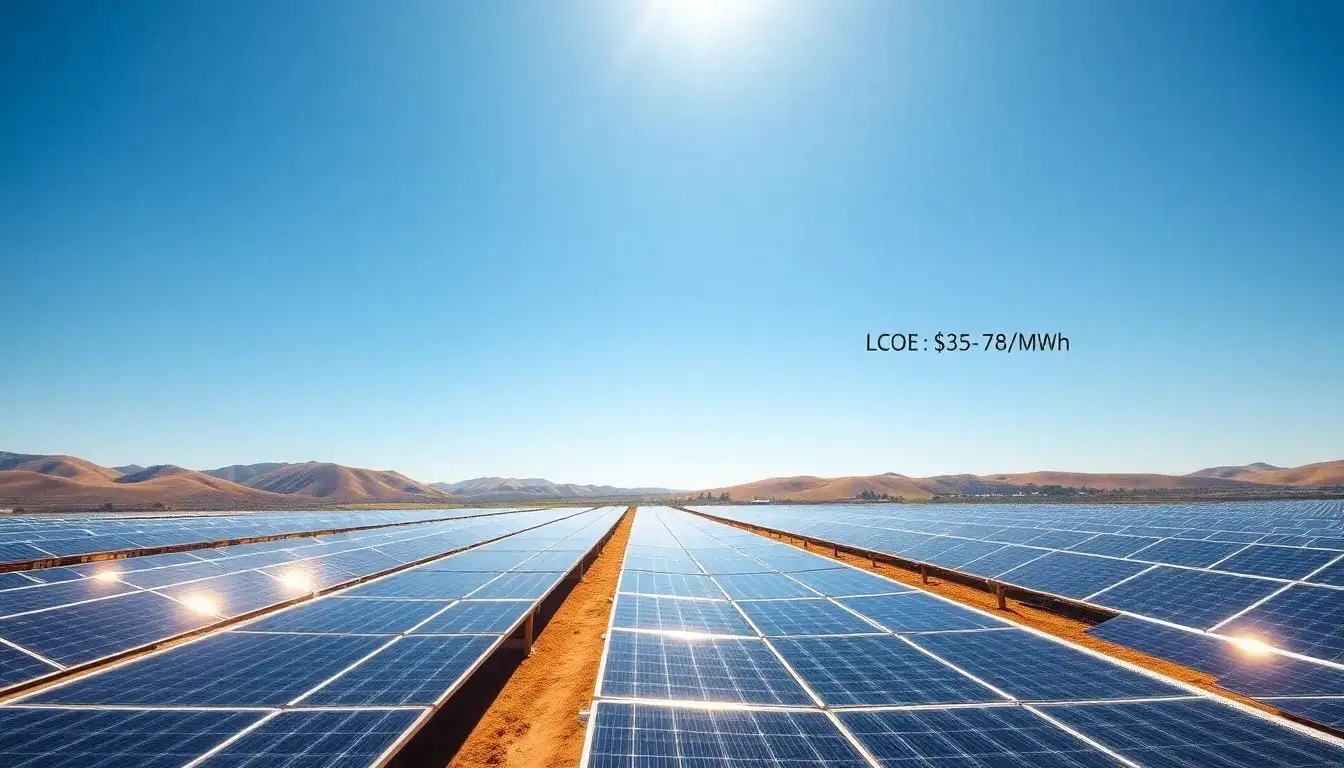
The average levelized cost of electricity (LCOE) for utility-scale solar projects in the United States has fallen by 4% year-on-year, now standing at US$58/MWh. According to Lazard’s latest report, this marks the third consecutive year of tightening for LCOE in the utility-scale solar PV sector. The report, now in its 18th edition, indicates that utility-scale solar PV LCOE ranges between US$38-78/MWh, a reduction from last year’s range of US$29-92/MWh.
Despite these reductions, utility-scale solar PV remains one of the most competitive energy generation technologies, alongside onshore wind, when tax credits are not considered. While the costs for utility-scale solar PV have slightly decreased, onshore wind costs have risen, with LCOE now ranging from US$37-86/MWh, up from US$27-73/MWh in the previous report. Renewables continue to be the most cost-effective generation method on an unsubsidized basis, ensuring that they will play a pivotal role in the development of new power generation in the U.S. due to their status as both the lowest-cost and quickest-to-deploy resources.
Lazard’s report highlights that the LCOE for utility-scale solar PV can further decrease when factoring in production tax credits (PTC), bringing it down to a range of US$20-45/MWh. George Bilicic, Vice Chairman of Investment Banking and Global Head of Power, Energy & Infrastructure at Lazard, emphasized the growing importance of data-driven decision-making in the evolving energy landscape, stating that the LCOE+ report is a crucial resource for industry stakeholders, policymakers, and investors.
The report also includes historical LCOE data, showcasing that utility-scale solar PV has experienced the most significant decrease in LCOE—an impressive 84%—since 2009. It is one of only two technologies to see a year-on-year decrease in LCOE for 2025, dropping by 4% to US$58/MWh.
Additionally, as renewable penetration increases, several independent system operators (ISOs) are adjusting their capacity accreditation methodologies to include seasonal adjustments and diversity benefits, which have generally led to higher firming costs. The development of more sophisticated capacity accreditation frameworks could have a significant impact on future firming costs.
For battery energy storage systems (BESS), the report notes a sharp decline in LCOE across both hybrid and standalone storage projects. This decline is attributed to market dynamics, such as lower-than-expected demand for electric vehicles (EVs) and an oversupply of battery cells, along with technological advancements that have improved cell capacity and energy density. As a result, the LCOE for BESS has reverted to levels seen in 2020.
Original article by NenPower, If reposted, please credit the source: https://nenpower.com/blog/us-utility-scale-solar-pv-lcoe-projected-to-range-between-38-78-mwh-by-2025-according-to-lazard-report/

