

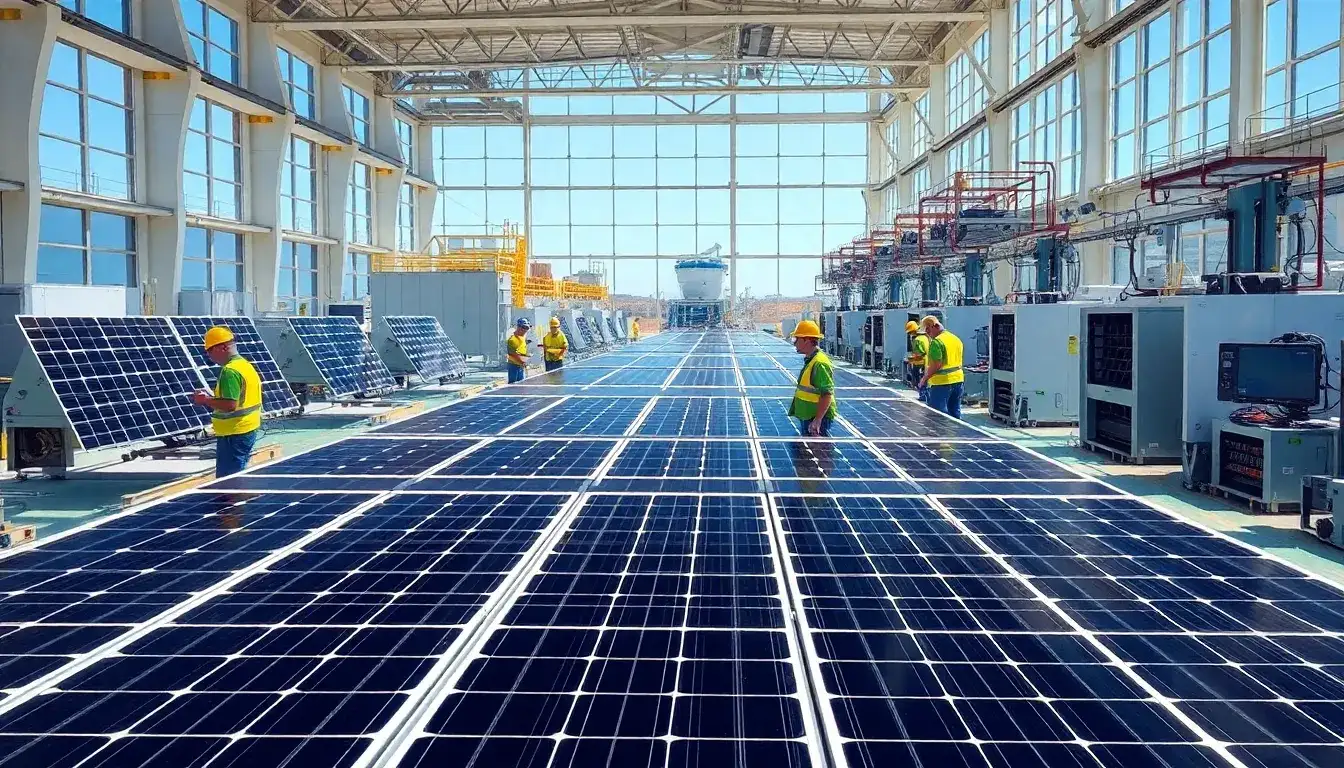
The U.S. is currently experiencing a significant surge in solar manufacturing. However, the question remains: can this growth endure if energy incentives are reduced or eliminated?
In the first quarter of 2025, the U.S. solar industry added 8.6 gigawatts (GW) of new solar module manufacturing capacity, marking the third-largest quarterly increase in history, according to the latest report from the Solar Energy Industries Association (SEIA) and Wood Mackenzie. This manufacturing boom can be attributed to the opening or expansion of eight factories located in Texas, Ohio, and Arizona. Additionally, U.S. solar cell production capacity doubled to 2 GW during this period with the inauguration of a new factory in South Carolina.
The report highlights that the U.S. solar sector installed 10.8 GW of new electricity-generating capacity in Q1, with solar and storage accounting for 82% of all new capacity added to the grid. Despite this impressive growth, SEIA warns that the introduction of new tariffs and potential modifications to federal tax credits could introduce significant uncertainty for the industry and jeopardize its long-term expansion.
Utilities in the Midwestern United States face considerable challenges due to extreme weather events, aging infrastructure, and the pressing need to incorporate renewable energy while ensuring grid reliability. The complexity of state decarbonization laws also complicates the process of bringing new power generation online. As utilities transition from fossil fuels to cleaner alternatives, they must navigate supply chain issues, labor shortages, and new cybersecurity risks. Service providers are under pressure to modernize their infrastructure to meet rising demand while keeping costs manageable—a daunting task for utilities of all sizes.
To address these challenges, a new regional event, DTECH Midwest, will focus on the specific issues confronting the power industry in the Midwest, featuring tailored content for municipal and cooperative utilities. Registration is now open for the event, scheduled for July 14-16, 2025, in Minneapolis, MN.
“Solar and storage continue to dominate America’s energy economy, contributing more new capacity to the grid than any other technology, increasingly using domestically produced equipment,” stated SEIA President and CEO Abigail Ross Hopper. “However, this success is at risk. If Congress does not rectify the legislation passed by the House—which would render energy tax incentives ineffective—lawmakers could trigger a dangerous energy crisis that would raise electric bills and halt America’s manufacturing boom. The Senate still has an opportunity to get this right and fulfill President Trump’s vision for U.S. energy independence.”
SEIA also noted that uncertainty surrounding tariffs, new anti-dumping and countervailing duties on cells and modules imported from Southeast Asia, and potential alterations to federal energy incentives could significantly impede U.S. solar deployment and manufacturing. This situation could lead to energy shortages, job losses, and factory closures.
“The 10.8 GW of solar capacity installed in Q1 2025 represents a substantial portion of new electricity generation in the U.S., underscoring solar’s increasing prominence in the energy mix,” said Zoë Gaston, Principal Analyst at Wood Mackenzie. “However, our analysis indicates that the U.S. solar market has not yet reached its full potential. Proposed changes to federal tax incentives, coupled with ongoing tariff concerns, could significantly affect this growth trajectory and lead to energy supply challenges. It is crucial to recognize the vital role of solar in America’s energy landscape.”
SEIA and Wood Mackenzie’s industry forecast, which considers tariffs imposed in Q2 but not potential rollbacks of federal tax credits, predicts a national decline in solar deployment. While the community solar forecast remains stable, all other segments have seen a downward revision in their five-year outlook compared to the previous quarter, including a 14% decrease in projected residential solar deployment and a 6% decrease in anticipated utility-scale deployment.
A recent analysis by SEIA of the impacts of the House-passed reconciliation legislation warns of an impending energy shortage in the U.S. economy if the bill is enacted. SEIA argues that failure to change course could result in the loss of 330,000 jobs, the closure or stalling of 331 factories, and the disappearance of $286 billion in local investments. The bill could also lead to significant energy inflation, increasing consumers’ electricity costs by $51 billion nationwide. If Congress eliminates energy tax incentives, SEIA’s analysis predicts a decline in energy production of 173 TWh, leaving the United States unable to meet demand or compete with China in the global race to power artificial intelligence.
According to the Solar Market Insight report, Texas emerged as the state with the highest solar capacity increase in Q1 2025, with Florida surpassing California for second place. Among the top ten states for solar installations in the first quarter, eight voted for President Donald Trump in the 2024 election: Texas, Florida, Ohio, Indiana, Arizona, Wisconsin, Idaho, and Pennsylvania.
Original article by NenPower, If reposted, please credit the source: https://nenpower.com/blog/us-solar-manufacturing-booms-amid-concerns-over-energy-incentives-and-future-growth/

