

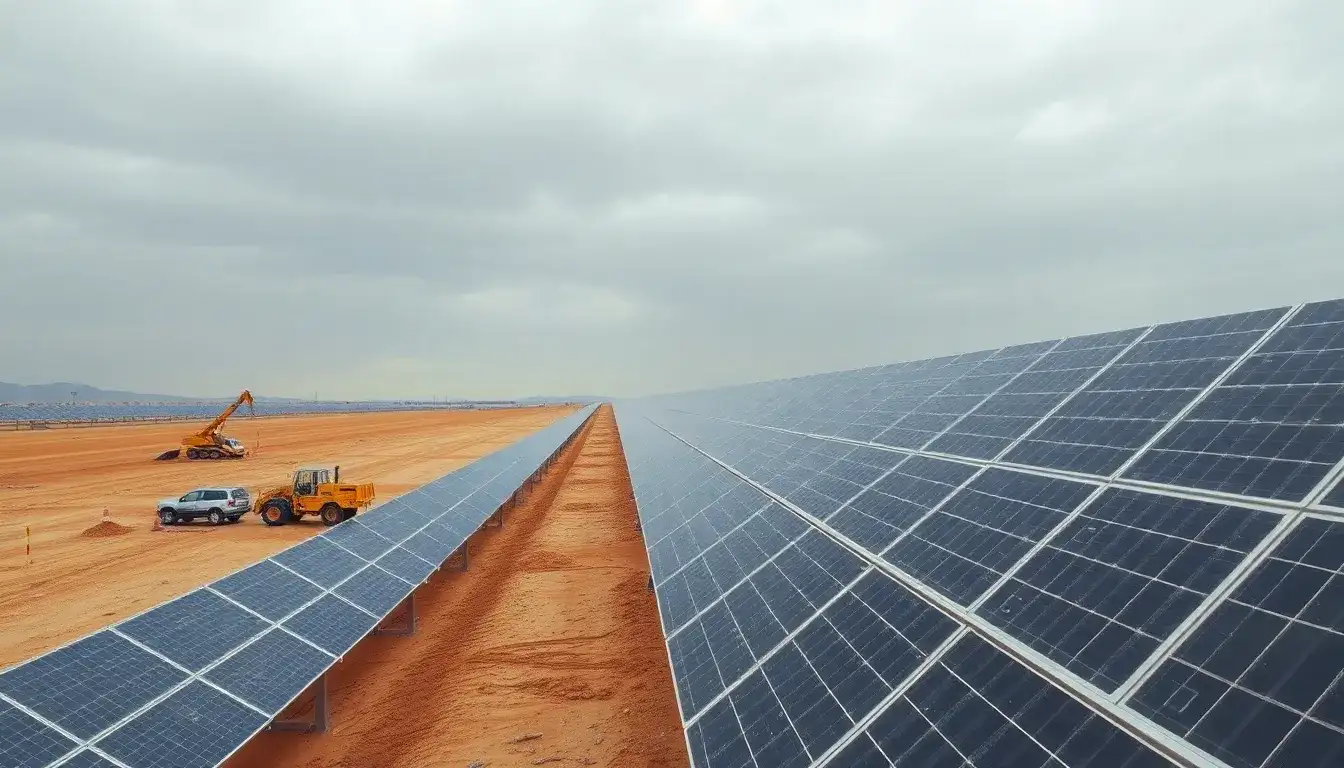
6.2GW! The largest solar photovoltaic project under construction in the United States has been halted.
Recently, reports from various media outlets, including the Financial Times and The Guardian, revealed that after frequently halting several renewable energy projects, the Bureau of Land Management (BLM) has rejected a large solar project in Nevada that had the potential to become the “largest solar power plant in the world.” This massive project, named The Esmeralda Seven, covers an area of 185 square miles, nearly the size of the entire city of Las Vegas.
The project was initiated during the Biden administration’s permitting process and was jointly developed by energy companies NextEra Energy, Arevia Power, and Invenergy. It includes seven solar power plants and energy storage systems, aiming for a total installed capacity of 6.2GW, enough to meet the electricity needs of nearly 2 million households. Once completed, it would not only be the largest solar project in North America but also rank among the largest globally.
For Donald Trump, who has labeled renewable energy as a “green scam,” the demise of this colossal project is yet another achievement in his campaign against renewable energy initiatives. Patrick Donnelly, director of a biodiversity center in Nevada, stated, “All solar projects on public lands in the state have come to a standstill, not just this one.”
The suspension of The Esmeralda Seven is not an isolated incident but rather a reflection of the systemic challenges facing the U.S. renewable energy sector. On August 6, the Trump administration announced the cancellation of the Lava Ridge wind project, which had been approved at the end of Biden’s term, citing “significant legal flaws” and violations of multiple statutory review procedures. This project was intended to construct 231 wind turbines in southern Idaho, with a total capacity of 1000MW, covering nearly 57,000 acres. On August 29, the U.S. Department of Transportation directly announced the cancellation of $679 million in federal funding for 12 offshore wind projects. This funding was reportedly reallocated to upgrade U.S. ports and other infrastructure.
The hydrogen energy sector in the U.S. also faced a downturn earlier this year. On May 30, the Trump administration announced cuts to clean energy projects worth $3.7 billion, including a $331 million hydrogen project at ExxonMobil’s Baytown refinery in Texas and a $270 million carbon capture project by Calpine Energy. Many companies, including Australia’s largest independent oil and gas producer, Woodside, subsequently halted hydrogen projects in the U.S. By October 2, the Department of Energy announced the termination of 223 energy projects, totaling approximately $7.56 billion (around ¥53.8 billion). Most of these terminated projects were concentrated in green energy sectors, primarily located in the 16 states that supported the Democratic Party in last year’s presidential election.
The Director of the Office of Management and Budget, Russell Vought, hinted on social media that “nearly $8 billion of the ‘green new scam’ funding aimed at advancing leftist climate agendas has been canceled.” Some Democrats publicly criticized the Trump administration’s actions as “political retaliation.”
Trump stated, “Any country relying on wind turbines and solar power is seeing its electricity and energy costs skyrocketing to record levels. This is the biggest scam of the century! We will not approve wind and solar projects that harm farmers’ interests. The era of foolishness in America is over!” In fact, data from the U.S. Energy Information Administration (EIA) shows that wind and solar are the fastest-growing energy sectors in the U.S., with their combined electricity generation accounting for 17% of the total power generation last year, providing an increasing amount of affordable clean energy.
However, the International Energy Agency (IEA) in its latest report, Renewable Energy 2025, indicated that due to shifts in clean energy policies under the Trump administration, the U.S. renewable energy growth forecast for 2030 has been downgraded by nearly 50%. The IEA now estimates that between 2025 and 2030, the U.S. will add nearly 250GW of renewable energy capacity, significantly lower than the previous forecast of 500GW.
This adjustment in forecasts stems from a range of policy changes, including the gradual phase-out of federal tax credits, new import restrictions, a pause on offshore wind project leasing approvals, and restrictions on permitting for onshore wind and solar projects on federal lands. The root cause of these project cancellations lies in the drastic shift in U.S. energy policy since Trump took office. The “Big and Beautiful” Act, which Trump signed into law on July 4, 2025, serves as a hallmark legislation of his return to the White House, aiming to solidify energy security and boost economic employment, but in reality, it disrupts the U.S. energy landscape.
The act stipulates that as of September 30, the U.S. will no longer provide tax credits for electric vehicles, and funding for solar and wind industries has been drastically reduced. The 30% tax credit for wind and solar, which was supposed to last until 2032, will now end in 2027, and subsidies for residential solar will be completely eliminated by the end of this year. Hydrogen tax credits will expire in 2028, while nuclear tax credits will persist until 2036.
In stark contrast, the act opens the door wide for fossil fuels: allowing the addition of 32,000 new oil and gas drilling sites, shortening the approval period for shale gas development from 18 months to 6 months, and implementing a “tiered tax rebate” policy for coal companies, enabling mines producing over 5 million tons annually to receive a tax refund of $12 per ton. The act even removes the previous administration’s ban on drilling in the Arctic, allowing energy companies to explore oil and gas in the northern slope of Alaska.
The U.S. Secretary of Agriculture, Brooke Rollins, posted on social media that the USDA will no longer support solar and wind projects on productive farmland and will stop using battery panels manufactured by foreign adversaries like China. He stated that millions of acres of prime farmland have become non-arable due to the construction of solar panels subsidized by the “Green New Deal.” This destruction of farmland and quality soil is depriving the next generation of farmers of their future and ultimately the future of America.
This reversal of policies favoring coal over green energy has inflicted a devastating blow to the U.S. renewable energy sector, casting a large shadow of uncertainty over its future development. Despite developers like NextEra expressing their commitment to collaborate with the BLM to complete environmental assessments, the discontinuity of policies has severely undermined investor confidence. The head of McKinsey’s hydrogen business previously indicated to the media, “This is a tough time; the hydrogen market in the U.S. will remain sluggish for a considerable period.” Complaints from leaders of companies like Fortis Group, which previously invested heavily in U.S. hydrogen, reflect a broader concern: “The lack of policy certainty and regression in green development goals are hindering the growth of the green energy market, making previously viable projects difficult to advance.”
Even if the Democrats regain power and potentially steer U.S. energy policy in a different direction, the damage caused by policy shifts to the industry chain is unlikely to be repaired quickly. An America diverging from the global trend toward low-carbon transformation is increasingly distancing itself from a position of international energy dominance.
Original article by NenPower, If reposted, please credit the source: https://nenpower.com/blog/us-halts-construction-of-6-2gw-solar-project-largest-in-the-nation/

