## US Energy Storage Market Update
**June 30, 2025** | Mega Trends & Analysis
This article is based on a recent report titled “The US Energy Storage Monitor” by Wood Mackenzie Power & Renewables and the American Clean Power Association.
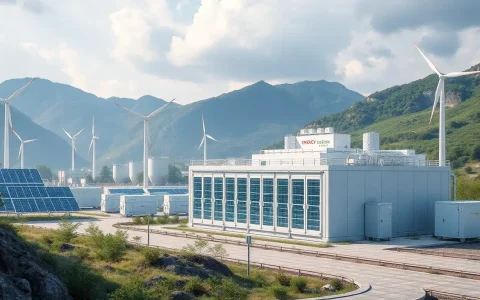
The US energy storage market added over **2 GW** across all segments in the first quarter of **2025**. Despite a quarter-over-quarter decrease in storage installations, the new additions for Q1 are the highest recorded for any first quarter. The utility-scale segment saw capacity additions that exceeded last year’s Q1 figures, with **1,558 MW** added in Q1 2025, reflecting a **57%** increase compared to the same period last year.
California led the way with **457 MW** of installed capacity, followed by Indiana with **256 MW**. Arizona and Texas each contributed **255 MW**, and Nevada added **200 MW**. Texas had the most projects installed this quarter, totaling eight, while California’s largest project, with a capacity of **240 MW**, came online during this period.
In the residential storage market, a record-breaking **458 MW** was installed. The residential segment continued its year-on-year growth in Q1, largely driven by the primary markets of California and Puerto Rico, which together accounted for **74%** of the overall growth. Illinois emerged as a new market, introducing net billing, although attachment rates have not yet met expectations. Across the country, efforts are ongoing to capitalize on existing tax credits while they remain available.
Following a record-breaking fourth quarter, the California CCI sector has returned to typical first-quarter levels. This segment has faced challenges due to slow adoption of NEM 3.0 projects, and the limited number of new community storage projects has also hindered growth.
### Five-Year Market Outlook
While all segments face short-term policy challenges, they are expected to rebound, achieving cumulative installations of **79.8 GW/289.4 GWh**. The year **2025** is anticipated to set another record for utility-scale storage, with a **22%** year-on-year growth. However, political uncertainties may limit the utility-scale segment by **29%** year-on-year in **2026**. Fluctuating tariff rates have affected battery procurement from China throughout Q1 and into Q2.
Assuming no changes to the Investment Tax Credit (ITC) or 45X, the storage market is projected to recover in **2028** and **2029**, achieving cumulative installations similar to the previous forecasts. Strong demand for renewables from hyperscalers, capacity-constrained Independent System Operators (ISOs), and state-level goals will drive long-term growth. The residential storage sector is expected to grow by **45%** in **2025**, supported by stabilized tariffs and ITC incentives, along with declining system prices and expanded programs.
However, CCI storage growth faces challenges due to lower-than-expected uptake in California and ongoing tariff and policy uncertainties. Potential changes in tax credit availability may further impact this segment, which is already grappling with complex use cases and challenging economics.
The House reconciliation bill’s stringent provisions could result in a **21.5 GW** reduction in installations. High and low scenarios indicate a potential **29.5 GW** swing in cumulative installations over the next five years. The high scenario predicts an additional **8 GW** installed, assuming federal clean energy tax credits remain unchanged and no new tariffs are imposed. Conversely, the low scenario anticipates a **27%** overall reduction in installations from **2025** to **2029**, particularly if the reconciliation bill is passed as currently written. Projects would need to commence construction within **60 days** of the bill’s passage and be operational by the end of **2028**. A sudden end to the ITC could lead to significant project cancellations due to qualification challenges and increased risk aversion among financiers. The low scenario also foresees continued US-China trade tensions, creating uncertainty around tariff rates through **2026**, which would increase system pricing and procurement delays.
In the residential market, it is assumed that the residential ITC under Section **25D** will end after **2025**, impacting both owned and leased systems.
[Access the report here](#)
Original article by NenPower, If reposted, please credit the source: https://nenpower.com/blog/us-energy-storage-market-update-q1-2025-records-high-additions-amid-policy-challenges/