

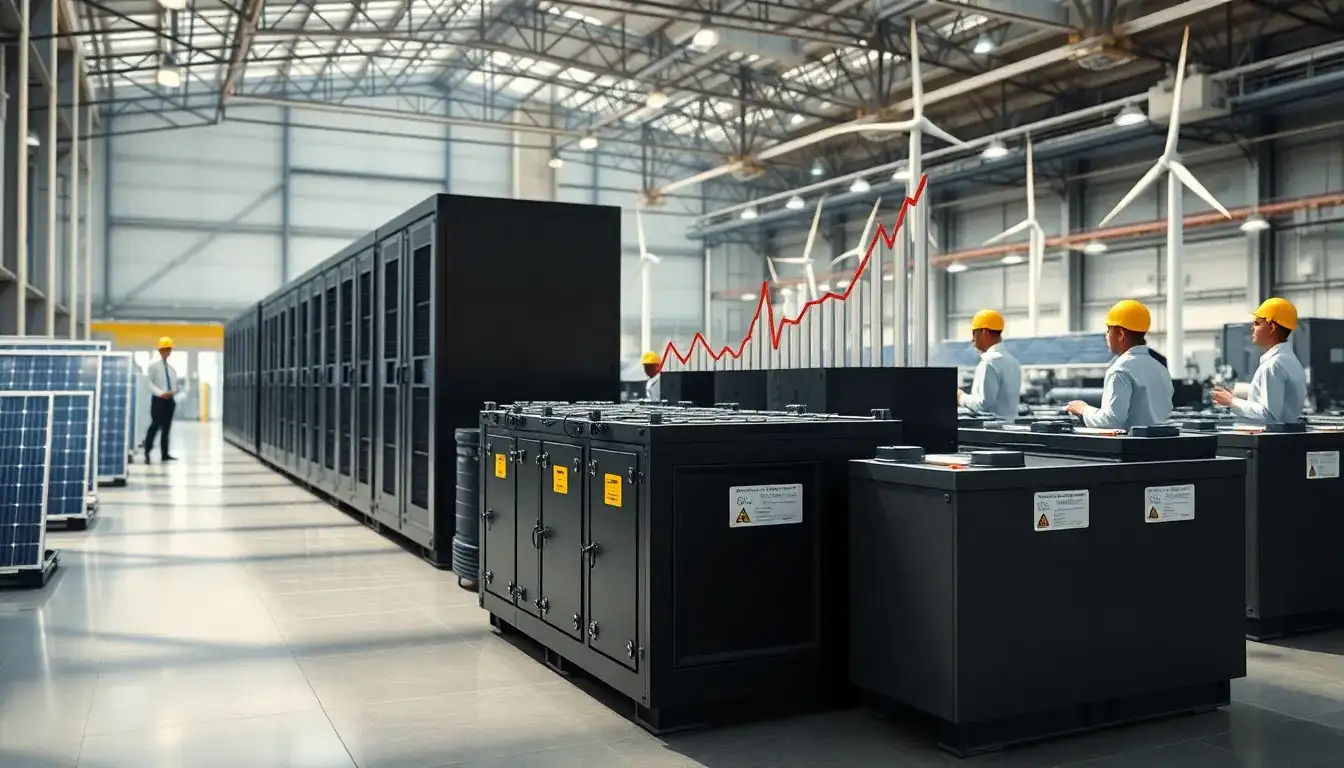
The U.S. Energy Storage Market Enters a Booming Phase: Expected to Account for Half of Global Demand by 2026
From 2010 to 2023, battery costs have plummeted by 90%, paving the way for the commercialization of large-scale energy storage systems. By 2024, utility-scale storage systems are projected to represent two-thirds of new capacity, while residential storage applications will account for one-third. The global grid-scale battery storage market is expected to reach $10.69 billion in 2024 and grow to $43.97 billion by 2030, with a compound annual growth rate of 27% from 2025 to 2030. In 2022, global investment in battery storage exceeded $20 billion, with over 65% of total spending dedicated to grid-scale deployments, demonstrating a strong demand for large-scale storage systems.
Battery systems have begun to reach scales of approximately 200 megawatts, enabling renewable energy to replace small to medium-sized natural gas generators. For example, the energy storage project at the Moslandin station in California can supply power for four hours to around 300,000 California homes during peak demand times such as evenings and heatwaves.
Transitioning from the Margins to the Core
Large-scale battery storage systems not only store excess electricity but also play a crucial regulatory role in the power system. These systems can release electricity during peak demand, providing multiple services such as frequency regulation, reserve capacity, and transmission peak-valley adjustment, thus becoming an indispensable part of the power infrastructure.
As of 2023, pumped hydro storage remains the largest form of grid storage, with an installed capacity of 181 gigawatts, exceeding the combined total of utility-scale and behind-the-meter battery storage at approximately 88 gigawatts. However, lithium-ion batteries are particularly well-suited for short-duration storage (less than 8 hours) due to their lower cost and sensitivity to degradation at high charge levels.
Globally, energy storage projects are being deployed at an accelerated pace. The installed capacity of grid-scale battery storage increased by over 75% in 2022 compared to 2021, adding approximately 11 gigawatts of storage capacity. In 2021, there were 1,363 operational storage projects worldwide, with an additional 11 under construction.
The U.S. Market Leads Globally
The United States accounts for 40% of operational projects worldwide, with California leading the nation with 215 operational projects (4.2 gigawatts), followed by Hawaii, New York, and Texas. The U.S. grid-scale battery storage market is expected to dominate the North American market in 2024 due to strong regulatory support and financial incentives.
Policy support is a key driver of market growth. The Inflation Reduction Act includes investment tax credits for standalone storage systems, expected to enhance the competitiveness of new grid-scale storage projects. Federal and state governments are implementing various incentives, such as an investment tax credit that allows storage systems paired with solar installations to receive a 30% tax rebate.
Localization Becomes a Strategic Priority
In response to the increasingly complex global trade environment, U.S. energy storage companies are accelerating their localization efforts. Fluence’s factory in Utah has been assembling and integrating since 2022 and began manufacturing battery modules in September of this year. This localization strategy enables the company to provide “100% non-Chinese products” for U.S. customers. Fluence’s Utah facility is producing battery modules that will integrate battery cells manufactured in Tennessee. Recent announcements regarding increased tariffs on imported batteries from China, expected to rise to 25% by 2026, underscore the necessity of establishing a robust domestic supply chain.
Fluence has also established a module factory in Utah, a component factory in Texas, and a battery storage system enclosure assembly plant in Arizona. This vertical integration strategy not only reduces supply chain risks but also allows the company to capture tax credits for domestic content under the Inflation Reduction Act.
Financial Performance and Market Outlook
For the fiscal year 2024, Fluence achieved $2.7 billion in revenue and $1.2 billion in fourth-quarter revenue, both record highs for the company, marking year-over-year increases of 22% and 82%, respectively. The company also reported its first-ever positive annual net income since its IPO, with a GAAP gross margin of 12.6% for the year and 12.8% for the quarter. Looking ahead, the Chief Financial Officer anticipates a 30% growth by fiscal year 2026, aligning with the company’s projections for global energy storage market growth. For fiscal year 2025, Fluence has set a revenue guidance of $3.6 billion to $4.4 billion, with the median of $4 billion already covered by current backlog orders.
However, challenges remain in the industry. In the first quarter of 2025, Fluence reported quarterly revenue of $168.8 million, a 49% year-over-year decline, attributed to a more uneven revenue distribution in fiscal year 2025. The CEO noted that the company has experienced delays driven by certain customer contract signings, compounded by competitive pressures that necessitated a reduction in the fiscal year 2025 outlook.
Global Competitive Landscape
Key players in the market include BYD, Sumitomo Electric, and Samsung SDI, which are employing various strategies to enhance their market positions, including strategic partnerships to leverage complementary strengths and expand technological capabilities. The Asia-Pacific grid-scale battery storage market is expected to dominate the global market in 2024, with a share of 46.6%, driven by growing electricity demand and a strong shift toward renewable energy. China is projected to hold the largest share of the Asia-Pacific market in 2024, benefiting from its status as a global leader in renewable energy deployment.
Recently, BYD announced a contract with Saudi Electricity Company for the “world’s largest grid-scale storage project,” which will see the installation of battery storage systems at five locations within the country. BYD’s first stationary battery storage system was deployed 17 years ago, and the company has since implemented 350 storage projects across more than 110 countries, with a total storage capacity of 75 gigawatt-hours.
Challenges and Opportunities in the Industry
Despite the promising market outlook, the energy storage industry faces multiple challenges. Investment returns and profitability models need continuous optimization, as many countries’ electricity market designs have yet to fully accommodate large-scale storage. Battery lifespan, decommissioning, and material recycling are critical issues for long-term operations. Prices for each component of the lithium value chain, from lithium ore extraction to high-purity lithium carbonate and lithium hydroxide, have been on the rise since early 2021, with lithium-ion battery prices experiencing their first increase since 2010, rising by 7% in 2022. Supply chain security is also a concern, as the production of key minerals used in battery manufacturing is highly concentrated; the Democratic Republic of the Congo accounts for 70% of global cobalt production, while Australia and Chile together represent 75% of global lithium production.
However, with technological advancements and policy support, energy storage systems are poised to become the “invisible power plants” of the energy system. In the coming decades, the added storage capacity may surpass that of newly constructed fossil fuel power plants. An industry expert noted, “Now we can truly build these hybrid resources—solar, storage, wind—and accomplish the tasks traditionally performed by fossil fuel power plants.” The integration of storage systems with renewable energy, smart grid technology, and demand response will create a more flexible and efficient power system structure. As a leader in this transformation, the development of the U.S. market will provide important references for the global energy transition.
Original article by NenPower, If reposted, please credit the source: https://nenpower.com/blog/us-energy-storage-market-set-for-explosive-growth-expected-to-dominate-global-demand-by-2026/

