

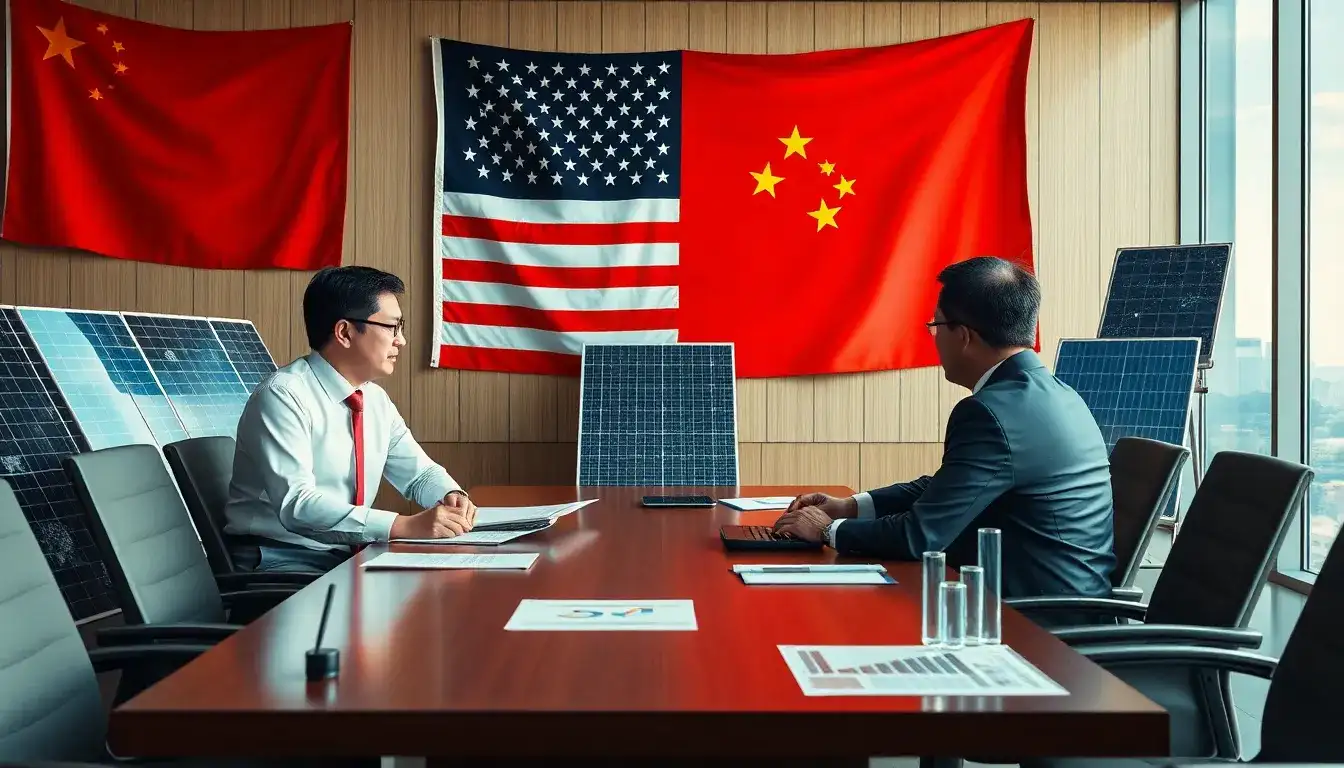
As the trade war intensifies, how is the photovoltaic capacity of Chinese enterprises in the United States faring? Today, we will share an inspiring story of a low-profile overseas Chinese photovoltaic company that continues to thrive despite the industry’s fierce competition. Leading companies like Canadian Solar, JinkoSolar, LONGi Green Energy, JA Solar, and Trina Solar have all had manufacturing capabilities in the U.S. For these industry giants, their U.S. production capacity constitutes a small percentage of their overall capacity. Therefore, apart from Canadian Solar, which has heavily invested in the U.S., these companies do not emphasize their U.S. operations in their disclosures. However, for Boviet Solar, U.S. production capacity is a critical aspect highlighted in their annual report.
According to Boviet Solar’s 2024 annual report, the gross profit margin for their photovoltaic segment reached an astonishing 44.6%. This raises questions about the challenges and opportunities facing Boviet’s capacity in the U.S. and Vietnam amidst intense geopolitical and trade conflicts.
This image shows Boviet Solar’s photovoltaic manufacturing facility located in North Carolina, USA.
Boviet Solar, a subsidiary of Boviet Alloy Materials, presents its photovoltaic segment on its website in English because all its production capacity is overseas. The company summarizes its photovoltaic business with the phrase, “Made in Vietnam, Made in America.” Boviet Solar shares similarities with other companies like LONGi Green Energy in Vietnam and Wuxi Boda, which faced challenges in the A-share market. Established in Vietnam in 2013, Boviet Alloy entered the photovoltaic sector in 2016 by acquiring 100% of Ningbo Connate. This move marked the beginning of a growth trajectory despite numerous challenges posed by U.S. tariffs and anti-circumvention measures over the years.
Boviet Alloy, founded in 1993, went public on the Shanghai Stock Exchange in 2011. It operates 16 specialized manufacturing plants across countries including China, Germany, the U.S., Canada, and Vietnam, focusing on high-performance, high-precision non-ferrous alloy materials and renewable energy, primarily photovoltaic manufacturing. The annual report for 2024 shows that Boviet Alloy achieved a revenue of 18.465 billion yuan, reflecting a year-on-year growth of 5.82%, with a net profit attributable to shareholders of 1.354 billion yuan, a year-on-year increase of 20.47%.
In detail: (1) Sales in the new materials sector grew by 22.21%, with revenue increasing by 27.65% and net profit rising by 54.64%; (2) However, the renewable energy segment experienced a 20.01% decrease in sales, with revenue declining by 30.56%, although net profit increased by 9.03%. The financial data indicates a downturn in the renewable energy sector’s contribution to overall revenue in 2024.
The report also shows that copper alloys accounted for 74.62% of total revenue, while components made up 24.36%, and other businesses contributed 1.02%. Despite the high profit margin of the renewable energy sector, it fell short of Boviet Alloy’s targets. At the beginning of 2024, the company had projected shipments of 3,200 MW of photovoltaic modules, but the actual figure was only 2,051 MW, resulting in a completion rate of just 64.09% and a year-on-year revenue decline of 20.01%.
It is commendable that the company transparently discloses both its targets and actual performance in the annual report, especially compared to many organizations that either boast about exceeding expectations or gloss over unmet goals. The primary reason for the shortfall in Boviet Alloy’s photovoltaic segment was not merely industry competition but the changing landscape of international trade. As is well-known, after the two-year exemption period ended on June 6, 2024, Vietnam’s photovoltaic capacity became one of the most impacted among Southeast Asian countries. In October 2023, the U.S. Department of Commerce announced preliminary findings regarding countervailing duties (CVD) on crystalline photovoltaic cells from Southeast Asia, with some companies facing rates as high as 292.61%.
The model of “Chinese R&D + Southeast Asian manufacturing + global distribution” is no longer viable. Last year, an investor inquired via an interaction platform about how the increased tariffs on solar silicon chips and polysilicon from China would affect Boviet’s new battery production capacity in Vietnam. The company responded that the policy would not affect their projects in Vietnam. However, this seems misleading in retrospect. In March of this year, the U.S. Department of Commerce determined that China had provided “cross-border subsidies” to photovoltaic plants established in Vietnam, leading to a significant increase in countervailing duty rates. According to analysis from the Washington law firm Wiley Rein, the preliminary countervailing duties for Boviet Solar’s Vietnamese factory surged from 0% to 157.38%, with a combined rate of 217.40% when factoring in anti-dumping duties. Consequently, the 3 GW TOPCon battery production project has been postponed. The annual report states that the project has completed construction and is now in the trial production phase.
Despite not yet being operational, the project is likely to be abandoned under such high tariffs.
Regarding U.S. projects, while component production has commenced, concerns remain for the battery supply. Boviet Solar has made significant inroads into the U.S. photovoltaic market, indicated by their provision of components for the Hornet Solar Power Plant, which boasts a capacity of 745 MW. However, with the adverse impact of U.S. tariffs, the competitiveness of their Vietnamese base has diminished entirely. The U.S. projects now represent the primary hope for investors in Boviet Solar.
On April 23, 2024, Boviet Alloy announced plans to invest in the construction of 2 GW of TOPCon components and 2 GW of TOPCon battery expansion projects in the U.S., with an anticipated investment of 2.09245 billion yuan. The selected location for this investment is North Carolina. The company’s annual report disclosed progress on these U.S. projects: (1) The 2 GW TOPCon component project has completed infrastructure construction, and equipment installation is finished, with trial production expected to begin in April; (2) The 2 GW TOPCon battery project has completed its design and permitting processes, with construction underway and equipment contracts signed. Additionally, the company plans to add another 1 GW of TOPCon battery capacity to align with component production.
From the information disclosed by the company, the progress of the component factory appears to be ahead of schedule. As the trade war escalates, investors are closely monitoring the prospects of Boviet Alloy’s U.S. projects. During discussions with investors, the company stated, “We are strategically building 2 GW of TOPCon components and battery projects in the U.S. Our domestic capacity will be completely insulated from tariffs, and as the U.S. tightens import tariffs on other regions, our domestic advantages will only strengthen.” However, uncertainties linger regarding the competitiveness and profitability of the U.S. projects.
Firstly, there are questions about whether IRA subsidies will be realized. The costs of establishing manufacturing facilities in the U.S. are high, prompting many Chinese companies to invest there in hopes of benefiting from the Inflation Reduction Act (IRA), which provides tax credits of $0.07 per watt for photovoltaic components. This would be crucial for ensuring profitability in U.S. solar projects. Public information indicates that Canadian Solar, which has been a frontrunner in U.S. manufacturing, has confirmed receipt of IRA subsidies, contributing to its profitability amid challenges in 2024.
While Boviet Alloy has received some support from local state and municipal governments, there is currently no information indicating that it has obtained IRA subsidies. Secondly, with the Trump administration’s embrace of fossil fuels leading to the suspension of multiple renewable energy projects, the likelihood of repealing the IRA is increasing. Thirdly, while Boviet Alloy’s component project is set to commence production in April, there is no clear timeline for the battery project’s investment. Local media reports suggest that the battery project is not expected to be operational until mid-2026. This raises a critical question: once the components are produced, where will the TOPCon batteries come from?
Since April, the U.S. tariff policies have fluctuated dramatically. Under the current tariffs, there is no possibility of exporting batteries from mainland China to the U.S. If not from Vietnam or mainland China, where will the battery supply for Boviet Alloy’s U.S. components originate? Additionally, there is another risk concerning TOPCon battery patents. It is understood that Canadian Solar, which initially announced plans to build TOPCon capacity in the U.S., later opted for a risk-free HJT route.
Despite the current competitive pressures in the photovoltaic sector, U.S. TOPCon photovoltaic modules still command prices of $0.30 per watt, with HJT modules fetching $0.33, significantly higher than prices in China. The varying tax rates for Southeast Asian countries, along with other nations and different enterprises, complicate matters. Many taxes imposed on Chinese and Chinese-invested photovoltaic companies are numerous and complex to calculate. However, for some businesses, the price advantage in the U.S. photovoltaic market still offers a degree of profit margin. The tariff battle initiated by Trump adds further uncertainty for companies striving to survive.
According to BNEF, the U.S. market is projected to add approximately 54 GW of new installations in 2025, around 57 GW in 2026, and about 62 GW in 2027, leading to a cumulative demand of approximately 306 GW over the next five years, with an annual growth rate of about 6%. Although component production in the U.S. has increased recently, there remains a significant shortfall in solar cell production. Many photovoltaic module manufacturers in the U.S. are struggling to secure materials. Reports indicate that drug traffickers in Mexico have been smuggling tons of eggs into the U.S. in modified vehicles. If profits are substantial, they might also be interested in solar cells. It is rumored that a certain enterprise in Wuxi has been involved in this high-risk business for years, a well-known secret within the industry. While smaller companies may take such risks, leading firms and publicly traded companies cannot afford to do so. The question remains: what should they do now?
Original article by NenPower, If reposted, please credit the source: https://nenpower.com/blog/us-china-trade-war-escalates-how-are-chinese-solar-companies-faring-in-the-american-market/

