

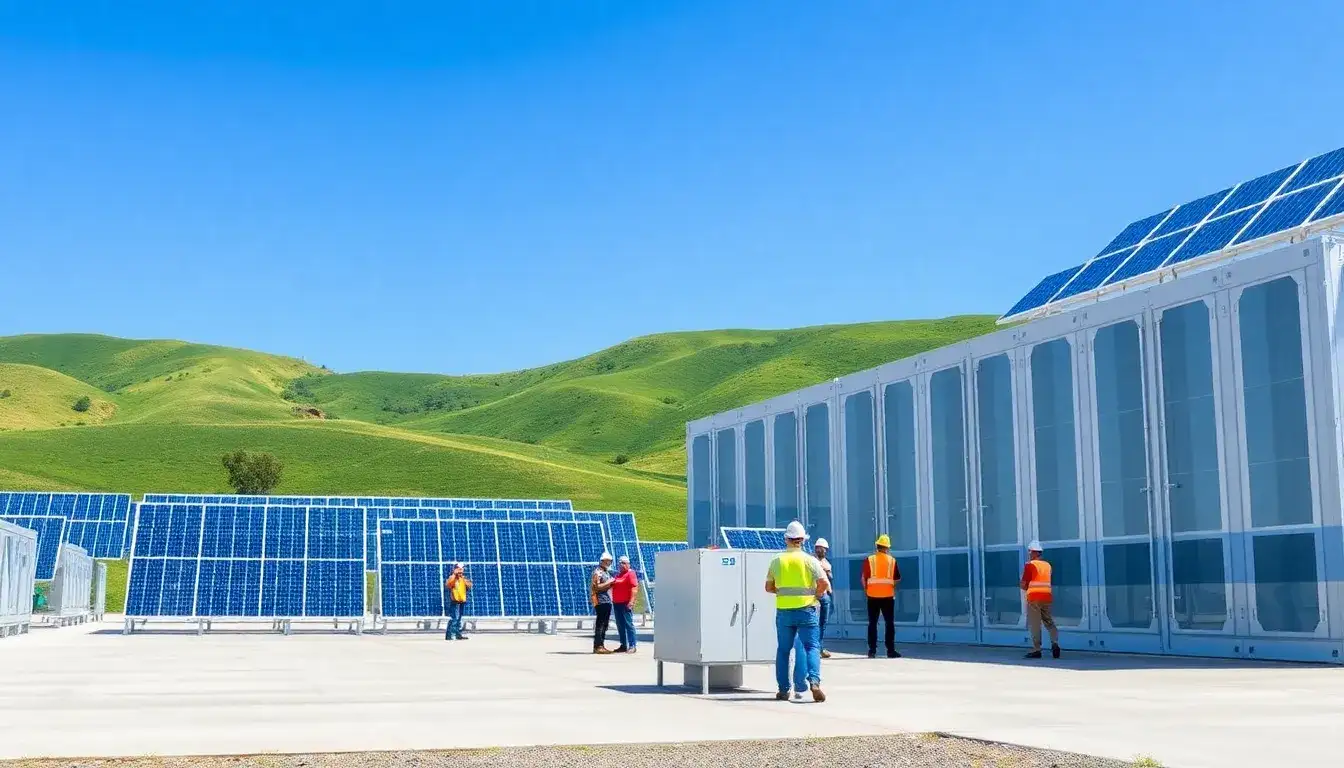
According to the American Clean Power Association’s (ACP) Q1 2025 market report, the United States set a new record for clean power deployment, achieving a total of 7.4 GW during the first quarter of the year. This figure includes projects across utility-scale solar, wind, and energy storage that were brought online in that period.
Of this total, the capacity for battery energy storage systems (BESS) accounted for 1.6 GW. Notably, ACP reported that more BESS capacity was connected in Q1 2025 than in any previous first quarter on record. This surge has helped elevate the cumulative operational storage capacity in the U.S. to over 30 GW, marking a remarkable 65% year-on-year growth since Q1 2024. Battery storage now represents 27% of all pipeline capacity, reflecting a robust 57% increase year-over-year.
During Q1 2025, a total of 28 battery storage projects were commissioned, including 22 standalone projects and 6 that were paired with wind or solar. The two largest projects that came online in this quarter were NextEra Energy Resources’ 200 MW/800 MWh Silver State South Storage in Nevada and AES Indiana’s 200 MW/800 MWh Pike County Energy Storage, which is situated on the site of the old Petersburg Generating Station coal power plant.
Texas saw nearly equal amounts of land-based wind, solar, and storage installations during Q1, contributing to approximately 1,800 MW of clean power installations. In California, energy storage dominated the clean power installations for the quarter. Indiana experienced the second-largest growth in storage capacity, increasing its capacity by 256 MW, which is four times its previous total.
Among the top ten states for Q1 clean power installations, eight voted for Donald Trump in the most recent U.S. presidential election. These states, in order of installations, include Texas, Florida, Indiana, Ohio, Wyoming, Kansas, Wisconsin, and Mississippi, with Illinois and California being the only exceptions.
Tax credits supporting clean energy development, backed by the Inflation Reduction Act (IRA), are currently at risk due to a budget reconciliation bill that passed the House of Representatives on May 22. This bill aims to eliminate production tax credits (PTCs) and investment tax credits (ITCs) for various technologies, including energy storage. If approved by the Senate, the bill would limit tax credits to projects that start construction within 60 days of the bill’s signing and are operational by the end of 2028. Despite these challenges, ACP’s report indicates that clean energy projects are continuing to grow in Republican-led states. Republican Senator John Curtis recently lauded energy tax credits during a visit to Fluence’s factory in Utah, emphasizing their role in driving innovation and economic growth.
Upcoming events include the Energy Storage Summit Central Eastern Europe 2025, scheduled for September 23, 2025, in Warsaw, Poland, and the Energy Storage Summit Asia 2025, taking place on October 1, 2025. By 2026, the Asia-Pacific region is expected to account for 68% of the projected $10.84 billion energy storage market, highlighting the region’s ongoing evolution in energy storage solutions.
Original article by NenPower, If reposted, please credit the source: https://nenpower.com/blog/us-achieves-record-utility-scale-battery-energy-storage-deployment-in-q1-2025-reports-acp/

