

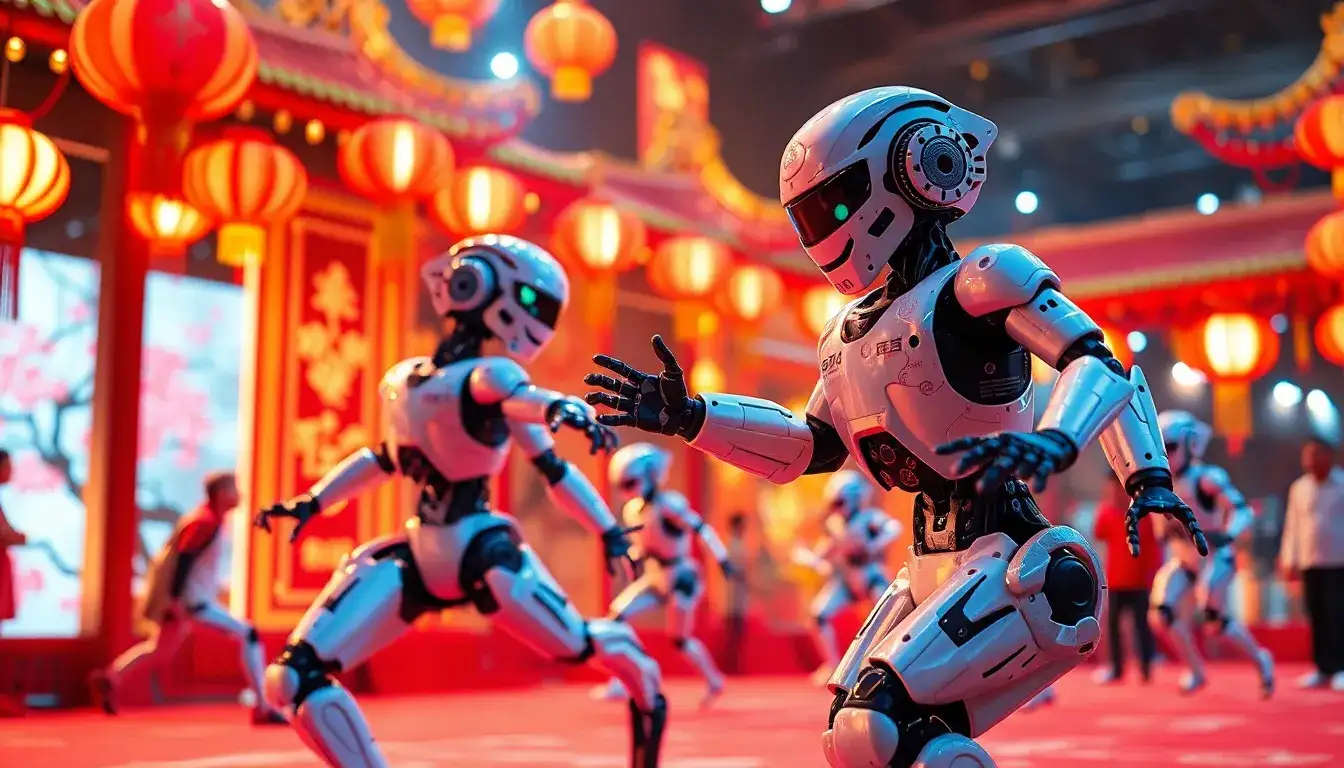
Yushu Technology Revealed! After showcasing their robots performing martial arts during the Spring Festival Gala, these robots are set to transition into real-world applications.
At the 2026 Spring Festival Gala hosted by China Central Television, Yushu Technology made its third appearance as a partner for the event, introducing its G1 and H2 humanoid robots. They presented the world’s first fully autonomous humanoid robot cluster martial arts performance in the program titled “Wu BOT.” Yushu Technology reported that their humanoid robots demonstrated unprecedented athletic performance, achieving several global firsts in technology: a continuous trick table-running parkour, a maximum aerial flip height exceeding 3 meters, single-leg continuous flips, two-step wall flips, and an Airflare spin with seven and a half rotations.
This performance utilized a newly upgraded high-concurrency cluster control system for coordinated operations, enabling dozens of robots to perform in real-time with strict synchronization error control, resulting in minimal latency.
Addressing Three Technical Challenges
According to Yushu Technology, preparations for the “Wu BOT” program began in November 2025. The team deconstructed the program’s concept into multiple technical modules, concurrently developing foundational software and validating algorithms. This included a dance group control platform, upgrades to positioning algorithms, and testing of new motion control algorithms. Following this, they collaborated with the performance team (Ta Gou) and established a testing venue for process optimization. Yushu Technology stated, “During this period, we engaged in multiple rounds of on-site communication and joint optimization with the gala’s director group, culminating in a complete presentation of the program on New Year’s Eve.”
Throughout the preparation process, Yushu Technology’s team tackled three major categories of technical challenges at different stages. In the early phase, the focus was on motion control algorithm design and model training to address key issues such as action transitions, time synchronization, and cluster control. In the mid-phase, challenges arose related to navigation and trajectory tracking. Yushu Technology employed AI fusion positioning algorithms to process perception data from the robots and deeply integrate it with 3D Lidar data, processing hundreds of environmental data points per second. This approach ensured accurate positioning even during intense movements, preventing traditional algorithms from losing track during flips and other dynamic actions. In the later stages, the emphasis shifted to stabilizing high-difficulty movements. The Yushu team conducted extensive testing, upgrading hardware structures and motors to enhance performance limits, optimizing action mapping and dynamic parameters to improve the quality of standard martial arts movements and achieving stable presentations of advanced stunt actions.
Three Categories of the Most Difficult Moves
Yushu Technology identified the most challenging technical moves in the “Wu BOT” program, categorizing them into three groups, each presenting unique technical barriers. The first category includes object interaction moves, such as staff techniques and dual-section staffs. The complexity lies in the robots’ real-time perception of the equipment’s status and adaptive control in response to external disturbances. Yushu achieved this through physical modeling of the equipment and extensive reinforcement learning training in a simulation environment, enabling robots to master dynamic perception and torque control of the tools. The second category involves environmental interaction moves, like parkour table flips and wall kicks, where the critical challenge is accurately estimating relative positions during high-speed movement and dynamically adjusting landing points. Engineers trained the robots to plan their foot placements in real-time during running, successfully allowing stable navigation over obstacles like tables and walls. The third category consists of extreme ground moves, such as continuous aerial rotations, which test the limits of the robots’ hardware performance, motion control, and fusion positioning. Through hardware upgrades, motor performance optimization, iterative algorithm development, and multi-sensor fusion positioning, the Yushu team accomplished these high-difficulty stunts and achieved centimeter-level landing control after flips.
How to Achieve Fully Autonomous Performances with Dozens of Robots?
To deliver this high-difficulty martial arts performance, Yushu undertook systematic upgrades in algorithms, hardware, and systems. The performance featured a fully autonomous display from dozens of robots, with the system developed in-house by Yushu Technology. Initially, the robots utilized their onboard 3D Lidar to scan and locate the entire stage in real time, allowing them to know their positions. Upon receiving instructions from the control console, the robots would invoke movement control algorithms to track the target point trajectory and reach the designated endpoint within the allotted time, subsequently executing martial arts sequences with precision. During the high-intensity performance, the robots also possessed real-time self-monitoring capabilities, maintaining oversight of each module’s operational status, autonomously identifying anomalies, and quickly recovering to ensure stable and smooth execution of martial arts actions over extended durations. Furthermore, multiple robots could autonomously maintain precise positioning and formation consistency while moving dynamically, quickly recovering even if they strayed off course.
Real-World Applications Following the Spring Gala Performance
Post-performance, how the robots’ capabilities can be applied and commercialized in real-world scenarios is a key issue for humanoid robotics companies and a focal point of market interest. Yushu Technology emphasized that the technical challenges addressed during the performance are highly relevant to those faced by robots in real-world environments, with clear pathways for application transfer. Yushu Technology pointed out that the multi-robot collaborative system supporting the entire martial arts performance’s automated control resolved real-time scheduling and action synchronization challenges for dozens of robots operating in complex formations. This technology can be adapted for multi-robot collaborative tasks in industrial settings, such as inspection, warehouse sorting, and assembly lines, enabling efficient large-scale operations. The ability to perform compliant operations and respond to external disturbances, as seen in the staff techniques during the performance, can be directly applied in precision assembly, heavy lifting, and domestic service scenarios, allowing robots to sense and adapt to external disturbances in real-time during operations. The parkour table-flipping moves demonstrated are rooted in relative positioning and environmental interaction technologies, which fundamentally align with tasks such as placing goods on shelves, navigating tight spaces, and climbing stairs, significantly enhancing robots’ operational efficiency and adaptability in real-world settings.
Original article by NenPower, If reposted, please credit the source: https://nenpower.com/blog/unveiling-yushu-technology-breakthroughs-in-robotics-from-the-spring-festival-gala-performance/

