

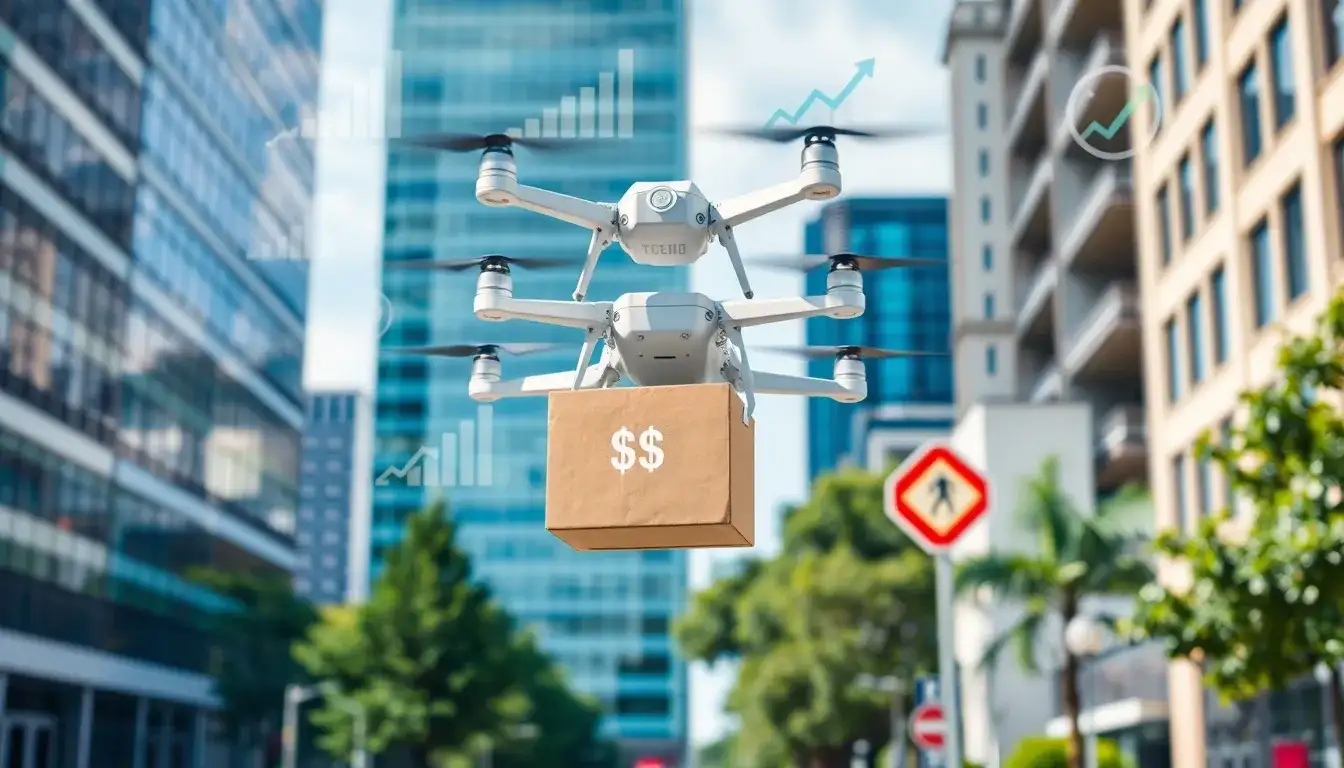
In the past year, the unmanned delivery industry has attracted nearly 10 billion yuan in investments, marking the beginning of a rapid expansion phase. Despite this growth, challenges such as road rights, standards, and long-tail issues still need to be addressed.
As of 2025, the unmanned delivery sector has seen financing reach almost 10 billion yuan, with companies like JiuShi Intelligent becoming the first unicorn valued over 10 billion yuan in the RoboVan (Level 4 autonomous delivery vehicle) field. Major enterprises such as New Stone and White Rhino have also secured multiple rounds of financing. Supportive policies and decreasing costs are driving the industry towards large-scale commercialization, with both New Stone and JiuShi Intelligent surpassing delivery volumes of 10,000 units. However, challenges related to technology bottlenecks, lack of standards, and road rights allocation remain prevalent.
According to forecasts from ZuoSi Automotive Research, the shipment volume of unmanned delivery vehicles is expected to reach between 100,000 and 150,000 units by 2026, demonstrating significant head effects in the market.
Recently, JiuShi Intelligent announced that it had completed a new financing round exceeding 300 million dollars, establishing itself as the first unicorn in its sector with a valuation surpassing 10 billion yuan. This landmark event has redirected market attention to the unmanned delivery industry, which is on the brink of explosive growth. Since 2025, leading firms such as New Stone, JiuShi Intelligent, and White Rhino have completed several financing rounds, accumulating close to 10 billion yuan. Concurrently, the cost of unmanned delivery vehicles has continued to decrease, with delivery volumes crossing the threshold of 10,000 units. However, behind the industry’s rapid progress, challenges related to technology, standards, and ecosystem dynamics are becoming increasingly evident.
The acceleration of financing reflects the rapid growth of the unmanned delivery sector. In 2025, the total funding for unmanned delivery companies approached 10 billion yuan, indicating a transition from R&D and testing to commercial operation. Capital is increasingly concentrated in leading enterprises; for instance, New Stone completed two financing rounds in 2025, raising over 5 billion yuan, including a 600 million dollar Series D round in October backed by multiple institutions such as UAE Leishi Capital, Gaoceng Investment, and China Mobile. White Rhino also secured three rounds of financing in 2025, amassing several hundred million dollars, with investors including SF Express, Jiukun Venture Capital, and Qifu Capital. JiuShi Intelligent raised a total of 400 million dollars across two rounds, receiving continued investment from industry leaders like Ant Group and Meituan.
From September 2025, New Stone reported that its cumulative delivery of Level 4 unmanned vehicles surpassed 10,000 units, with monthly deliveries exceeding 2,000 vehicles. In the same month, JiuShi Intelligent also announced its delivery volumes exceeded 10,000 units. For context, data from the Huajing Industry Research Institute indicated that the sales of unmanned logistics vehicles in China were only 5,100 units in 2024. As leading companies expand quickly, players throughout the supply chain are also entering the market. In September 2025, Desay SV and Youjia Innovation launched their unmanned delivery vehicle brands and related models. For example, Youjia Innovation introduced the Xiaozhu unmanned vehicle series, which features two models with different loading capacities: the T5 model with a capacity of 5.5 cubic meters and the T8 model with a capacity of 8.5 cubic meters. The T8 model is suitable for urban delivery scenarios and can also be adapted for industrial logistics, operating in complex environments such as mines and ports.
Analysis of financing trends in the L4 unmanned logistics delivery sector in 2025 reveals two significant characteristics: first, leading companies with scalable delivery capabilities are more favored by investors; second, state-owned capital and industrial capital are replacing traditional financial investment institutions, becoming key drivers of industry development.
In 2025, there has been an acceleration in the introduction of supportive policies for unmanned delivery vehicles from both central and local governments, with some provinces and cities beginning regular operations. As we enter 2026, these policy benefits continue to unfold. On January 7, at the 2026 National Postal Work Conference, the State Post Bureau emphasized the need to deepen the integration of “artificial intelligence + postal express,” accelerate digital transformation, and issue policy documents to promote the application of unmanned delivery technology, including trials for unmanned vehicles and drones within the industry. This policy easing has opened up development space for the industry, while technological advancements are driving down costs and improving performance, enabling unmanned delivery vehicles to shift from experimental settings to public roads.
According to a report by ZuoSi Automotive Research, rapid advancements in chips, lidar, AI models, and intelligent driving technologies have led to comprehensive innovations in the perception, decision-making, and execution capabilities of unmanned delivery vehicles. Liu Guoqing, chairman of Youjia Innovation, stated in an interview with a reporter that, “China has been the world’s largest logistics market for nine consecutive years. The traditional model struggles to create more profit margins by simply reducing labor costs or enhancing organizational efficiency. Future logistics demand smarter delivery solutions, and unmanned logistics vehicles can fundamentally address the core challenges of labor costs and organizational efficiency.”
Wang Yueping, vice chairman and secretary-general of the Zhejiang Express Association, further explained from a cost perspective, stating that “the application of unmanned delivery vehicles will significantly reduce costs and improve efficiency in the logistics industry. They not only enable uninterrupted delivery with increased frequency but also directly lower the cost per shipment.” A report by Guojin Securities highlights that a substantial reduction in hardware costs is essential for the mass production of L4 vehicles, indicating a sharp decline in vehicle prices, with reductions exceeding 80% from 2023 to 2025. For example, New Stone’s disclosed data from 2025 indicates that its unmanned vehicles have undergone six iterations, each improving performance while reducing costs by approximately 30%, bringing the cost per unit below 100,000 yuan.
In terms of cost control, companies with experience in mass-producing passenger vehicles demonstrate unique advantages. Liu Guoqing noted that compared to competitors originating from non-passenger vehicles, Youjia Innovation can leverage the scale and supply chain of passenger vehicle mass production to negotiate lower procurement prices by 40% for similar components. According to Guo Long, vice president of Youjia Innovation, the company expects to achieve sales of tens of thousands of units by 2026, with revenue projected to reach about 400 to 500 million yuan, maintaining a gross margin of 20% to 30%.
Despite the acceleration of commercialization in the unmanned delivery sector, significant challenges remain before widespread adoption can be achieved, particularly relating to technology and ecosystem dynamics. From a technological standpoint, while the costs of chips and lidar have drastically decreased, numerous technical bottlenecks remain for Level 4 unmanned delivery vehicles to achieve stable operation on open roads in all weather and scenarios. ZuoSi Automotive Research’s 2025 market report highlights that unmanned delivery vehicles still face challenges in perception, such as the “long-tail problem,” which includes sensor failures in adverse weather, human-vehicle interactions at complex intersections, and boundary recognition on unstructured roads. Although these extreme cases account for less than 1% of scenarios, they consume over 90% of R&D resources.
Additionally, the absence of industry standards and testing frameworks limits the efficiency of technological iterations. There is a perspective that currently, there are no unified mass production testing standards for unmanned delivery vehicles in China, leading to a dispersion of R&D resources as different companies adopt varying technical routes and validation methods. Furthermore, as unmanned logistics vehicles are deployed rapidly, the core constraints on industry development do not solely stem from technological issues, but also from the adaptability of urban governance systems to new logistics models. For instance, issues related to liability determination and road rights allocation in mixed traffic scenarios need to be further clarified.
Zhang Qiang, deputy general manager of the Intelligent Information Division at China Automotive Research, pointed out that the primary obstacles currently facing the unmanned delivery industry are the lack of a unified national access threshold and road rights management rules, leading to discrepancies in operational requirements across different regions, thereby increasing the costs for enterprises seeking to scale operations across regions. Liu Guoqing further explained from a resource perspective that challenges also arise from the consumption of public resources by unmanned vehicles. He noted that due to the slower speeds of unmanned vehicles, road rights may become scarce and heavily regulated resources in the future. Thus, companies will need to secure more operational licenses within limited road rights to support their market share expansion.
In response to the limited road rights allocation, some companies are exploring new collaboration models. Liu Guoqing noted that Youjia Innovation has signed a tripartite strategic cooperation agreement with Shenzhen Postal and Eastern Public Transport to jointly develop unmanned logistics services. “Public transport companies possess infrastructure resources such as stations and charging facilities that are currently underutilized. By involving local public transport or state-owned enterprises, we can activate their idle resources, thereby effectively reducing our overall operational costs and helping us rapidly establish operational scale locally.”
Predictive analyses from ZuoSi Automotive Research suggest that the shipment volume of unmanned delivery vehicles will reach between 100,000 and 150,000 units by 2026, with figures projected to soar to between 600,000 and 1 million units by 2030. Currently, leading companies such as JiuShi, New Stone, White Rhino, and Cainiao hold over 90% of the market share, indicating a pronounced concentration effect within the industry.
Original article by NenPower, If reposted, please credit the source: https://nenpower.com/blog/unmanned-delivery-sector-sees-nearly-10-billion-in-funding-as-industry-accelerates-yet-faces-challenges-in-standards-and-road-rights/

