

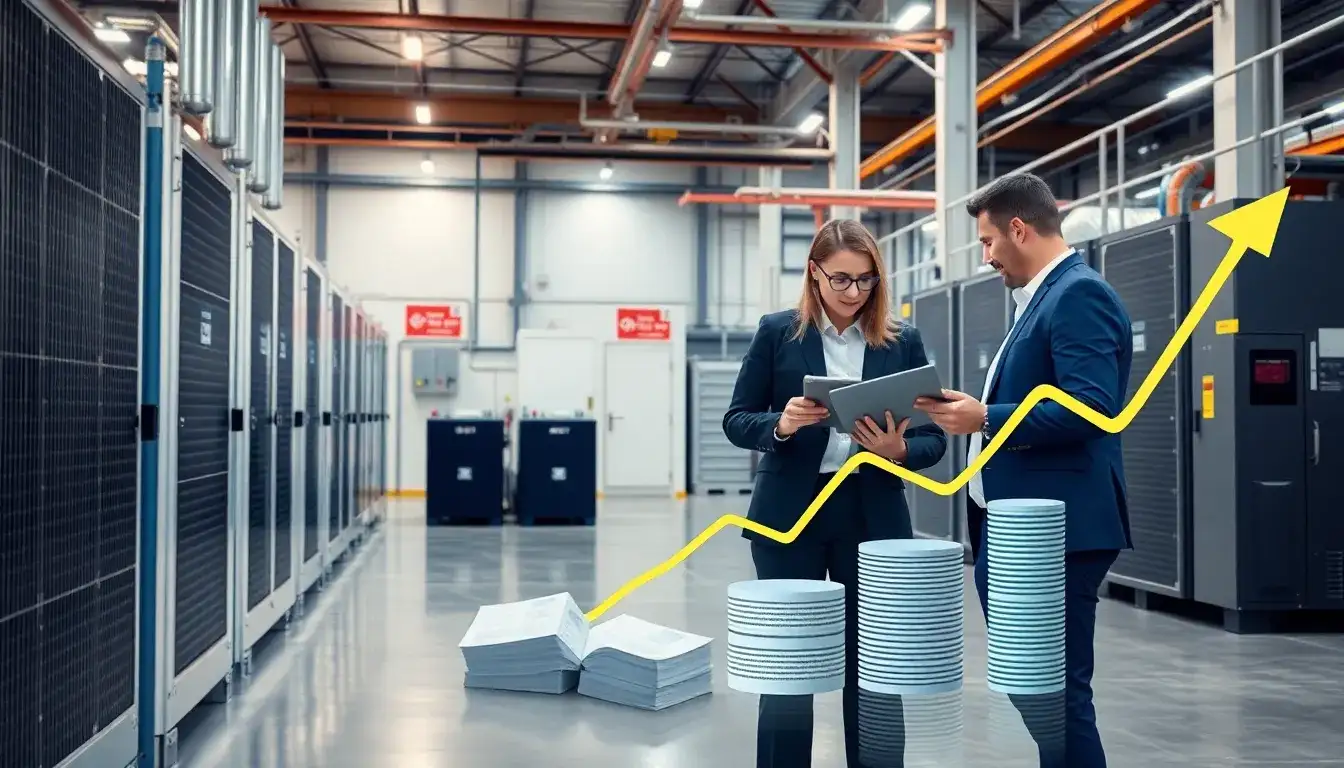
Unlock Savings Through Energy Storage: Turning High Electricity Costs into Profit for Your Business
In the context of rising global electricity prices, investing in energy storage is shifting from being an optional choice to a necessary one. Recently, many business owners have been asking whether it is worthwhile to install energy storage systems in their factories. The answer may be more optimistic than expected—under the right conditions, an energy storage project could break even within 3 to 5 years, and then continue to operate reliably for many years, generating ongoing net profits.
The core of this profitability logic lies in arbitraging the price differences between peak and off-peak electricity rates. In simple terms, this means charging the energy storage system when electricity prices are low (during off-peak hours) and discharging it for factory use when prices are high (during peak hours), thereby profiting from the price differential.
The Logic of Making Money with Energy Storage
An energy storage system functions as a tailor-made “super power bank” for factories. Its business model is straightforward: buy low and sell high. For example, in Shanghai, the peak electricity price for large industrial users can exceed 1.2 RMB per kilowatt-hour, while the off-peak price can be as low as 0.3 RMB per kilowatt-hour. This creates a price difference of over 0.9 RMB per kilowatt-hour. If a factory’s energy storage system completes a full charge and discharge cycle daily, consuming 1000 kWh of off-peak electricity (costing 0.3 RMB per kWh) and discharging 900 kWh of electricity during peak hours (selling at 1.2 RMB per kWh), the profit for that day would be: 900 * 1.2 – 1000 * 0.3 = 780 RMB. This represents only the basic earnings.
In regions like Zhejiang and Guangdong, where policies support energy storage, a clever “two charge, two discharge” strategy (charging and discharging twice during multiple peak and off-peak periods each day) can significantly enhance earnings.
Calculating the Payback Period
Let’s simulate the revenue scenario for a medium-sized commercial energy storage project with a capacity of 5 MW/10 MWh.
- Investment Cost: Currently, the unit investment cost for energy storage systems has significantly decreased. The EPC cost for a 2-hour storage system ranges from 1.376 to 2.226 RMB per Wh, so we will use an average value of 1.64 RMB per Wh for our calculations. Therefore, the total investment for a 5 MW/10 MWh plant is approximately 16.4 million RMB.
- Operating Revenue: The core revenue comes from arbitraging the price difference between peak and off-peak rates. Assuming a peak price of 1.2583 RMB per kWh and an off-peak price of 0.3160 RMB per kWh. Additional earnings may also include savings on capacity fees and participation in demand response programs for subsidies.
- Payback Period Calculation: Based on this model, in the Zhejiang region, a well-designed 5 MW/10 MWh energy storage plant has an estimated static payback period of around 3.9 years. This means that the net profits generated by the project can cover the initial investment in less than four years. It is worth noting that the lifespan of energy storage systems typically far exceeds the payback period. High-quality storage products promise that after 6000 cycles, the usable capacity will not drop below 70%. This indicates that, after breaking even, the energy storage system will continue to generate substantial net profits during its remaining lifespan.
Key Factors Influencing the Payback Period
Not all factories are suitable for installing energy storage systems, and the payback period is influenced by several key factors:
- Local Peak and Off-Peak Price Differences: This is the decisive factor. The larger the price difference, the greater the arbitrage potential. Currently, many regions across the country have a peak and off-peak price difference exceeding 0.7 RMB per kWh.
- Electricity Load Characteristics of the Enterprise: The factory’s electricity load during the day needs to be sufficiently large and stable to effectively utilize the power discharged during peak periods; otherwise, it may result in wasted electricity.
- Cost and Performance of the Energy Storage System: The charging and discharging efficiency, cycle life, and degradation rate of the storage battery directly affect profitability. Simultaneously, with advancements in technology and economies of scale, the initial investment cost of energy storage systems continues to decline, further improving project economics.
- Government Subsidy Policies: In some regions, to encourage energy storage development, capacity subsidies or discharge subsidies may be offered, which can effectively shorten the investment payback period.
Taking the First Step in Investment
If you are interested in investing in energy storage, you can follow these steps for an initial assessment:
- Verify Key Conditions: Review your recent electricity bills, focusing on peak and off-peak price periods and calculating the average price difference. Assess whether your factory’s daytime electricity load is sustained and sufficiently large.
- Conduct Precise Calculations: Evaluating the economic viability of energy storage is a specialized process that needs to consider initial investment, operational costs, electricity pricing structure, subsidy policies, and capital costs. It is advisable to contact a professional energy storage system integrator or energy service company to provide basic data and obtain a customized investment return analysis report.
- Select a Cooperation Model: Besides fully self-funding the investment, businesses can consider collaborating with energy service companies, adopting models like Energy Management Contracts (EMC), where the partner invests and operates, allowing the business to share energy savings while reducing investment risks and financial pressures.
For industrial enterprises facing high electricity costs, investing in energy storage is no longer just about “green and sustainable” practices; it has become a market-validated economic decision with clear prospects. When high peak electricity prices squeeze your factory’s profits, installing an energy storage system equates to building a stable, controllable micro power plant, directly leading to significant savings on electricity costs and increased profits.
We offer free preliminary calculation services for interested businesses. Simply provide your electricity bills from the past three months, and you will receive a customized investment return analysis report.
About Us: We are a high-tech enterprise focused on the research, development, manufacturing, system integration, and solutions of advanced energy storage systems. We aim to deeply integrate cutting-edge energy storage technology with practical application scenarios, customizing safe, efficient, and economical commercial energy storage, residential energy storage, microgrids, outdoor power supplies, and integrated photovoltaic storage solutions for our clients. If you are planning an energy project or would like to learn more about how energy storage can create value for you, please contact us for professional consultation.
Contact Us: Leave your information, and we will get in touch with you.
- Name: Name
- Company: Company
- Email: Mail
- Country: Country
Original article by NenPower, If reposted, please credit the source: https://nenpower.com/blog/unlocking-savings-through-energy-storage-transforming-high-electricity-costs-into-business-profit/

