

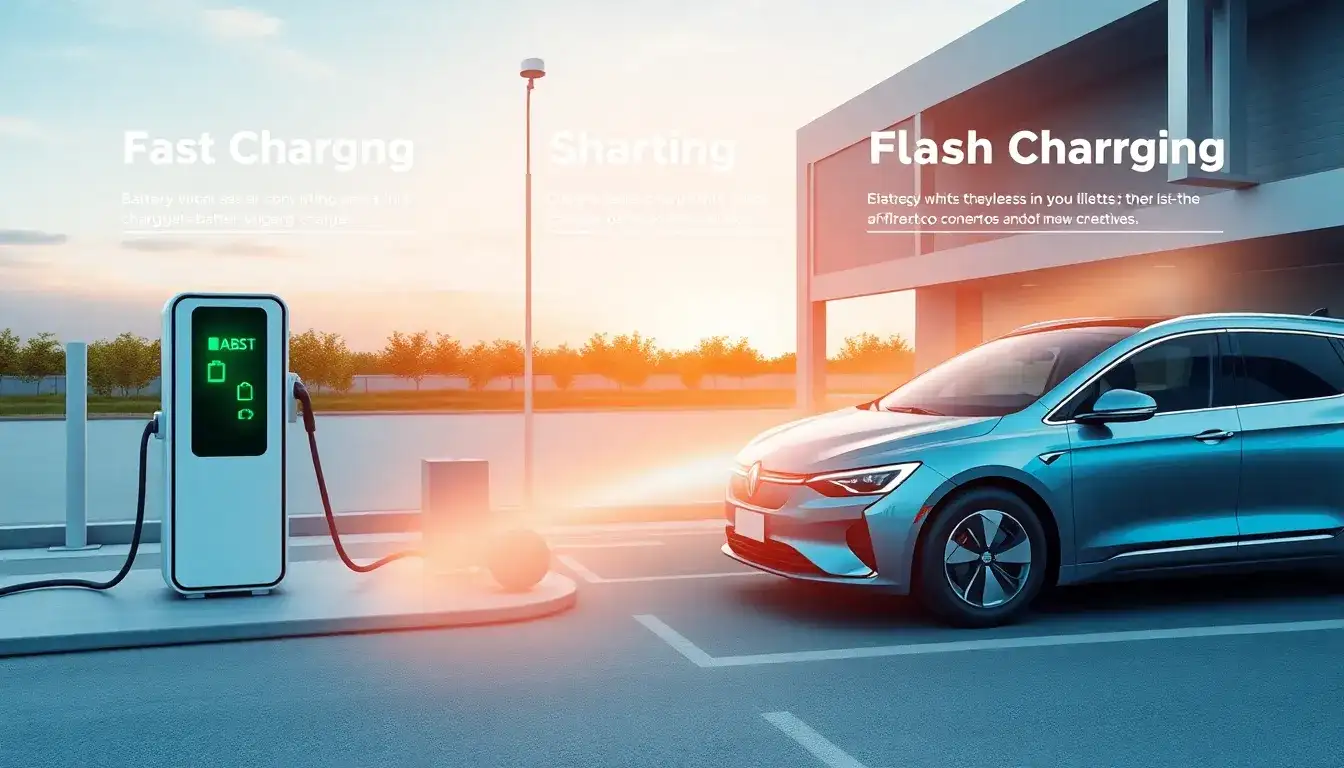
In recent years, electric vehicles (EVs) have transitioned from a concept to a mainstream mode of transportation, accompanied by rapid advancements in charging technology. This evolution has seen the emergence of various charging methods, from home-based “slow charging” to roadside “fast charging,” and now to “supercharging” or “flash charging,” which claims to replenish energy in just a few minutes. These terms frequently appear in media and marketing, yet their meanings, implications, and impacts on battery lifespan and safety are often simplified or obscured. This article aims to connect academic definitions, industry practices, and policy directions to clarify the origins of these terms, summarize authoritative or semi-authoritative opinions, analyze points of contention, and discuss their benefits and drawbacks on batteries while looking ahead to future developments.
Origins of Terminology and Authoritative Definitions
In the battery sector, the fundamental physical quantity used to measure charging speed is the C-rate (rate), which represents the ratio of charging/discharging current to the battery’s rated capacity: 1C means theoretically charging fully in one hour, while 0.2C takes about five hours. The C-rate provides a physical scale to categorize “fast” and “slow” charging. However, in practical applications, manufacturers and media often describe experiences using power (kW) or marketing terms:
- Slow Charging: Typically refers to low-power AC charging constrained by the onboard charger (OBC), common at home or parking stations (usually 3–7 kW).
- Fast Charging: Generally refers to DC charging (external DC-DC), with power levels ranging from several tens to over a hundred kW, enabling significant energy replenishment in about 30 to 60 minutes.
- Supercharging/Super Fast Charging: There is no unified industry definition; some define “supercharging” as ≥100 kW, while specific cities or manufacturers classify ≥480 kW as supercharging.
- Flash Charging: In the mobile phone context, it usually refers to low-voltage, high-current rapid charging strategies. In the automotive context, it emphasizes the ability to significantly replenish energy in a very short time (minutes).
It is important to note that national/international standards (such as the GB/T 20234 series) mainly stipulate interface, communication, and safety requirements rather than providing a unified power threshold definition for “fast,” “super,” or “flash.” Therefore, these categorizations are more about engineering practice and market agreements rather than strict “authoritative” standards.
Industry Controversies and Conceptual Ambiguities
The vagueness of terminology has resulted in the marketing sector gaining a significant voice. Manufacturers promote their rapid energy replenishment capabilities as “flash” or “supercharging,” leading consumers to misinterpret these as universally fast and battery-friendly solutions. Operators differentiate pricing and equipment configuration based on station costs, thermal management capabilities, and grid load. Meanwhile, local governments and industry organizations have begun attempting to define “supercharging” (e.g., some cities define single guns ≥480 kW as supercharging), but a nationwide unified threshold remains absent.
Debate among academia and engineering circles centers on whether extremely high-power charging accelerates battery irreversible degradation or poses safety risks. Some studies and experts argue that as long as battery materials, structures, thermal management, and battery management systems (BMS) are well-maintained, short-term high-power charging can be controlled. However, ample evidence suggests that improper parameters or temperature conditions during high-rate charging can lead to lithium metal deposition on the graphite anode surface, causing localized short circuits or accelerating capacity degradation. For instance, Academician Ouyang Minggao from Tsinghua University, who has extensively researched battery safety and fast charging, highlighted at the 2025 TEDA Automotive Forum that online detection of lithium plating and cell inconsistencies is a critical challenge in super fast charging scenarios.
Technical Comparison: Advantages and Disadvantages of Charging Methods
Slow Charging (Low Power AC)
Advantages: Minimal stress on the battery, low heat generation, conducive to longevity; simple implementation and low cost, ideal for home use.
Disadvantages: Time-consuming, unable to meet long-distance rapid energy replenishment needs.
Impact Mechanism: At low C-rates, the current density within the battery is low, leading to milder lithium ion migration and solid phase interface reactions, promoting the formation and maintenance of a stable solid electrolyte interface (SEI), thereby reducing irreversible capacity loss.
Fast Charging (Medium-High Power DC)
Advantages: Balances speed and safety; current mainstream public charging stations (ranging from dozens to hundreds of kW) adopt this method, allowing for a high state of charge (SOC) in 30-60 minutes.
Disadvantages: Higher charging power results in greater thermal load and electrochemical gradients, requiring improved thermal management and BMS strategies.
Impact Mechanism: High current increases localized concentration differences and potential shifts on the anode surface. If temperatures are low or the cell state is poor, lithium deposition can occur, either reversibly or irreversibly. Engineering solutions include current limiting, segmented charging, temperature control, and layered cell management to mitigate this.
Supercharging/Flash Charging (Extremely High Power, Short Duration)
Advantages: Can compress “energy replenishment time” to a few minutes, offering an experience akin to refueling, thus significantly enhancing commercial operations and user acceptance.
Disadvantages: Places extreme demands on cell materials (conductivity, reaction kinetics), structures (electrode thickness, compaction density), thermal management (liquid-cooled guns, cable cooling), and BMS (SOC estimation, balancing strategies). If any aspect is inadequate, risks such as lithium plating, localized overheating, or even thermal runaway may arise.
Practical Solutions: Manufacturers address these challenges through higher voltage platforms (like 800V), broad temperature control windows, liquid-cooled charging guns, and optimized charging curves.
Lithium Plating – The Unresolved Issue of High Rate Charging
Research indicates that lithium deposition on the anode surface is one of the most common failure mechanisms under high rate, low temperature, or high SOC conditions. This phenomenon reduces usable capacity and poses safety hazards (localized short circuits). Recent studies and models are working to quantify the triggering thresholds for lithium plating and develop online warning and control strategies, but reliable real-time onboard detection methods remain a research challenge.
Policy, Industry, and Future Outlook
Policies and infrastructure play a significant role in shaping the direction of charging modes. China has proposed a “moderate advance” layout goal for planning high-power charging facilities, encouraging the deployment of numerous high-power stations by 2027 while emphasizing scientific planning to avoid overinvestment. The equipment industry is advancing in areas such as liquid-cooled charging guns, modular inverters, high-voltage platforms (from 400V to 800V), and vehicle-station synergy (compatibility for slow/fast charging and smart scheduling).
From a technological evolution perspective, several parallel paths warrant attention:
- Cell Materials and Structure Upgrades: High-conductivity anode materials, lithium-rich or high-voltage cathodes, and interface engineering to reduce lithium deposition tendencies.
- Thermal Management and Charging Hardware: Liquid-cooled guns, cable cooling, and station heat dissipation design.
- Intelligent Charging Strategies and Online Monitoring: Real-time model-based segmented charging, pulse heating, and lithium plating prediction algorithms (related models and experimental validations already exist in academia).
- System Synergy: Vehicle-grid interaction (V2G) and experimental scenarios combining with renewable energy (like photovoltaic direct charging/”photovoltaic flash charging”) are emerging. Academician Ouyang Minggao proposed such technological directions at the 2025 TEDA Forum, emphasizing the high requirements for battery technology in flash charging.
Overall, for flash/supercharging to scale, it requires advancements in cell and thermal management hardware, as well as institutional guarantees for BMS and standards.
Conclusion
“Slow charging,” “fast charging,” “supercharging,” and “flash charging” are not entirely separate technological domains but rather a spectrum based on charging power, time, and the capabilities of battery chemistry/thermal management. Slow charging is known for its battery-friendly nature; fast charging is currently the backbone of public networks; while supercharging/flash charging represents the pinnacle of user experience but pushes battery materials, structures, thermal management, and BMS to their limits. Academia is increasingly clarifying the mechanisms of failures such as lithium plating, while engineering advances progress concurrently in hardware (high-voltage platforms, liquid cooling), software (online prediction, segmented charging), and standardization. Policy and market dynamics also encourage rational infrastructure and charging model layouts. As Academician Ouyang Minggao emphasized, flash charging is a promising technological direction, but it must be predicated on the technical matching of batteries and systems; otherwise, it risks introducing localized lithium plating, lifetime degradation, and safety concerns to users. Thus, when judging the meaning of “flash charging/supercharging” in news and manufacturer promotions, it is essential to focus on the power (kW), voltage platform (V), and the charging curves and temperature control descriptions provided by manufacturers, rather than solely relying on marketing terms.
Original article by NenPower, If reposted, please credit the source: https://nenpower.com/blog/understanding-fast-super-and-flash-charging-in-new-energy-vehicles-impacts-on-battery-life-and-safety/

