

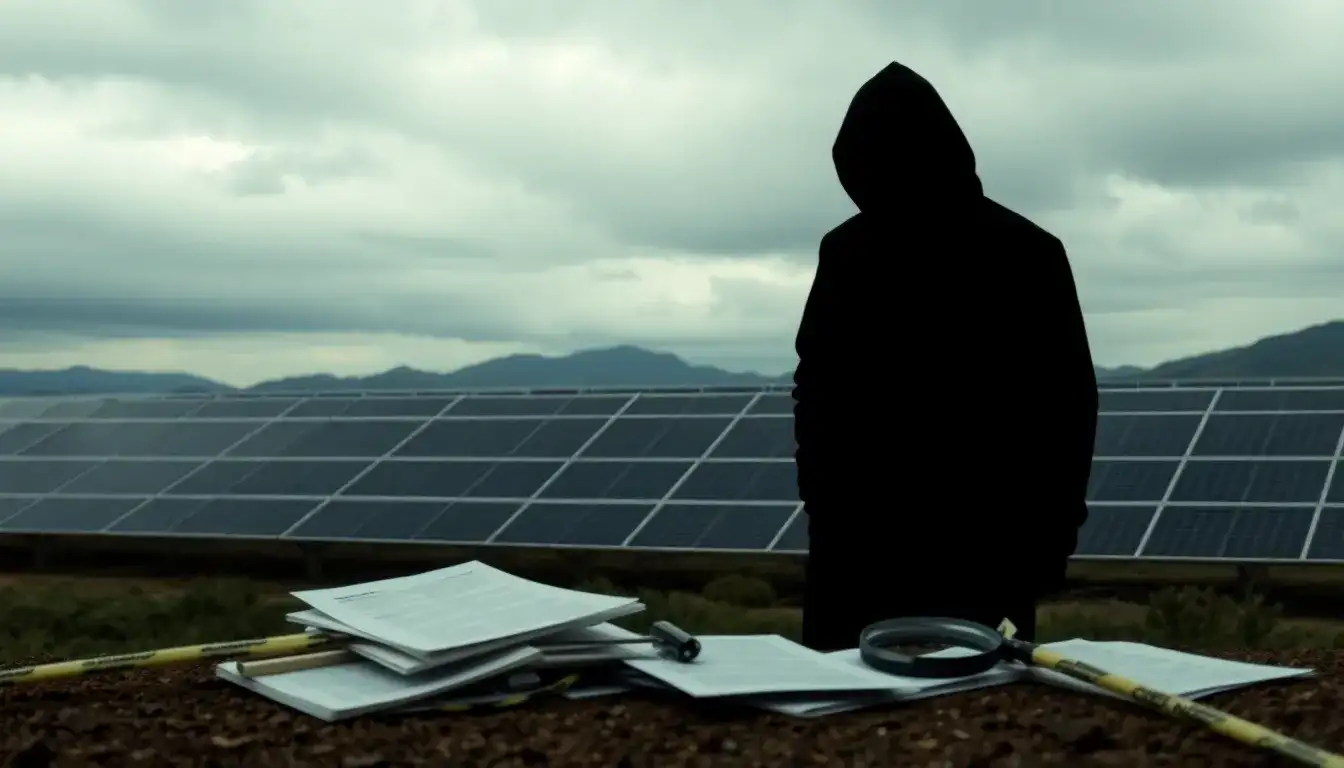
Clean energy, dirty secrets: Inside the corruption plaguing California’s solar market
California’s solar energy boom is often celebrated as a model for sustainable growth, but a new study reveals a troubling reality lurking beneath the surface of its sun-kissed panels. Researchers have identified seven distinct forms of corruption that threaten the integrity of the state’s clean energy expansion, including favoritism, land grabs, and misleading environmental claims. Among the most shocking findings are allegations of romantic relationships between senior officials and solar lobbyists, which blur the lines between personal influence and public interest. The report highlights a solar sector that is advancing rapidly while governance and ethical standards lag dangerously behind.
Solar power is expanding rapidly across the United States, driven by climate mitigation policies and goals for carbon-free energy, with California leading the nation as its top producer of solar electricity. However, a new study published in *Energy Strategy Reviews* exposes a darker side to the state’s rapid investment, deployment, and adoption of solar energy. Researchers from Boston University’s Institute for Global Sustainability (IGS) have uncovered various forms of corruption within the California solar market.
The study identifies seven specific types of corrupt practices and risks in California’s solar energy sector. Notably, favoritism in project approvals is highlighted, including a high-profile case involving senior officials at the U.S. Department of the Interior and their connections to a solar company lobbyist. To ensure a fair energy transition, the authors advocate for significant reforms in California’s solar market as the U.S. increasingly depends on solar energy to decarbonize its electricity sector. “This is a wake-up call that the solar industry cannot continue on its current trajectory of poor governance and unethical behavior,” states lead author Benjamin Sovacool, director of IGS and a professor at Boston University.
Through a combination of literature reviews, interviews, and fieldwork, the study’s authors provide a framework to explore the broader socio-political realities that drive corruption during the explosive growth of California’s solar market from 2010 to 2024. During this period, solar energy production in California surged, reaching 79,544 gigawatt hours in 2024—enough to power approximately 7.4 million U.S. households for a year, according to the State of Renewable Energy dashboard. The research indicates that solar energy is linked to numerous corrupt practices that negatively impact communities, policymaking, regulation, and planning decisions.
“The most revealing finding for me is the prevalence of corruption at all levels of solar development, from small-scale vendors to high-ranking government officials, even in a state as well-regulated and progressive as California,” remarks co-author Alexander Dunlap, an IGS research fellow.
### Corruption Types Identified
To understand how corruption undermines the solar market, researchers examined utility-scale deployments in Riverside County, California’s fourth most populous county. They aimed to document perceived corruption patterns through a diverse array of voices, utilizing organized focus groups, observational studies at various solar sites, and interviews conducted in local settings. Respondents included residents affected by solar development, solar construction workers, non-governmental organizations, solar company employees, and representatives from federal, state, and local governments.
While acknowledging the challenges of verifying individual claims of corruption, the authors combined personal accounts with analysis from news articles, court testimonies, and other official sources to validate their findings. They identified a mix of public, private, social, and political corruption patterns in California’s solar energy market:
– **Clientelism and favoritism**: Choosing friends or family over qualified candidates for solar projects and unfairly allocating government contracts or permits, exemplified by an investigative report questioning the influence of a personal relationship.
– **Rent-seeking and land grabbing**: Diverting public funds or lands for the benefit of private developers, including the appropriation of communal or public land from Indigenous peoples and other groups for energy infrastructure.
– **Service diversion**: Withholding local benefits such as reduced electricity bills or distributing locally generated power exclusively to higher-paying regions.
– **Theft**: Illegally removing vegetation or cultural artifacts, or disturbing wildlife habitats to construct solar project sites.
– **Greenwashing**: Misleading the public about a solar project’s environmental advantages; relying on flawed environmental or cultural impact assessments; and bypassing environmental protections to expedite solar infrastructure development.
– **Tax evasion and avoidance**: Failing to pay or underreporting taxes, or governmental authorities inadequately allocating project funds to communities affected by solar project developments.
– **Non-transparency**: Concealing or manipulating important information regarding solar projects, including local economic benefits and environmental impacts.
### A Call for Reform
Despite a few high-profile scandals, corruption in California’s renewable energy sector has largely been overlooked, allowing underlying issues to undermine the potential for a just energy transition. To address this, the authors recommend implementing corruption risk mapping to document problematic practices and entities, establishing subsidy registers and sunset clauses to deter rent-seeking and tax evasion, promoting transparency initiatives related to environmental changes and data production, enforcing anti-corruption laws more stringently, and adopting shared ownership models for solar projects to enhance accountability.
This newly published study, titled “Sex for Solar? Examining Patterns of Public and Private Sector Corruption within the Booming California Solar Energy Market,” is part of a larger IGS research initiative that investigates injustices in U.S. solar and wind energy supply chains.
Original article by NenPower, If reposted, please credit the source: https://nenpower.com/blog/uncovering-corruption-in-californias-solar-energy-market-a-study-of-ethical-breaches-and-governance-failures/

