

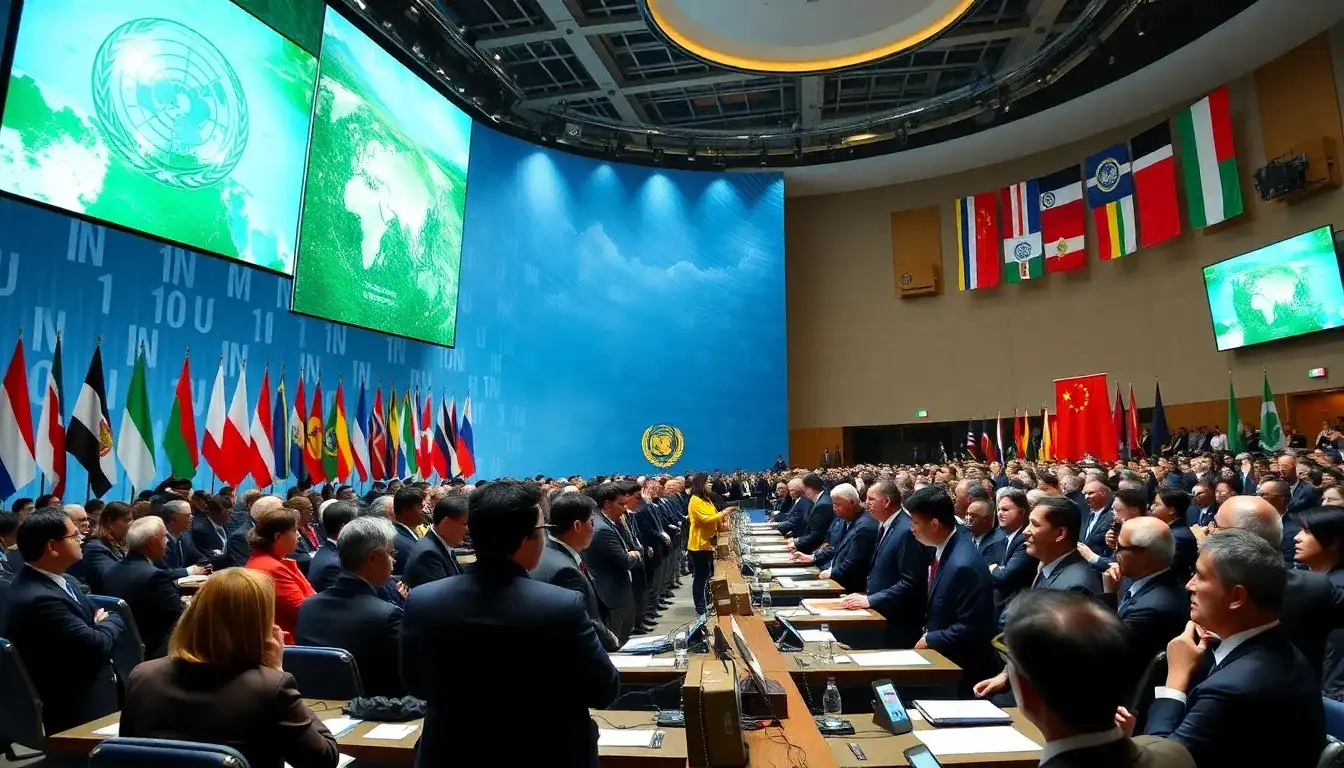
On September 24, during the United Nations Climate Change Summit held in New York, 120 countries along with the European Union announced new greenhouse gas reduction targets for the next decade. Under the framework of the Paris Agreement established in 2015, countries are required to submit more ambitious reduction plans every five years. However, UN Secretary-General António Guterres warned that global progress in emissions reduction is significantly lagging, posing a “collapse” risk to the goal of limiting global warming to 1.5 degrees Celsius.
Despite many countries expressing a commitment to enhance climate action at the summit, scientists indicated that with current plans, the Earth could still warm by 3 degrees Celsius, greatly exceeding the safety threshold set by the Paris Agreement. Guterres emphasized, “Science demands action, law demands action, and economic conditions compel us to act.”
Notably, the United States, historically the largest emitter of greenhouse gases, was “absent” from the summit. On the previous day, President Donald Trump referred to the climate crisis as “the greatest hoax ever” in his speech at the UN, criticizing clean energy policies and starkly contrasting with the mainstream international consensus.
Former US Secretary of State and Presidential Climate Envoy John Kerry acknowledged in an interview that the inconsistency in US policy has impacted global climate cooperation and weakened international trust. He pointed out that amid the US’s withdrawal from the Paris Agreement and the weakening of clean energy policies, China should continue to play a leadership role. However, he also stressed that the drive for energy transition comes not only from government policies but also from market forces. “In 2024, over 90% of new global electricity will come from renewable energy, and this trend is hard to reverse,” Kerry stated, adding, “The capital market, not public opinion, decides the energy transition.”
During the special summit on new climate goals, Guterres urged countries to “further and faster” reduce greenhouse gas emissions. He noted that most countries are significantly behind in fulfilling their temperature control commitments, failing to effectively prevent exceeding established temperature increase limits. In his speech at the UN General Assembly the day before, Guterres described fossil fuels as a “failed gamble” and warned that the international goal of keeping global temperature rise within 1.5 degrees Celsius is facing the risk of “collapse.” He emphasized that the upcoming UN climate negotiations (COP30) in Brazil must establish a “credible global response plan” to help redirect global climate action.
Currently, all countries are submitting their new Nationally Determined Contributions (NDCs) to the UN, although comprehensive analysis will take some time. Among all countries and regions, the US, China, and the EU are under the most scrutiny. On the same day Guterres issued his warning, President Trump dismissed mainstream climate science and criticized wind turbines as “pathetic,” while claiming that the green energy agenda has pushed many countries “to the brink of disaster,” revealing that he had pressured nations like the UK to increase oil extraction.
Previously, the Trump administration had withdrawn from the Paris Agreement twice and therefore did not submit a new NDC, resulting in its absence from the climate conference in Brazil this November. In response, John Kerry pointed out that the shifts in US positions on energy transition have had substantial impacts on global climate efforts. The US’s exit from the Paris Agreement and the reduction in clean energy investments sends a dangerous signal to the international community, undermining trust and hindering global cooperation during a critical time.
However, Kerry also noted that the drive for energy transition is not solely government-led but is also rooted in economic principles. He highlighted that clean energy’s economic appeal is continuously growing, and actions at the grassroots, local, and corporate levels are ongoing, often unaffected by federal policy fluctuations.
Manish Bapna, President of the Natural Resources Defense Council, echoed this sentiment, stating that contrary to Trump’s opposition to climate action, most major emitting countries have committed to continue reducing climate pollution in the coming years. These commitments bring hope to the world, yet the speed and scale of emissions reductions are still insufficient to address the most severe impacts of climate change.
During the summit, leaders from the vast majority of countries expressed that regardless of the shifting stance of the US under Trump, nations should unite and accelerate the transition to renewable energy. This consensus is backed by data, showing that last year global investments in renewable energy, including solar and wind, reached $2 trillion, which is double the total investments in oil, natural gas, and coal combined. Philip Davis, Prime Minister of the Bahamas, emphasized that “policymakers must realize that replacing fossil fuels with renewable energy will not sacrifice economic prosperity but is, rather, a necessary prerequisite for future prosperity.”
As a focal point of global attention, China accounts for approximately one-third of total global emissions and has emerged as a leading nation in clean energy. According to reports, Chinese President Xi Jinping announced via video link at the summit the new round of China’s NDC targets: by 2035, the net greenhouse gas emissions across the economy will decrease by 7% to 10% from peak levels, with non-fossil energy consumption accounting for over 30%, and installed capacity for wind and solar to exceed six times that of 2020. Xi stated that this target is set “in accordance with the requirements of the Paris Agreement and reflects our utmost efforts,” and emphasized China’s “determination and confidence to fulfill its commitments.” He also called on the international community to “maintain the correct direction” and not to waver in confidence due to the actions of individual countries.
Simon Stiell, Executive Secretary of the UN Climate Change, positively commented on China’s proposed NDC, stating, “China is providing clean, reliable, and affordable energy on an unprecedented scale. Its latest targets indicate that China’s accelerated pace in climate action, manufacturing, and deployment will continue to strengthen.” He noted that the investment scale driven by these targets will be unprecedented, helping to lower costs, promote global clean energy technology innovation, and is crucial for further expanding clean energy deployment.
Stiell also highlighted China’s good track record in achieving and surpassing climate and clean energy targets and praised President Xi’s goals and statements on “striving for better.” He believes that today’s announcement sends a clear signal that the future global economy will rely on clean energy. For all countries, stronger and faster climate action means more economic growth, job opportunities, affordable and safe energy, cleaner air, and healthier populations, which is of great significance to the entire world.
Li Shuo, Director of the China Climate Center at the Asia Society Policy Institute, noted in an interview that China has fully considered multiple domestic and international factors when setting its NDC targets, demonstrating an awareness of both opportunities and challenges. The target setting continues China’s consistent style of “valuing effectiveness and being cautious in commitments,” reflecting the government’s confidence in fulfilling its promises. He stated that China’s latest commitments should be seen as a “starting point” for climate action in the next decade, representing “the baseline of ambition, not the ceiling of potential.”
Chen Meian, Senior Project Director and Analyst at the Green Innovation Development Research Institute, remarked that China’s new round of NDC target follows a pragmatic path. She recalled that China achieved its 2030 wind and solar installed capacity target of 1.2 billion kilowatts six years ahead of schedule, showcasing strong policy execution and industrial development capabilities. The new round of targets covers economy-wide emissions reductions and is expected to promote reductions in non-CO2 greenhouse gases, further enhancing the systematic nature of climate action and sending the international signal that “action is superior to words.”
Wang Xiaojun, Executive Director of the Asia Climate Activists (Philippines), stated that on the occasion of the 80th anniversary of the UN, the international community needs to work together and steadfastly pursue multilateral cooperation. In light of the 70th anniversary of the Bandung Conference, China’s proposed principle of “upholding fairness and justice, fully respecting the development rights of developing countries, and narrowing rather than widening the North-South gap through global green transformation” is especially historically significant. Developing countries also need to unite and transition to green low-carbon energy to break free from the shackles of fossil fuels, achieving a leap in technology, economic development, and political confidence.
As the world faces critical climate governance challenges, whether countries can unite in the face of differences, and translate commitments into actions, will determine humanity’s ability to maintain the final climate safety threshold. China’s announcement of new targets is seen as an important signal, but global cooperation still faces multiple challenges related to economic, political, and execution capabilities.
The European Union, another key player in global climate governance, has yet to finalize its emissions reduction commitments; however, the EU legislative body has preliminarily agreed to reduce greenhouse gas emissions by 66% to 72% from 1990 levels by 2035. EU Climate Commissioner Frans Timmermans stated that the relevant provisions are expected to be finalized during COP30. However, Europe’s climate ambitions also face real challenges. As part of negotiations with the US, EU Commission President Ursula von der Leyen committed in August to purchase $750 billion worth of US fuels before the end of Trump’s current term. Analysts have pointed out that while this commitment is nearly impossible to fulfill, the plan itself could severely hinder Europe’s transition to renewable energy.
Yao Zhe, Global Policy Advisor at Greenpeace East Asia, suggested that the climate summit on the 24th can be seen as a subtle yet powerful response to Trump’s “climate hoax” narrative. Most countries recognize the positive effects of low-carbon transitions on the environment, economy, and society and hope to leverage this trend to expand their own development space. However, she also noted that current global climate actions indeed lack new momentum and leadership. Despite hundreds of countries submitting their NDCs, there remains a significant gap between these commitments and the efforts required to meet global temperature control targets. The EU has not submitted new targets on time due to internal disagreements, while China has proposed absolute reductions for the first time, though there is still room for improvement in its ambitions.
Faced with multiple challenges in economics, domestic politics, and geopolitical issues, whether countries can unite in consensus and form a collective effort will be a core issue for future global climate governance. Amid these daunting challenges, governments will convene at COP30 in Belém, Brazil, in November to attempt to bridge the emissions reduction gap. However, due to local hotel capacity limitations, the size of the attending delegations may be reduced. Some ministers have complained that the logistics of COP30 are “a complete nightmare” and expressed pessimism about achieving substantial outcomes from the conference.
“The international community must address the gap between collective NDC targets and actual needs at COP30. Whether the conference can clearly respond to this gap and call on all parties, especially major emitting countries, to reassess and strengthen targets in the coming years will be crucial. Whether China is willing to support this important discussion and even take the lead in promoting heightened ambitions will be another important measure of its global climate leadership,” Li Shuo stated.
Original article by NenPower, If reposted, please credit the source: https://nenpower.com/blog/un-climate-summit-over-100-countries-led-by-china-announce-new-ndcs-amid-us-absence-and-eu-disputes/

