

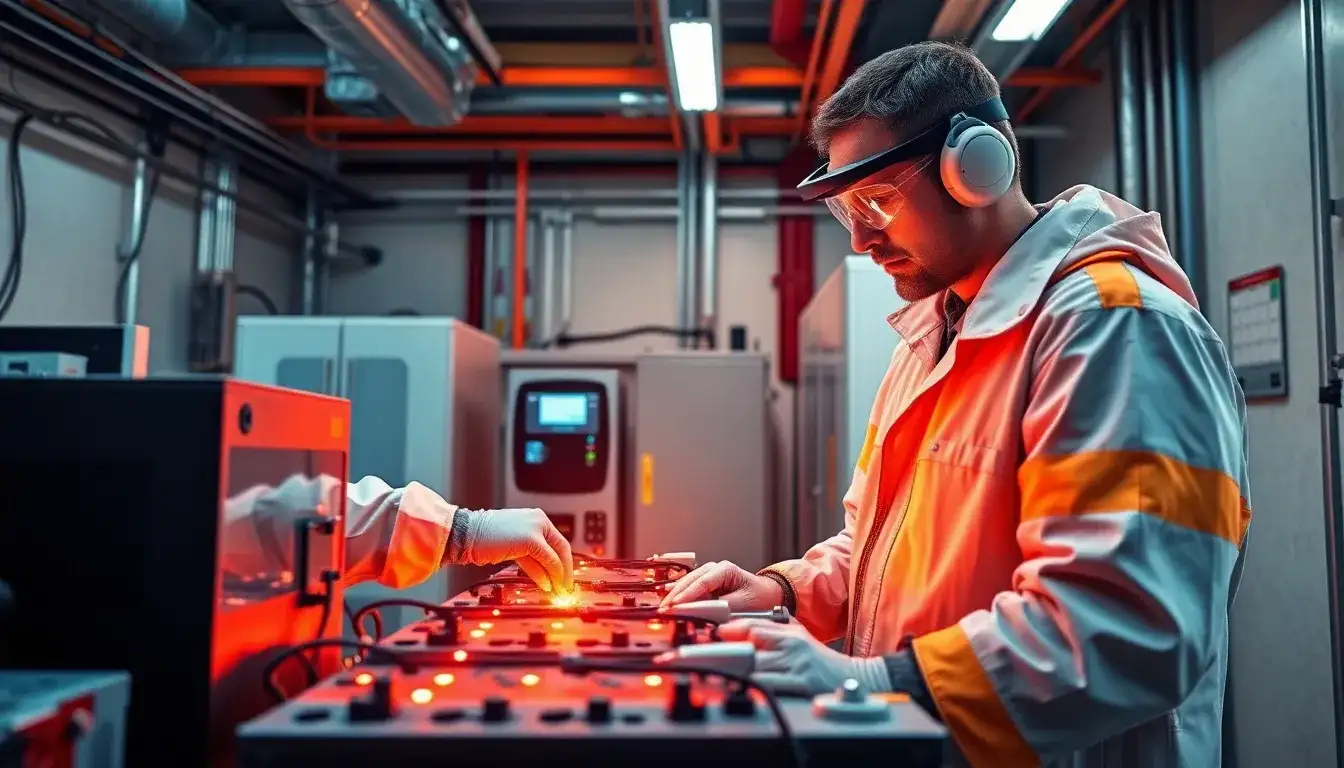
UL Solutions, a global leader in applied safety science, has announced a significant update to its testing methods for thermal runaway fire propagation in Battery Energy Storage Systems (BESS). This update is crucial for safely storing energy from renewable sources such as solar and wind power. The revised testing methods were developed in collaboration with the energy storage industry, regulatory bodies, and other stakeholders, aimed at enhancing safety and sustainability in the battery storage market.
The new testing methods include protocols for innovative battery technologies, including non-lithium-ion chemical systems such as high-temperature sodium batteries. These updates reflect advancements in battery technology while also addressing the fire risks associated with energy storage systems. The changes in UL Solutions’ testing methods align with updates in the ANSI/CAN/UL 9540A fifth edition, which serves as the standard for evaluating the propagation of thermal runaway fires in battery energy storage systems in both the United States and Canada.
Wesley Kwok, Vice President and General Manager of UL Solutions’ Energy and Industrial Automation division, stated, “We are committed to collaborating with the industry to bring safer products to market and promote the safety and sustainability of the energy storage sector. Working with industry stakeholders and fire safety organizations ultimately enhances our approach to energy infrastructure safety and improves public safety globally.”
The ANSI/CAN/UL 9540A standard provides a standardized testing method to evaluate the sensitivity of battery technologies to thermal runaway. Thermal runaway is a chemical reaction that can cause a rapid increase in battery temperature and pressure, potentially leading to significant safety hazards such as fires or explosions. Additionally, the testing methods assess the fire and explosion risks posed by thermal runaway, such as the ejection of hot particles. The data generated from these tests will be utilized to determine the fire and explosion protection required for BESS installations, thereby effectively enhancing safety measures.
The data in the test reports will also help demonstrate compliance with relevant codes and installation standards, which are essential for public safety and property protection. These include the NFPA 855 standard for the installation of stationary energy storage systems, as well as fire codes like the International Fire Code®, International Residential Code®, and NFPA 1 Fire Code.
Originally established in 2017, the testing methods for evaluating thermal runaway propagation in energy storage systems have undergone several revisions, culminating in their inclusion in the consensus standard ANSI/CAN/UL 9540A fourth edition published in 2019. The key updates in the latest fifth edition include clearer definitions of cell-to-cell propagation, testing methods for various battery chemistries (such as high-temperature sodium and flow batteries), and testing procedures for emerging application scenarios like rooftop and open garage BESS installations.
The ANSI/CAN/UL 9540A focuses on testing methods, while the related UL 9540 standard provides comprehensive product safety evaluation requirements, forming the basis for UL certification of the entire BESS. This encompasses battery cells, modules, and racks, as well as power conversion, battery management, energy management, communication, and safety systems. The synergistic application of UL 9540A and UL 9540, along with compliance with relevant installation codes, supports the safe deployment of BESS.
Ken Boyce, Vice President of UL Solutions’ Engineering Department, remarked, “The rapid adoption of energy storage technology across various sectors necessitates our continuous focus on mitigating fire and explosion risks while closely collaborating with the industry, regulatory agencies, and other experts. This must be grounded in solid scientific principles, as safety and reliability are crucial for the global energy transition.”
As energy demands increase, the number of BESS installations is also rising, leading to heightened global attention on the safety of these systems, particularly for large-scale projects. UL Solutions is actively involved in developing a Large Scale Fire Test (LSFT) methodology. Currently, UL Solutions is working with the National Fire Protection Association (NFPA) technical committee to establish a task group focusing on refining the guidelines and consensus standards for LSFT. Furthermore, UL 9540A remains the only consensus standard explicitly cited in NFPA 855 for large-scale fire testing in the United States and Canada.
For more information on how UL Solutions is addressing fire safety issues in BESS, visit our website.
About UL Solutions: As a global leader in applied safety science, UL Solutions (NYSE: ULS) helps clients in over 110 countries turn safety, security, and sustainability challenges into opportunities. UL Solutions offers testing, inspection, and certification services, as well as software products and consulting services to support clients in achieving product innovation and business growth. The UL mark is a recognized symbol of trust for clients’ products, reflecting our strong commitment to advancing safety. We assist clients in driving innovation, launching new products and services, navigating global markets and complex supply chains, and developing sustainably and responsibly for the future. Our science is your advantage.
Original article by NenPower, If reposted, please credit the source: https://nenpower.com/blog/ul-solutions-enhances-safety-testing-methods-for-battery-energy-storage-systems-to-address-evolving-fire-risks/

