

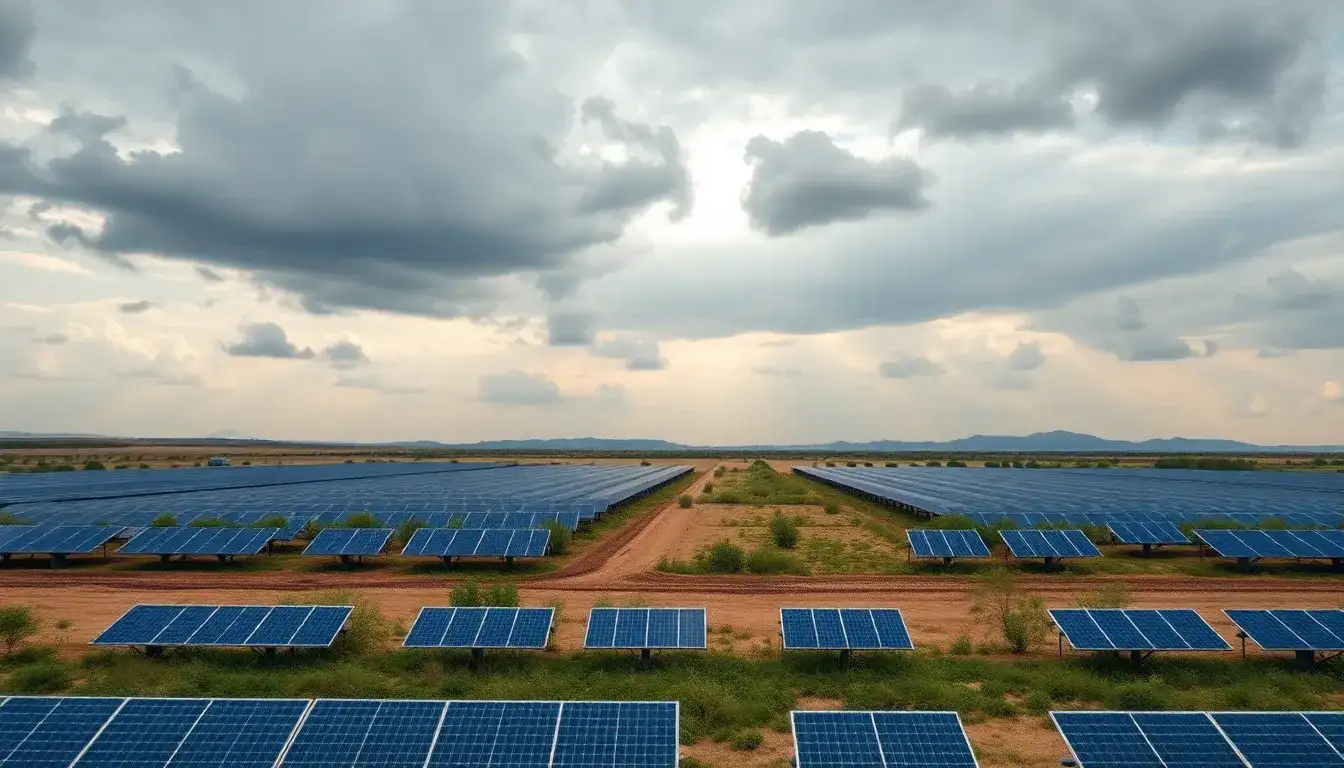
The U.S. solar industry experienced a significant decline in the first quarter of 2025, with the installation of 10.8 GW of capacity. This figure marks a decrease of 43% from the previous quarter and a 7% drop compared to the same period last year. Despite these declines, it ranks as the fourth-best quarter on record, according to the U.S. Solar Market Insight Q2 2025 report released by the Solar Energy Industries Association (SEIA) and Wood Mackenzie. Notably, photovoltaic solar accounted for 69% of all new electricity-generating capacity in this quarter, underscoring its dominant position in U.S. power additions.
### Utility Installations
Utility-scale solar installations reached 9 GW in Q1 2025, representing a 7% year-over-year decline. The states of Texas, Florida, Ohio, Indiana, and California contributed to over 65% of these installations. Contracted projects totaled 5.7 GW, reflecting a 2% year-over-year increase. Major corporate buyers, including Meta, Amazon, and Verizon, secured 55% of these contracts, primarily in Texas, with Meta leading the pack. Wood Mackenzie anticipates 199 GW of new utility-scale capacity will be added between 2025 and 2030. However, it is expected that installations will plateau and decline from 2026 onward due to pipeline contraction, policy uncertainties, potential changes to federal tax incentives, and trade disputes affecting imports.
In Q1 2025, utility-scale solar system prices rose, with fixed-tilt systems priced at $1.08/W and single-axis tracking systems at $1.23/W, marking increases of 3% and 4% respectively. Engineering, procurement, and construction costs surged by 20% due to labor shortages, extended equipment lead times, tariff changes on steel and imports, and compliance burdens related to prevailing wage and domestic content rules. Module prices increased by 4% to $0.32/W, influenced by the Department of Commerce’s anti-dumping and countervailing duties findings on imports from Southeast Asia. However, the adoption of tunnel oxide passivated contact (TOPCon) modules helped mitigate these cost increases by enhancing efficiency and reducing equipment and labor needs.
### Distributed Solar Plus Storage
The solar-plus-storage sector is gaining momentum, representing a record 38% of residential solar installations in Q1 2025, up from 32% in Q4 2024. This indicates a 10% quarter-over-quarter growth in residential solar plus storage installations, even as the overall residential solar market contracted by 4%. Non-residential solar plus storage deployments remained stable, with approximately 213 installations compared to 220 in the same period last year. California led with 15 MW of commercial solar-plus-storage deployed, followed by Puerto Rico with 1.3 MW, Arizona with 250 kW, and Rhode Island with 200 kW.
### Residential PV
In Q1 2025, the residential solar market added 1,106 MW, reflecting a 13% year-over-year decline and a 4% quarter-over-quarter decrease. Installation declines were noted in 22 states compared to Q1 2024. California led with 255 MW, despite experiencing its lowest quarter since 2020, followed by Puerto Rico and Florida. Ongoing market challenges, including supply chain issues related to tariffs, potential tax credit eliminations, and high interest rates, continue to create uncertainty and dampen expectations for recovery. The five-year residential outlook has been reduced by 9%, predicting a slight contraction compared to 2024. Proposed changes in the House reconciliation bill threaten tax credits under Sections 25D and 48E, adding further risks. Nonetheless, residential solar maintains strong long-term potential, with national penetration still below 10%. The base forecast anticipates an average annual growth rate of 9% from 2025 to 2030, driven by rising retail electricity rates and increased concerns about resiliency.
Residential solar system prices remained relatively stable in Q1 2025 at $3.36/W, representing a slight $0.01/W decrease quarter-over-quarter.
### Commercial Installations
Commercial solar installations reached a record 486 MW in Q1, marking a 4% year-over-year increase despite a 28% drop from the year-end surge in Q4 2024. Growth was largely driven by California’s NEM 2.0 projects, with significant contributions from Illinois, New York, Pennsylvania, and Texas. Developers continue project activities amid federal uncertainties, including the early sunsetting of the Section 48E Investment Tax Credit and potential changes to transferability. The commercial solar five-year forecast has been reduced by 4% due to tariff impacts on pricing. Although California’s NEM 2.0 projects are coming online more slowly than anticipated, the segment is expected to recover and grow at an average annual rate of 12% from 2027 to 2030, supported by rising electricity prices and the emergence of new markets in the Midwest and Southeast.
### Community Installations
Community solar installations declined 22% year-over-year in Q1 2025, totaling 244 MW. Maine and Massachusetts faced significant reductions of 85% and 78%, respectively. New York’s volumes also saw a slight decline but still account for 52% of the market. The national community solar market is expected to contract by 22% in 2025 following a robust 2024, though it is projected to remain above 2023 levels, reaching approximately 1.5 GW. New York and Illinois are expected to lead capacity additions, with new programs in New Jersey and Maryland gaining traction.
### Manufacturing
The U.S. solar-grade polysilicon sector remains largely stagnant, with only Hemlock Semiconductor and Wacker Chemie continuing production. REC Silicon shut down its Moses Lake plant in late 2024 after failing to produce a usable product. Highland Materials plans to start construction at its Tennessee facility in 2026, with production expected to begin in 2027. U.S. polysilicon capacity peaked at 55,900 metric tons in Q4 2024 but fell to 41,500 metric tons in Q1 2025 due to the closure of REC. Solar wafer production has yet to be brought back onshore, although Qcells and Corning aim to start production in late 2025. Domestic cell production grew with ES Foundry’s South Carolina factory coming online in January, boosting capacity to 2 GW. This capacity could rise to 9.3 GW by year’s end with new facilities from ES Foundry, Qcells, and Silfab. Other companies, such as Boviet Solar and Canadian Solar, plan to initiate cell production in 2026 or later. The U.S. added 8.6 GW of solar module manufacturing capacity in Q1, bringing the total to 51 GW. Further expansions could increase capacity to 88 GW by year-end, though many announced projects have yet to break ground.
### Component Pricing
Polysilicon prices saw a slight increase in Q1 2025 due to low manufacturing utilization but remain below 2023 levels. Chinese polysilicon prices rose from $4.71/kg to $5.36/kg, while non-Chinese polysilicon prices increased from $17.23/kg to $18.59/kg. Prices for n-type wafers and TOPCon cells remained stable at $0.05/W and $0.07/W, respectively, due to weak demand. Module prices from Southeast Asia rose significantly in Q1, spurred by the anti-dumping/countervailing duty case affecting imports from Cambodia, Malaysia, Thailand, and Vietnam. Passivated emitter and rear cell (PERC) modules increased to $0.30/W, while TOPCon modules rose to $0.34/W. U.S. module imports decreased by 55.8% year-over-year to 6.6 GW. Domestic module production reached record levels with 7.5 GW in Q4 2024 and 6.5 GW in Q1 2025, contributing to competitive pricing. Utility-scale PERC modules manufactured in the U.S. dropped to $0.30/W, while distributed generation PERC modules fell to $0.33/W. The microinverter market experienced a 3% quarter-over-quarter price increase, reaching $0.43/W, as Enphase ramped up domestic production. Prices for single-phase string inverters remained at $0.17/W, while three-phase string inverters decreased by 5% to $0.08/W. Central inverter prices fell 1% from the previous quarter and nearly 20% year-over-year, averaging $0.051/W due to improved power density. Residential racking prices remained steady at $0.11/W, while commercial rooftop racking increased by 8% to $0.11/W due to larger module sizes. Ground-mount systems, primarily sourced domestically to meet content requirements, experienced slight declines, with fixed-tilt and single-axis trackers averaging $0.09/W and $0.15/W, respectively.
### Market Outlook and Risks Through 2030
The U.S. solar market is projected to add over 250 GW by 2030 in a base case scenario, but significant risks remain. Uncertainties surrounding federal policies and trade actions persist, including the current 25% tariffs on Canada and Mexico and anticipated 30% tariffs on China for 2025-26, alongside 10% tariffs on other countries. Although tariffs are expected to have a minimal impact on installations in 2025, they pose challenges across all segments. Residential installations are projected to see a slight decline following a 30% drop in 2024, driven by high interest rates and market pressures. Commercial capacity is expected to decrease by 4% as California’s NEM 2.0 backlog is resolved and growth in mature markets slows. Community solar is anticipated to contract by 22%, while utility-scale solar will decline by 2% after two years of growth.
From 2025 to 2030, the industry is projected to contract at an annual rate of 2% while still adding nearly 43 GW on average each year. Installations are expected to decline by 7% annually from 2025 to 2027 before rebounding with 3 GW of growth from 2028 to 2030. This recovery will be driven by shifts in the domestic supply chain and increased electricity demand from AI and data centers, although labor shortages and interconnection delays remain significant barriers.
Original article by NenPower, If reposted, please credit the source: https://nenpower.com/blog/u-s-solar-industry-experiences-7-decline-in-q1-2025-with-10-8-gw-installed-capacity/

