

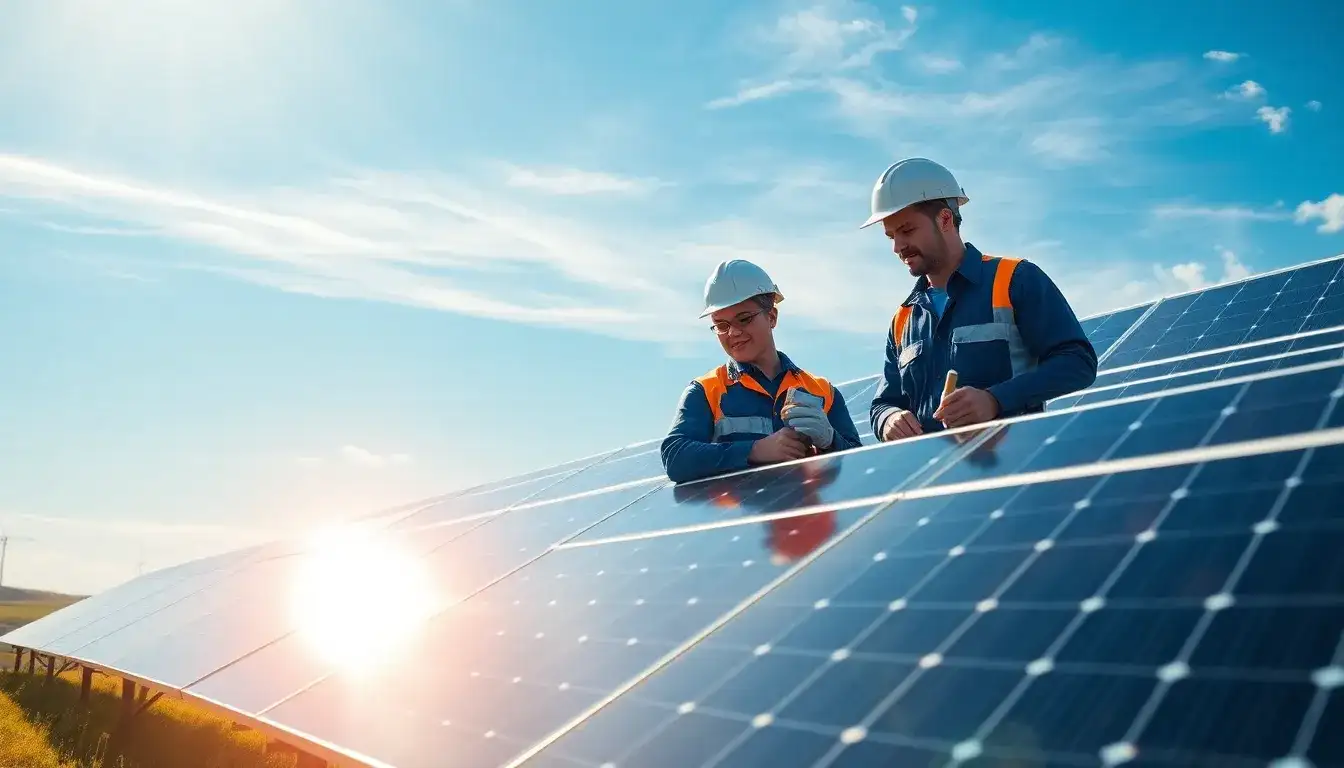
Recently, listed companies in China’s photovoltaic sector have begun to release their annual reports for 2024 and first-quarter reports for 2025. Trina Solar has stated in its report that to lead the development of new scenarios for solar energy and storage integration, the company plans to further optimize its business structure. This will create a four-dimensional business matrix that includes photovoltaic products, energy storage, system solutions, and digital energy services, aimed at achieving high-quality technological innovation and ecological collaborative development.
In recent years, China’s photovoltaic industry has experienced rapid growth. By the end of 2024, the cumulative grid-connected capacity of solar energy reached 887 million kilowatts, solidifying its position as the second-largest power source in the country and becoming a key component in building a new energy system. However, due to challenges arising from the international economic landscape, local repetitive layouts, and accelerated corporate expansions, issues such as supply-demand imbalances and intense competition have become increasingly prominent, presenting a challenge of “internal competition with external barriers.”
Statistics show that the monthly export value of photovoltaic components in 2024 was significantly lower than in the same period of 2023. While the output value of domestic photovoltaic manufacturing (excluding inverters) remained at a trillion yuan scale, it still saw a year-on-year decline. As a result, profit margins for companies have been severely compressed, leading to widespread losses in the industry.
In search of solutions to overcome this intense competition, many companies in the industry are accelerating their transformation on both the market and technological fronts. They are emphasizing self-discipline and fair competition to promote quality upgrades within the industry. For instance, in the market sector, Trina Solar is taking the lead in standardizing small, medium, and large-sized components across the industry. The company, in collaboration with leading industry players, has advocated for a 210 ecosystem model to co-create a friendly photovoltaic ecosystem. In 2024, Trina Solar’s 210 components achieved cumulative shipments of over 170 GW, maintaining its position as the industry leader.
At the same time, as renewable energy is increasingly integrated at large scales and high proportions, the demand for flexible adjustment resources in the power system has become urgent, prompting leading companies to accelerate their layout in solar energy and storage integration. According to Trina Solar’s 2024 annual report, the company’s energy storage installation capacity exceeded expectations, achieving over 100% growth, with energy storage shipments reaching 4.3 GWh, doubling compared to 2023. By the end of 2024, Trina Solar’s energy storage battery cabinets and systems had been sold in six major global markets, with cumulative shipments reaching 10 GWh. The company ranked among the top ten global energy storage system integrators in China, the UK, and Australia, and was included in the top ten for global shipments among Chinese energy storage companies in 2024. Trina Solar plans to continue its focus on the energy storage business, targeting shipments of 8 GWh to 10 GWh this year, and has recently secured a significant energy storage order in North America.
On the technological front, industry companies are actively laying out next-generation photovoltaic technologies to secure competitive advantages. According to patent application data for perovskite solar cells, released by the globally recognized intellectual property service provider IPRdaily, 16 out of the top 30 companies are from China. Trina Solar leads with 481 patents, surpassing Panasonic and Oxford PV, making it the only Chinese company in the top three for perovskite patents and ranking first globally, exceeding the second-place company by nearly 40%. Its independently developed 210 large-size perovskite/crystalline silicon tandem solar cell components have become the world’s first industrial-standard photovoltaic products to exceed the 800W power threshold. Moreover, its independently developed 210mm large-area perovskite crystalline silicon tandem solar cells achieved a maximum efficiency of 31.1%, setting new world records and representing comprehensive breakthroughs in both efficiency and power in the perovskite crystalline silicon tandem technology field. Currently, in mainstream battery technologies, Trina Solar ranks second globally in solar cell and module patents and is also second in the global TOPCon solar cell invention patent rankings, establishing a synergistic and high-quality development system that integrates technological research and development, intellectual property, and industry standards.
To promote healthy and orderly development in the photovoltaic industry, more companies are focusing on differentiated competition and exploring new development models that align with market needs. At the beginning of this year, Trina Solar achieved a strategic transformation, upgrading from a solar product manufacturer to a provider of integrated solar and energy storage smart energy solutions. The company is concentrating its efforts on distributed, centralized, and new scenario applications, fostering new growth areas such as smart microgrids, virtual power plants, source-network-load-storage systems, zero-carbon parks, green computing power, and green hydrogen production. This expansion aims to open new market spaces, continuously increase the proportion of new business, enhance industry profitability, and shift from “price competition” to “value creation,” thereby building a green and low-carbon energy supply system for end users.
Original article by NenPower, If reposted, please credit the source: https://nenpower.com/blog/trina-solars-energy-storage-expansion-navigating-challenges-in-the-photovoltaic-industry/

