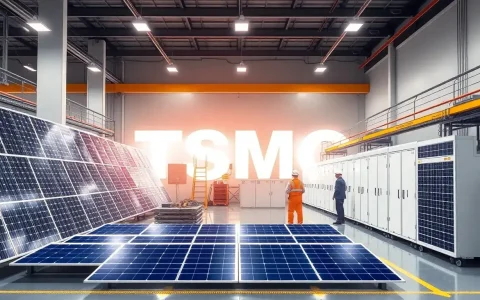
Trina Solar reported a net loss of 1.32 billion yuan in the first quarter, stating that “the competitive landscape of the industry will undergo fundamental changes in the future.”
On the evening of April 29, Trina Solar (688599.SH) released its annual report for 2024 and its quarterly report for the first quarter of 2025. In 2024, Trina Solar achieved revenue of 80.282 billion yuan, a decline of 29.21% year-on-year, and recorded a net loss of 3.443 billion yuan, a decrease of 162.30% compared to the previous year.
In the first quarter of 2025, Trina Solar, along with major component manufacturers such as JinkoSolar (688223.SH), JA Solar (002459.SZ), and LONGi Green Energy (601012.SH), all reported net losses. Trina Solar’s net loss of 1.32 billion yuan was the lowest among these companies, compared to 1.39 billion yuan for JinkoSolar, 1.638 billion yuan for JA Solar, and 1.436 billion yuan for LONGi Green Energy.
The losses were primarily attributed to the decline in the prices of photovoltaic components and provisions for credit and asset impairments. According to Trina Solar, the profitability of its photovoltaic component business has decreased due to the ongoing drop in prices, leading to an overall operating loss for the year. “Additionally, based on a principle of prudence, the company conducted impairment tests on long-term assets showing signs of impairment, which affected performance,” they stated.
Specifically, in the first quarter of 2025, Trina Solar made provisions for various credit and asset impairments totaling 359 million yuan, including 73 million yuan for credit impairment losses and 285 million yuan for asset impairment losses. In 2024, the total provisions for credit and asset impairments amounted to 3.106 billion yuan, with 508 million yuan for credit impairment losses and 2.598 billion yuan for asset impairment losses.
To further meet overseas localization demands, Trina Solar has strategically invested in overseas light manufacturing, establishing an intelligent tracking manufacturing plant in Saudi Arabia. The company has also secured multiple GW-level orders, enhancing local delivery and service efficiency to support global market share expansion.
Additionally, according to company reports, benefiting from the decline in prices of photovoltaic components and energy storage devices, Trina Solar acquired more than 5.7 GW of project indicators for wind-solar storage projects domestically. The company’s bracket business shipped 7.3 GW, ranking among the top five in regions such as Europe, Latin America, and the Middle East; and the cumulative shipment of energy storage containers and systems exceeded 10 GWh.
Looking ahead, the competitive dynamics of the industry are expected to change significantly. There has been ongoing debate within the photovoltaic industry regarding the next generation of photovoltaic technology. Currently, there is a consensus that domestic photovoltaic companies can be categorized into three types based on their technology stance: the TOPCon camp, represented by JinkoSolar and Trina Solar; the BC camp, represented by LONGi Green Energy and Aiko Solar (600732.SH); and the heterojunction camp, represented by Huasheng New Energy and LONGi Solar (300118.SZ).
In its latest 2024 annual report, Trina Solar stated that it expects TOPCon technology to maintain a dominant position in the coming years. “In the next few years, TOPCon will continue to hold a leading technical position,” the company noted, adding that the efficiency of mass production can be further enhanced through front-side texturing and passivation optimization, metallization processes, and low-temperature material applications.
Trina Solar also elaborated on its strategic focus on new perovskite photovoltaic technology in 2024, improving the conversion efficiency of perovskite-silicon tandem cells through techniques such as perovskite phase doping, interface treatment, component regulation, process control, and composite layer structure design. “With the addition of TOPCon to perovskite tandem technology, the theoretical conversion efficiency of photovoltaic cells could exceed 30%, laying the groundwork for the development of the next generation of perovskite tandem technology.”
In its 2024 report, Trina Solar indicated that, although all segments of the main photovoltaic industry chain are currently under profit pressure, they have reached the bottom price range, and end-market demand continues to be released. “The future competition in the photovoltaic industry will undergo a fundamental transformation,” the company stated. The focus will shift from merely supplying photovoltaic components to delivering comprehensive solutions for energy storage systems and integrated management capabilities. The improvement of company profitability will depend on multi-product technological realization and supply capabilities, maximizing system value, and offering full lifecycle solutions.
According to the China Photovoltaic Industry Association (CPIA), it is projected that by 2025, the Chinese market will see an additional installed capacity of 215 GW to 255 GW, maintaining a high level of new installations. Globally, the new installed capacity is expected to reach 531 GW to 583 GW, with rapid growth in demand from emerging markets such as Latin America and the Middle East.
Original article by NenPower, If reposted, please credit the source: https://nenpower.com/blog/trina-solar-reports-13-2-billion-yuan-net-loss-in-q1-predicts-fundamental-shift-in-industry-competition/