

MWC 2026 Observations: AI Reshaping Devices, Accelerated 6G Development, and Rapid Robot Applications
The 2026 World Mobile Communication Conference (MWC) concluded on March 5 in Barcelona, Spain, highlighting three key trends: AI is transforming device capabilities and forms, the telecommunications industry is actively promoting concurrent advancements in both 5G-A and 6G, and robotics are being integrated into an expanding array of real-world scenarios.
This year’s conference, themed “The IQ Era”, delved into six core topics, including Connect AI, AI 4 Enterprise, and AI Nexus, showcasing the profound changes brought about by the integration of artificial intelligence and communication technologies.
Over 350 Chinese companies participated in the event, spanning various sectors such as telecommunications, smartphone manufacturing, robotics, and chip production. A clear trend emerged: AI is becoming a native core capability of devices, driving comprehensive innovation and significantly extending the physical boundaries of hardware.
Trend 1: Transforming Device Forms – AI as a Human “Intelligent Partner”
At MWC 2026, it was evident that AI has become the fundamental capability of devices, enabling innovative functionalities and expanding hardware limits. Notably, companies like Honor and Xiaomi are reimagining the device ecosystem with AI as the underlying architecture, evolving devices from mere tools to “proactive intelligent partners.” These devices serve as multidimensional gateways connecting AI to the physical world.
Honor emerged as a focal point by introducing the Robot Phone, a smartphone integrated with a robotic camera system that can actively perceive its environment and follow moving objects. Honor’s CEO, Li Jian, emphasized that “phones should not be just a boring black rectangle with a touchscreen. We decided to give it a brain and limbs.”
The Robot Phone exemplifies Honor’s Augmented Human Intelligence (AHI) concept, which prioritizes a human-centric approach to AI, emphasizing not only intelligence but also emotional understanding and adaptability in a rapidly changing world. Li Jian articulated the need for a precise collaboration between personal intelligence, global intelligence, and edge intelligence to realize AHI.
As smartphone specifications have reached their limits and innovation has stalled, the launch of the Robot Phone is anticipated to inject new vitality into the market, with a planned release in China in the second half of this year.
Additionally, the Nubia M153 Bean Bag Phone Assistant made its overseas debut, sparking discussions about intelligent assistant permissions, data privacy, and app ecosystem compatibility. This product’s innovation lies in its deep system-level integration, allowing users to execute complex tasks across applications through natural language.
Major brands like Huawei, vivo, and Xiaomi also showcased their latest offerings. Huawei unveiled the global version of its Mate 80 series, marking its flagship smartphone’s return to the European market after three years. Xiaomi presented its “human-vehicle-home all-scenario” strategy, supported by its proprietary base model, MiMo. Vivo introduced the X300 Ultra, featuring a 400mm zoom lens to enhance its imaging capabilities.
AI hardware also saw significant advancements, with Alibaba’s “Thousand Questions” launching its first AI glasses, extending large model capabilities to wearable devices. Lenovo showcased several AI concept devices, including the ThinkBook modular AI PC and the AI Workmate.
While not all these concept products may reach mass production soon, they collectively indicate a shift away from fixed physical forms, with AI redefining device boundaries.
A driving force behind this trend is the enhanced computing power from chip manufacturers. Qualcomm released its Snapdragon Wearable Platform, empowering personal AI across various forms, including watches and pendants. MediaTek showcased AI smart glasses powered by the Dimensity 9500, capable of real-time translation and object recognition without internet connectivity, relying on local processing for image semantic segmentation.
This signifies that edge AI is becoming the core driving force for the independence of wearable devices, allowing smartwatches and AI glasses to gradually detach from smartphones and gain their own identities.
Trend 2: AI-Native Communication Infrastructure – Concurrent Development of 5G-A and 6G
The widespread adoption of AI devices and embodied intelligence has set new demands for communication networks, necessitating not only higher speeds and lower latency but also intelligent scheduling, computational collaboration, and scene adaptation capabilities. This year’s MWC marked a comprehensive shift towards an “AI-native” transformation in the telecommunications sector, with a dual focus on accelerating the commercialization of 5G-A and laying out strategies for 6G.
Akash Palkhiwala, CFO and COO of Qualcomm, stated that 6G will be the world’s first AI-native network, integrating connectivity with deep AI capabilities. He projected that AI will contribute about 30% of the anticipated tripling of global network traffic.
Yang Chaobin, CEO of Huawei’s ICT BG, revealed that the standardization process for 6G has officially commenced, with the first 3GPP standard version not expected to be finalized before March 2029. However, the next five years are crucial for the explosion of mobile AI business, making 5G-A an inevitable choice for industries.
The U6GHz frequency band has been established as a mainstream band for future mobile communications following extensive discussions at the World Radiocommunication Conference (WRC). Currently, 5G-A supports U6GHz, and the mainstream terminal chips and industry chain are maturing, paving the way for large-scale commercialization.
In response to the golden development window for 5G-A, Huawei presented a comprehensive product matrix covering macro, small, and microwave systems tailored to meet AI applications’ demands for high capacity and low latency.
China’s three major telecommunications operators have demonstrated the ability to scale AI-native networks. China Mobile has built the world’s largest 5G-A network, covering over 330 cities, achieving operational goals of “zero wait, zero faults, and zero contact.” China Unicom is integrating air, space, and ground networks in preparation for 6G, while China Telecom promotes the “full-space, full-access, and full-scenario” development concept for its 6G network.
Qualcomm and Ericsson are also accelerating their 6G initiatives. Palkhiwala noted that 6G will be built on three pillars: connectivity, computation, and perception, aiming for significant performance improvements in low and mid-frequency FDD spectrums. Qualcomm plans to unveil pre-commercial 6G terminals by 2028 and enter the commercial stage in 2029, while Ericsson collaborates with Apple and MediaTek to demonstrate its 6G capabilities.
Trend 3: Accelerated Application of Embodied Intelligence – Robots as Intelligent Gateways to the Physical World
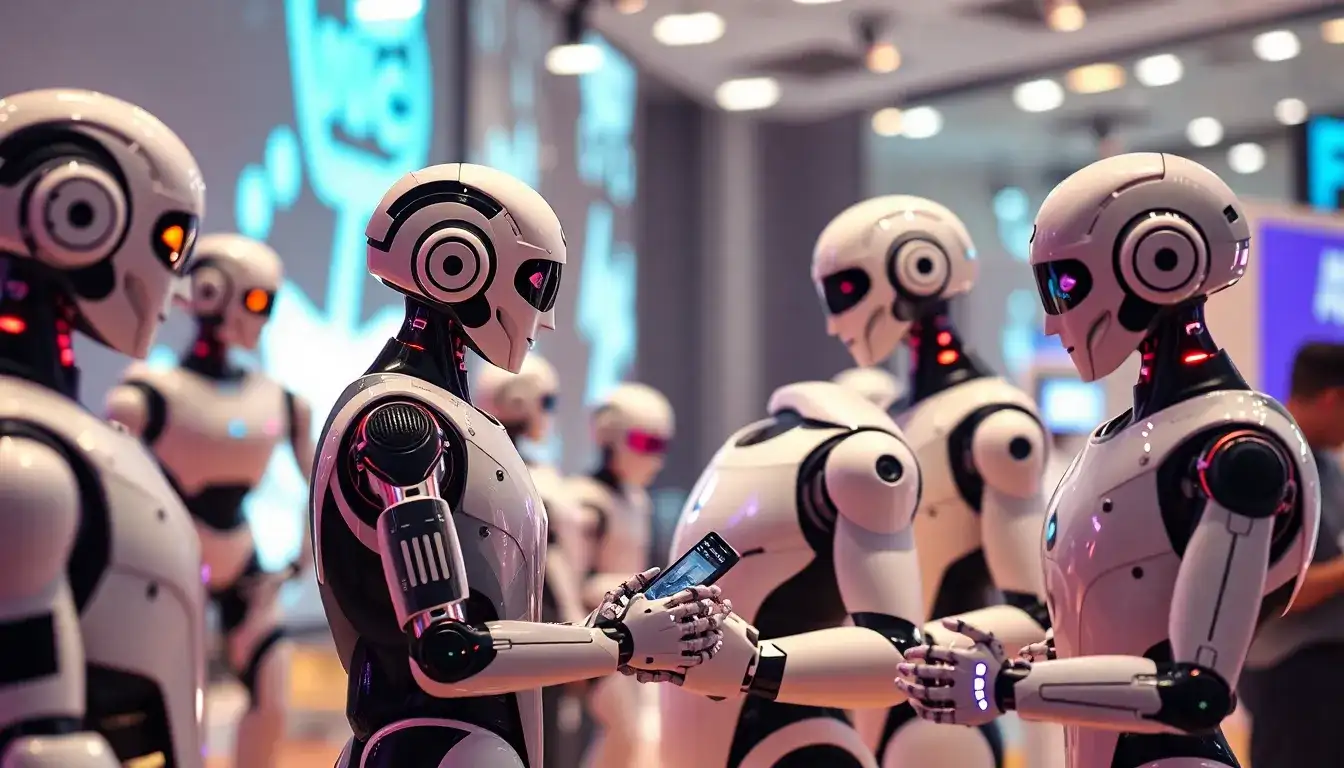
Numerous Chinese robotics companies, including Yushu, ZhiYuan, and the Beijing Humanoid Robot Innovation Center, showcased their technological innovations and practical applications in robotics at this year’s MWC. Honor also presented its humanoid robot, ROBOT.
ZhiYuan introduced a full range of general-purpose embodied robots. Their collaboration with China Telecom showcased the innovative achievement of a “6G + quadruped robot.” This quadruped robot serves as an “intelligent autonomous mobile platform” capable of operating in challenging environments, expanding its reach beyond structured scenarios to inaccessible areas like nuclear facilities, deep-sea oil platforms, and lunar bases.
Honor’s humanoid robot demonstrated a range of skills, including acrobatics, dancing, and interactive capabilities, marking Honor as the first smartphone company to enter the consumer humanoid robot market. They plan to explore shared intelligent services and AI ecosystem collaboration between smartphones and robots, fostering a “human-machine-environment” symbiosis.
The Beijing Humanoid Robot Innovation Center showcased its embodied TianGong 3.0 robot, which achieved significant breakthroughs in interactive physical control and autonomous tasks, leveraging its proprietary “HuiSiKaiWu” general-purpose intelligent platform.
Original article by NenPower, If reposted, please credit the source: https://nenpower.com/blog/trends-from-mwc-2026-ai-transforms-devices-accelerates-6g-development-and-expands-robotic-applications/

