

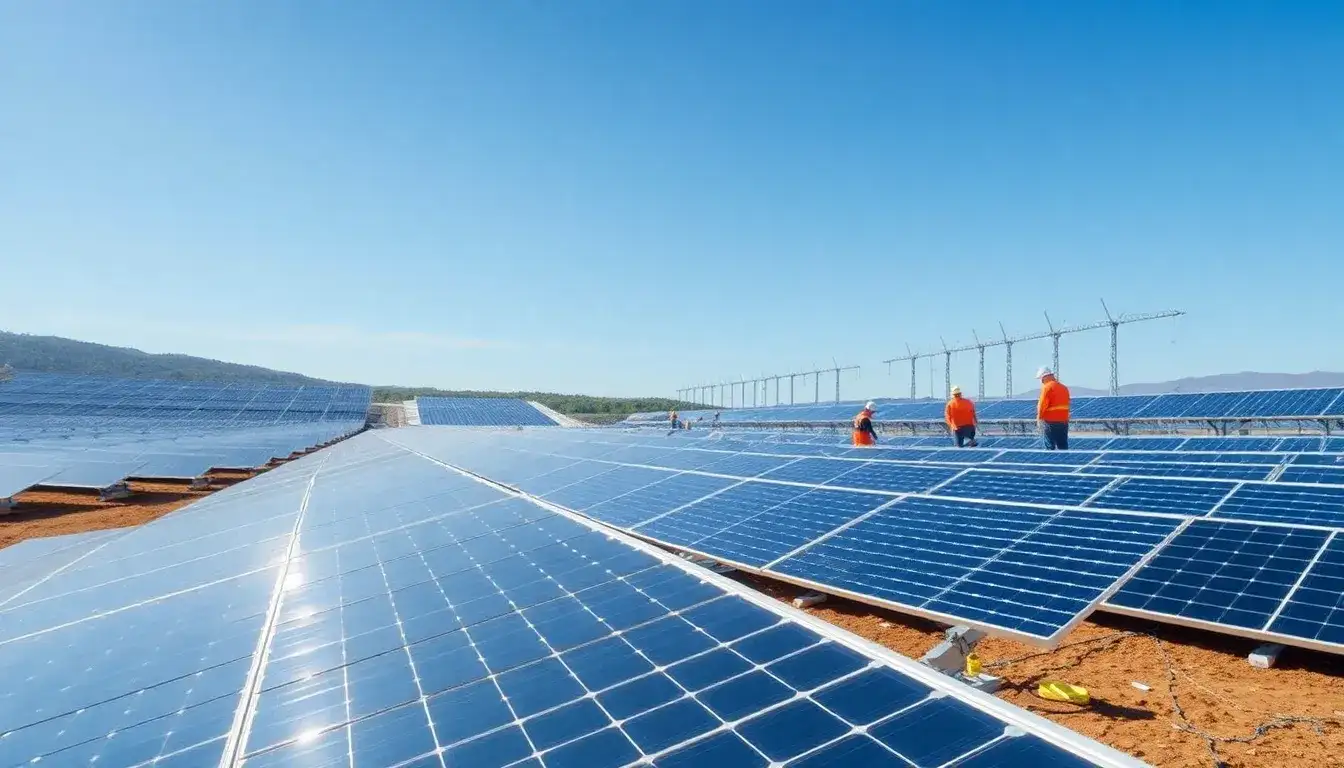
The photovoltaic (PV) industry is facing a challenge with over 100 GW of existing power plants encountering operational inefficiencies. As a result, a trend of upgrading solar modules by replacing smaller components with larger ones is emerging. By the first quarter of 2025, China’s total installed PV capacity exceeded 945 GW, with outdated solar plants that were connected to the grid prior to 2018 amounting to 174 GW, representing nearly 20% of the total. These older plants typically suffer from high efficiency degradation and low output value. Particularly, plants built before 2014 relied on multicrystalline modules that experience an average annual degradation of about 1%, leading to a significant decrease in module efficiency over time. According to calculations by Sunshine Wisdom, there is nearly a 10% efficiency gap between early mainstream modules and current models. Given the same land area and without changing the arrangement of modules, the output value per unit area of older plants is only 62%-72% of that of new plants.
However, the retrofitting of these older plants with upgraded modules is hampered by multiple factors, and the business model remains to be refined. While upgrading with larger modules can significantly enhance plant revenue, actual implementations often resemble “surgical” small-scale renovations. This approach minimizes operational pressure on companies but has notable drawbacks. Sunshine Wisdom points out that incremental upgrades have a typical window of opportunity. For instance, in the case of plants built in 2015, retrofitting typically begins in the 6th to 8th year. Considering the investment recovery period, any remaining lifespan of about 6 to 8 years makes retrofitting generally unsuitable, thus limiting the window for modifications to just a few years.
Furthermore, companies like Zhejiang Chint New Energy have observed that, even when factoring in the costs of upgrading components, the increase in electricity generation from simply replacing modules often does not suffice to cover the additional procurement and installation expenses, rendering the projects less economically attractive. Issues related to system compatibility are also critical, since new high-efficiency modules generally necessitate upgrades to inverters and mounting systems. These additional costs can substantially inflate the total investment needed for the project.
Moreover, deeper constraints arise from changes in the policy environment surrounding electricity market reforms. As solar energy gradually shifts from a fixed-price system to market-based transactions, the future revenue from electricity generation becomes increasingly uncertain. This policy shift complicates the decision-making process for plant owners considering retrofitting, making it challenging to accurately estimate the project’s lifecycle revenue and thereby suppressing investment willingness.
In addition to the aforementioned factors, practical limitations such as grid connection capacity constraints and land resource restrictions also hinder the implementation of retrofitting projects. Currently, PV plant renovations primarily fall into two categories: capacity maintenance at the original site and capacity expansion at the original site. Maintenance renovations maintain the rated capacity without increasing land usage, while capacity expansion maximizes land resource utilization and effectively enhances the power generation capacity per unit area. However, the management procedures for upgrading plants are complex and involve numerous regulatory changes related to capacity adjustments, grid connection system re-evaluations, and modifications to approvals and power purchase agreements.
Sunshine Wisdom recommends that if the AC-side capacity remains unchanged during module upgrades, the grid department should refrain from intervention. For upgrades where AC-side capacity is modified, as long as the structural capacity meets safety standards, it is advisable for the grid department to establish streamlined processes. For upgrades that do not meet the structural capacity requirements, they should be treated as new projects requiring full compliance with relevant regulations.
Regarding land lease renewal, Sunshine Wisdom states that, looking ahead, a PV plant designed for a 25-year lifespan can be built up to four times within a century. If the plant can renew its lease for an additional 10 years after the initial 25-year term, only three constructions would be necessary, thus saving on one construction investment and extending the window for module upgrades while improving economic efficiency.
Overall, under the current market conditions and policy framework, the upgrading of PV modules has yet to establish a sufficiently attractive business model. Chint New Energy emphasizes that developing a robust commercial model for module upgrades requires collaborative innovation across various segments of the supply chain. This includes leveraging technological advancements to reduce costs and advocating for clearer and more stable policy support to foster healthy market development.
Addressing the ‘last mile’ of module recycling is crucial for the survival of existing plants. According to the China Photovoltaic Industry Association, by 2025, the cumulative retirement of PV modules nationwide is expected to reach 9 billion watts, with over 2.7 billion watts slated for retirement that year. A report titled “2024 China Photovoltaic Recycling and Circular Economy White Paper,” published by the Photovoltaic Recycling Industry Development Cooperation Center, forecasts that in a scenario of early retirements, the cumulative market size for PV recycling could reach 26 billion yuan by 2030 and 420 billion yuan by 2050. Driven by market demand, policies related to module recycling are gradually being introduced. In August 2023, six ministries, including the National Development and Reform Commission, released guidelines to promote the recycling of retired wind and solar equipment, marking the first domestic policy document to encourage PV recycling. Furthermore, the 2024 document on “Large-Scale Equipment Renewal and Consumer Goods Replacement” also includes PV equipment upgrades and recycling in its support initiatives.
Despite the potential for a multi-billion yuan recycling market, China’s PV module recycling sector has yet to overcome the “last mile” issue, facing a complicated competitive landscape with varying recycling quality. Chint New Energy notes that the current recycling industry is under pressure from low-price competition, and significant improvements are needed in its profit models, supply chain organization, and technological capabilities. Currently, compliant large enterprises are scarce, and the industry is plagued by irregularities that result in inconsistent recycling quality. One New Energy concurs, stating that small operations employing low-cost, indiscriminate dismantling methods (such as burning and landfilling) are rapidly expanding, severely disrupting market order and causing environmental pollution. Conversely, legitimate companies face high environmental costs and operational expenses, often resulting in losses and hindering their ability to achieve economies of scale. Although policies are being rolled out, they lack enforceable entry standards and regulatory measures, leading to inadequate enforcement of industry norms and a fragmented recycling network with high logistics costs.
Currently, PV module recycling technology has developed into a systematic process comprising three phases: separation of junction boxes and frames, delamination of glass and back sheets, and refining of silicon metal. However, technological bottlenecks, such as the processing of fluorinated back sheets, remain unbroken and heavily rely on imported solutions. Additionally, insufficient recovery rates for precious metals also impact overall economic viability. One New Energy advocates for embedding green principles at the component development stage, such as using fluorine-free back sheets and lead-free soldering materials, to simplify dismantling processes and optimize module structural designs to enhance disassembly efficiency, which would aid in establishing a green circular economy within the PV industry.
In conclusion, establishing a comprehensive recycling system is crucial for achieving the green retirement of PV modules. One New Energy has innovatively created a “recycling-processing-regeneration” closed-loop system, leveraging an “Internet + Recycling” platform to collaborate with operational enterprises to build regional recycling networks. This allows for precise tracking of module retirement status and optimization of logistics radius, significantly reducing transportation costs. The mid-phase employs multi-level component sorting technology to extract PV-grade silicon powder with a purity of 99.5% and high-purity silver paste from waste modules, achieving a material recovery rate of 98%. The end phase directly supplies regenerated materials back to the production line, successfully mass-producing fully recycled modules with efficiencies reaching 20.7%, thus forming a virtuous cycle of “resources-products-regenerated resources.” Although the company has established core competitive advantages in recycling, collaboration with the industry is essential to jointly tackle challenges related to costs, standards, and policies. In terms of technological upgrades, there is a need to develop low-temperature pyrolysis processes and AI sorting technologies to further enhance precious metal recovery rates while reducing energy consumption and emissions. In terms of model innovation, promoting trade-in services and binding them to operation contracts can lower recycling costs. From a policy collaboration perspective, efforts should be made to establish a comprehensive lifecycle database for components, enhance carbon footprint accounting systems, and secure support from green finance.
Original article by NenPower, If reposted, please credit the source: https://nenpower.com/blog/transitioning-from-inefficient-old-solar-plants-will-large-scale-upgrades-become-the-norm-in-photovoltaic-technology/

