Technological Transformation in the Construction Industry: 3D Printing and Robotics Boosting Productivity
Local construction companies are actively exploring and adopting new technologies, such as 3D printing and painting robots, to meet increasingly complex operational demands. However, many contractors face significant pressure due to high initial investment costs and technological barriers in their transformation journey. The Straits Times spoke with three companies to understand their paths toward transformation.
Seng Soon Huat Construction Pte Ltd has implemented painting robots to enhance efficiency. These robots utilize cameras and sensors to automatically identify openings such as windows and doors. Each layer of paint is applied with a 50% overlap to ensure an even finish.
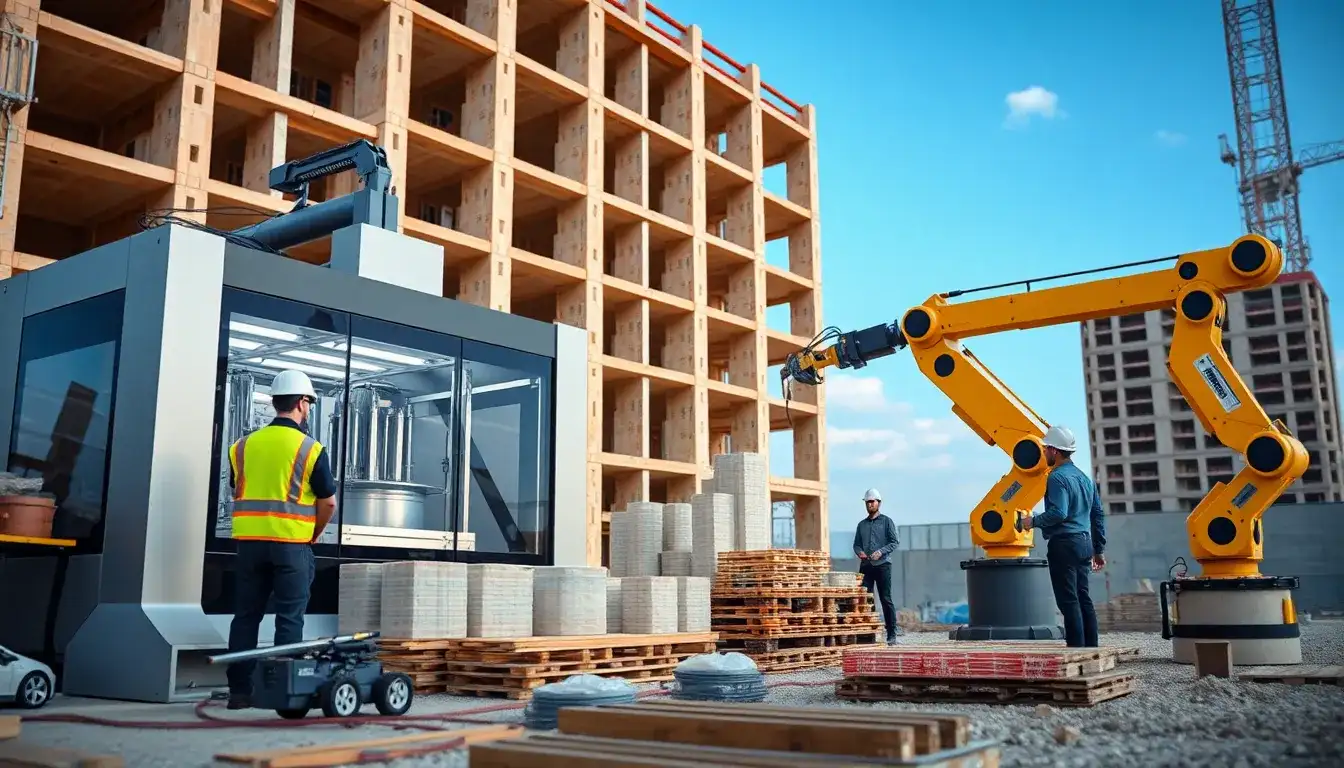
In cases where building structures feature complex curves or irregular designs, conventional carpentry can struggle to achieve precision. One local construction firm is attempting to overcome this issue by introducing a 3D printing robot for a new public housing project. BHCC Construction project manager Chen Xing shared that the company is collaborating with the National University of Singapore to employ 3D printing technology in constructing a wavy landscaped planter wall on the roof garden of a multi-storey car park in the Woodlands North Grove project. This wall, which stands less than one meter high and spans over 100 meters, is suitable for continuous 3D printing operations. Chen explained that 3D printing is more efficient for “long and low” walls compared to “short and high” walls, as cement requires 10 to 30 minutes to set. If the wall is too high, the lower layers must set before continuing to print. The lower height of the roof planter wall allows for uninterrupted printing.
Chen admitted that currently, the cost-effectiveness of 3D printing in Singapore is not ideal, as it is more expensive than traditional methods. Due to restrictions on the robot owned by the university, the company must either purchase, lease, or collaborate with suppliers for their own technology. Despite the substantial upfront investment, the company remains willing to invest in order to keep pace with cutting-edge market technologies.
In 2024, the firm had previously introduced a tile grouting robot in the Woodgrove Ascent public housing project. This AI-enabled robot weighs about 50 kilograms, can detect the floor through sensors, and automatically plans its grouting path. Workers simply need to load the materials and press the start button, allowing one operator to oversee multiple robots simultaneously. In terms of efficiency, while traditional manual grouting achieves 44 meters per hour, the robot can reach 62 meters, resulting in a productivity increase of approximately 40%. However, manual inspection and touch-up of corners are still necessary after the robot completes its tasks.
Chen emphasized that the automation of robot operations is a global trend in the construction industry, and local businesses are transitioning from traditional methods to digitalization and automation. The company aims to invest to stay ahead of the curve and use robots to replace repetitive and physically demanding tasks. Operations director Cai Junhao added that adopting technology is also a strategy to reduce reliance on foreign labor and alleviate the workforce shortage. With large projects like Changi Airport’s Terminal 5 and integrated healthcare facilities underway, the construction sector will face even greater labor shortages. “Particularly under tight deadlines, without advanced technology, we will struggle to deliver projects on time and may fall behind in competition,” he noted.
Seng Soon Huat Construction Pte Ltd‘s owner, Huang Yicheng, hopes to leverage automation to break industry norms and attract younger individuals to the construction sector. The company began discussions to introduce robots in early last year and imported its first painting robot from Germany in June, currently owning five of them. This painting robot can reach heights of 3.2 meters and operates autonomously by recognizing openings and following preset paths. Each layer of paint is applied with an overlap to ensure uniformity.
Huang pointed out that a robot can paint the walls and ceiling of a room in about 30 minutes, compared to an hour for traditional manual work, effectively halving the time required. Additionally, the quality of manual work can vary based on workers’ moods or experiences, whereas robots provide a more consistent finish, eliminating human error. “Previously, multiple workers were needed, but now one operator can manage the machine. When the machine is set to automatic mode, the operator can focus on other preparatory tasks, such as laying protective mats in the next room or preparing paint,” he explained. A single robot costs around 150,000 Singapore dollars, but they received funding through the Construction Productivity Innovation Project, making the actual cost comparable to four months’ worth of labor expenses. Considering that robots can be utilized for over two years with easy maintenance, Huang believes that the long-term economic benefits outweigh labor costs.
He added that as a labor-intensive industry, the introduction of automation technology is essential to address operational pressures and drive industry advancement. By transforming traditional physical labor into operations similar to “playing a game,” the company hopes to attract the younger generation who may not be interested in conventional manual labor.
Huang mentioned that they are also exploring the possibility of introducing robots for exterior wall painting, currently in discussions with suppliers for research and development. However, external wall robots are more complex and present greater challenges. “The difficulty with exterior wall painting lies in the numerous windows on buildings. While the robot can recognize windows, an excess of them may overload the system.”
Corrosion Proof Construction (Asia) Pte Ltd, which primarily provides floor coating services for the pharmaceutical and semiconductor industries, has introduced a ground grinding robot to assist with operations. During a project at a semiconductor factory last year, they achieved approximately a 60% increase in efficiency. General manager Luo Tianhan stated that the company introduced the ground grinding robot in early 2025, after learning about the technology at the end of 2024 and conducting a week-long inspection in China. Rising labor costs and a shortage of workers following the COVID-19 pandemic have prompted small and medium-sized enterprises to turn towards automation. Luo emphasized that as a labor-intensive industry, companies aim to reduce their dependence on human labor through technology. He noted that unlike manual labor, robots are not affected by fatigue, emotions, or physical conditions, ensuring consistent output. By setting predefined parameters, robots can deliver stable and uniform grinding results, which can be challenging for multiple workers operating manual machines to achieve consistently.
The company currently owns one ground grinding robot, which has shown significant results after its use in the semiconductor factory project last year. “According to the data we’ve observed, efficiency improved by about 60%. However, this is just preliminary data; we are still gathering more information, and the results so far are very encouraging.”
However, Luo mentioned that the robot measures about 200 cm long, 120 cm wide, and weighs approximately 1100 kg, making it suitable mainly for open areas. For more detailed tasks, such as around corners or columns, manual grinding machines are still required. “I believe technology can assist in many cases, but in the epoxy flooring industry, we still need to rely on human expertise and experience for judgment. Once epoxy materials cure, they cannot be altered, and any issues that arise during construction must be promptly identified and adjusted by experienced workers. This is something robots cannot yet achieve,” he concluded. The cost of a robot is around 60,000 to 70,000 Singapore dollars. He acknowledged that this is a significant upfront investment for small to medium-sized enterprises, but the company is utilizing grants from the Construction Productivity Innovation Project to offset some costs. He also mentioned that while the savings brought by robots may not translate to immediate visible benefits within a year, the company prefers to focus on the long-term investment value. He believes that as this technology matures and becomes more widespread, the anticipated adoption costs will decrease.
Original article by NenPower, If reposted, please credit the source: https://nenpower.com/blog/transforming-the-construction-industry-how-3d-printing-and-robotics-are-enhancing-productivity/