

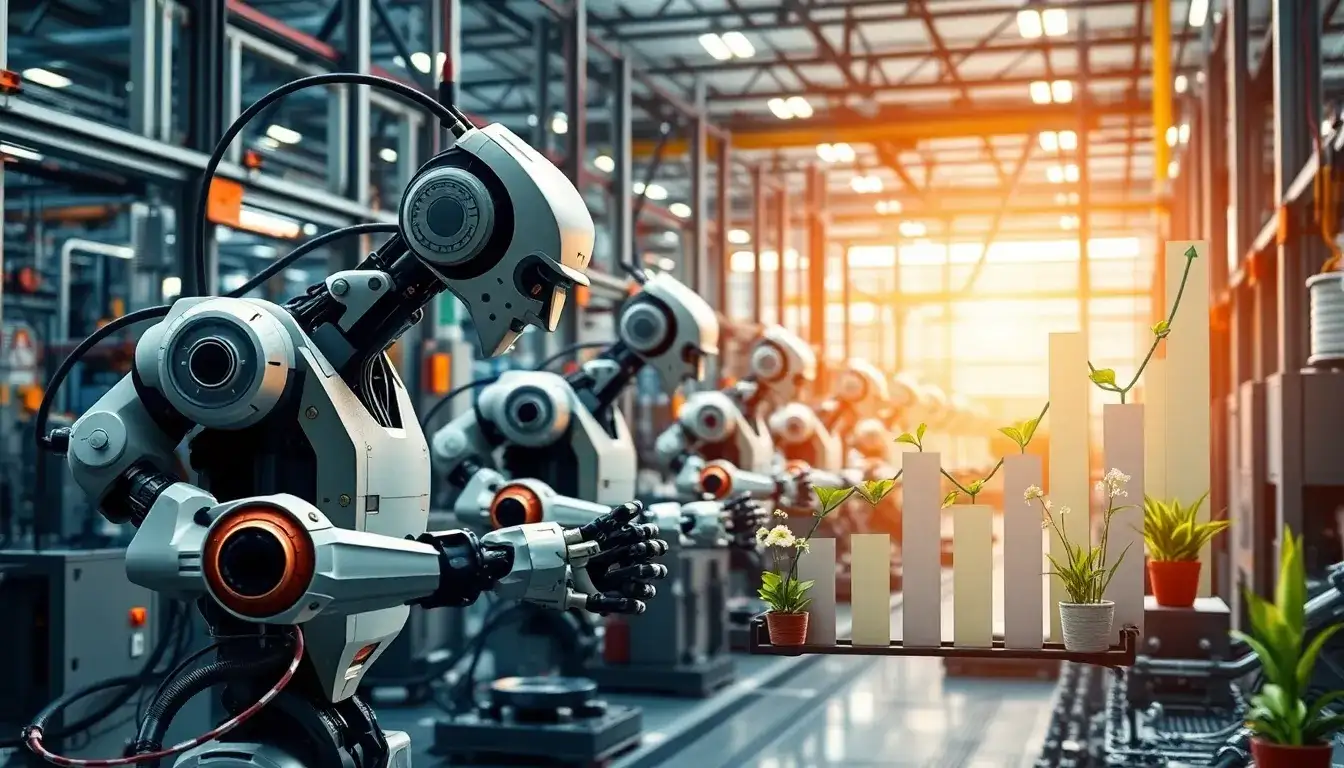
New Ideas Leading New Journeys: Extraordinary “14th Five-Year Plan” – Rapid Development of China’s Robotics Industry
General Secretary Xi Jinping attaches great importance to the development of the robotics industry, emphasizing the need to advance technological self-reliance and strive to overcome critical challenges in core technologies and equipment manufacturing. During the “14th Five-Year Plan” period, China’s robotics industry has focused on achieving self-reliance in technology, making significant advancements in key components, building industrial chains, and expanding application scenarios. As a result, it has emerged as a global hub for robotics technology innovation, high-end manufacturing, and integrated applications.
At the recent 2026 International Consumer Electronics Show, there were 38 exhibits dedicated to humanoid robots, with 21 of them originating from China. One notable innovation is the world’s first full-body force-controlled humanoid robot, standing at only 80 centimeters tall and easily fitting into a backpack when folded. Robots are often referred to as the “crown jewels of manufacturing,” serving as a crucial indicator of a nation’s technological innovation and high-end manufacturing capabilities.
Throughout the “14th Five-Year Plan,” Xi Jinping has visited various robotics-related companies to gain insights into their efforts in addressing core technological challenges. His guidance has instilled confidence and provided direction for the industry’s development. According to Wang Hong, Deputy Director of the Equipment Industry Department at the Ministry of Industry and Information Technology, Xi’s close attention and directives have solidified the confidence in advancing the robotics industry.
During this period, China has implemented a development plan for the robotics industry and launched the “Robotics+” industry application initiative. These efforts have led to simultaneous improvements in the scale, technological capabilities, and application levels of the robotics industry. For the first time, the market share of domestically branded industrial robots has surpassed 50%.
The “14th Five-Year Plan” outlines a clear goal to break through key technologies for intelligent robots, including advanced controllers, high-precision servo drive systems, and high-performance reducers. Over the past five years, China has continuously established special funds for related industrial development and created national and local joint innovation centers for humanoid robots, focusing on enhancing the domestic production levels of key components and the reliability of complete machines. Additionally, the formulation of relevant industry standards has been accelerated, resulting in over 220 national and industry standards being introduced to date.
The talent cultivation mechanism has also improved, with nearly 400 universities successfully registering “Robotics Engineering” programs and more than 700 vocational colleges offering industrial robotics technology courses. Supported by a series of policies, the comprehensive strength of China’s robotics industry has achieved a qualitative leap during the “14th Five-Year Plan” period.
Innovative technologies continue to break through barriers. Heavy-duty handling robots now boast a load capacity of up to 600 tons, while soft robots have achieved autonomous navigation at depths of 4,070 meters in the ocean. Special robots are being deployed in extreme environments such as plateaus, deep space, and polar regions, showcasing their vast capabilities. Today, China holds the largest number of robotics patents globally, with approximately two-thirds of the world’s robot patent applications expected to come from China by 2024. The country has cultivated 514 specialized “little giant” enterprises in the robotics sector and 19 manufacturing champions, continuously elevating the domestic production rate of robots.
Collaboration across the industrial chain is also accelerating. In Nanshan, Shenzhen, the entire chain from research and development to industrialization is nearly covered, with enterprises and research institutions located in close proximity. According to Nie Xiangru, co-founder of Pasini Perception Technology, nearly 80% of their upstream and downstream partners are situated nearby, allowing for rapid response to market demands and swift technology validation and pilot testing.
During the “14th Five-Year Plan,” the revenue of China’s robotics industry has doubled. Currently, over 2 million industrial robots have been deployed in production facilities, resulting in an average efficiency improvement of 35%. In remote desert areas, photovoltaic cleaning robots operate 24/7, increasing annual energy output by 12%. Maintenance robots have extended the observation time of the “China Sky Eye” by 30 days, while intelligent seedling inspection robots have enhanced inspection efficiency by five times.
From factories to fields, and from major national projects to daily services, the diverse application scenarios in China are continually driving the rapid growth of robotics. The “15th Five-Year Plan” is expected to recognize embodied intelligence as one of the forward-looking industries in its layout. In the next five years, China will accelerate the integration and innovative development of embodied intelligence, large models, and robotics technology, continually expanding application scenarios to further enhance the growth rate of robotics, and injecting robust momentum into the realization of new industrialization and comprehensive promotion of modernization in the Chinese context.
Original article by NenPower, If reposted, please credit the source: https://nenpower.com/blog/transformative-growth-in-chinas-robotics-industry-during-the-14th-five-year-plan/

