

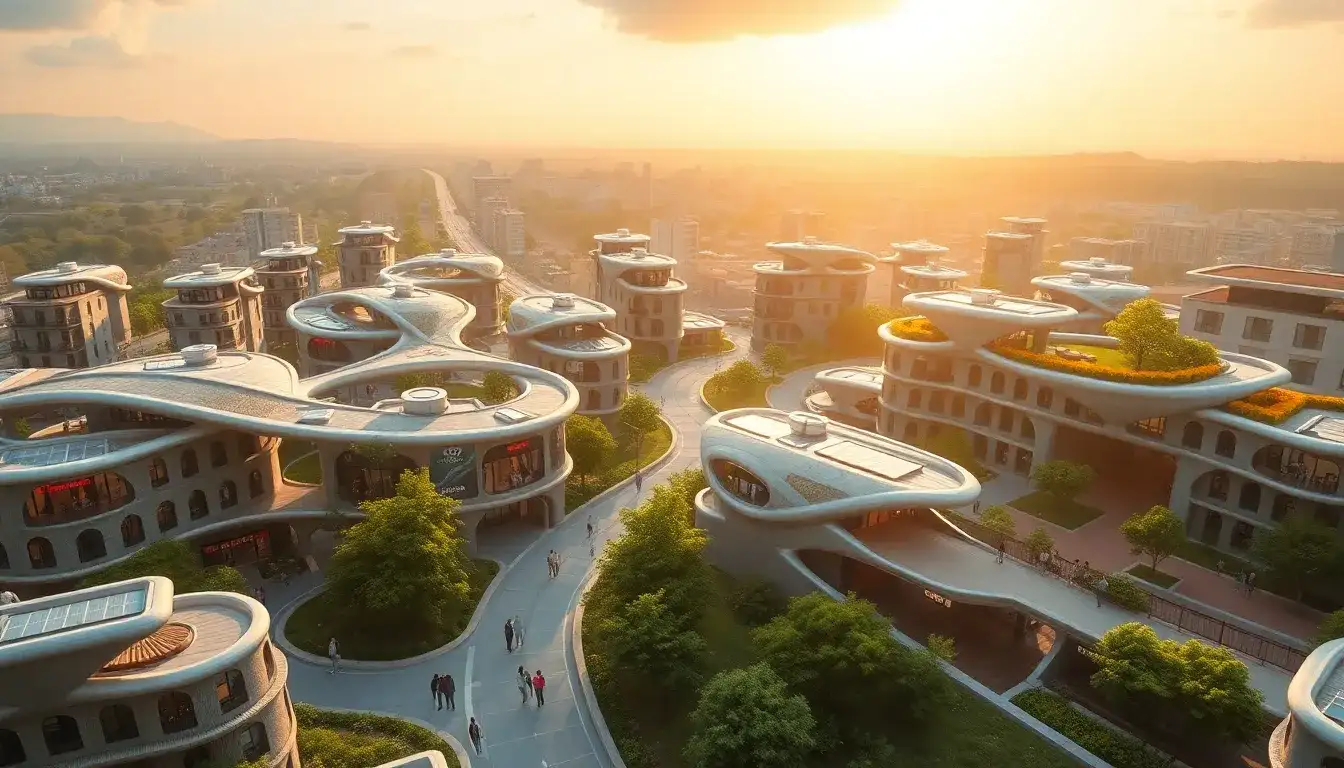
In 1968, Toyota’s Higashi-Fuji Plant was officially completed, producing its first product, the Mark II truck. Over the next 50 years, this plant manufactured a total of 7.52 million vehicles, establishing Toyota’s dominance in the global automotive market. After fulfilling its historical mission, Toyota decided in 2021 to build a “Woven City” on the site of the old Higashi-Fuji Plant. Recently, this city has officially opened. What ambitions lie behind Toyota’s investment of 101 billion USD (723 billion RMB) to create a city?
The Woven City is operated by Toyota’s subsidiary, Woven by Toyota, which is responsible for technological collaboration and development. Construction of the project began in early 2021 on the old site of the Higashi-Fuji Plant, starting with an initial area of approximately 50,000 square meters, which will eventually expand to around 700,000 square meters. The total investment in Woven City is 101 billion USD, and by October 2024, the first phase of construction will be completed. It is expected to receive Japan’s first “LEED Platinum” certification in early 2025. On September 25, 2025, Woven City welcomed its first residents.
So how does this “future city” differ from current urban environments? The primary energy source for Woven City is hydrogen. While electricity is still utilized, it is primarily generated from hydrogen. The homes where residents live are mainly powered by hydrogen and equipped with solar panels. Additionally, Toyota is constructing and operating hydrogen refueling stations around the city and will deploy stationary fuel cell generators.
The roads within Woven City are designed with a futuristic vision. Toyota has divided the streets into three zones based on three different modes of transportation. The most notable feature is the dedicated roads for autonomous vehicles. In this area, Toyota will test its self-developed e-Palette autonomous driving technology, while also conducting in-depth validation of hydrogen fuel cell vehicles. There are also pedestrian-only walkways and paths for small personal mobility devices such as bicycles and scooters.
In this era of connectivity, Woven City is equipped with a smart system that is pervasive throughout the area. Various sensors are integrated into the building exteriors and interiors, using Internet of Things technology to connect the entire city. Equipment suitable for empirical testing is found throughout the area, with adaptable traffic lights and poles that can accommodate sensors and cameras, and roads laid underground for autonomous delivery robots.
Robots within the developing Woven City interact deeply with their environment through the ubiquitous sensors and IoT technology. These robots will participate extensively in public space management, healthcare services, and daily household activities, performing a variety of functions to explore potential roles in future living.
Woven City is planned to ultimately accommodate approximately 2,000 residents. Why would a car manufacturer invest over 723 billion RMB to build a city? There are questions about whether Woven City can generate profits for Toyota. The company’s response is that there may not be immediate financial returns, but that’s acceptable; as a global citizen, Toyota feels responsible for investing in a shared future and sharing its knowledge and technology to support beneficial ideas for the planet and humanity, offering happiness through innovation.
From a business perspective, Woven City is more of a laboratory than a city. It breaks the limitations of closed testing environments, allowing Toyota to gather complex, real-world data that cannot be obtained in traditional labs or closed roads. For instance, when testing autonomous driving, car companies typically use closed locations, which cannot replicate the unpredictability of human behavior in real urban settings. Even when testing on public roads, they face restrictions from laws, risk management, and sensitive data, making extreme scenario tests impossible. Woven City provides Toyota with a “real-world” testing environment.
Within Woven City, Toyota can safely and repeatedly create various complex and even extreme traffic scenarios for testing, which would be impossible on public roads. Besides residents, Woven City also houses robots, smart homes, artificial intelligence (AI), and hydrogen energy technologies. This setup offers Toyota a cutting-edge platform for integrated testing of technologies.
In many other automotive companies, the departments for autonomous driving, robotics, and energy often operate independently, leading to challenging technology integration. However, Woven City places autonomous driving alongside robotics and hydrogen energy within the same physical space, compelling them to collaborate. Only when all technologies operate within the same ecosystem can systemic issues be exposed, and new, disruptive service models be created.
In the age of big data, the entities that control data have the power to define future products and services. By continuously operating Woven City, Toyota can collect comprehensive, multi-dimensional behavioral data from residents, covering everything from home life and travel to work and entertainment. Notably, in addition to residents, Woven City has also attracted 12 other companies, including space development innovator Interstellar Technologies and Denso, drawn to the innovative ecosystem that Woven City fosters.
Toyota has established an “Inventor’s Lab” within Woven City, integrating equipment such as 3D printers and laser cutters, supported by experienced technicians to assist in the full development cycle from prototype to mass production. Various public platforms in Woven City will also be open to startups. In the future, innovators can leverage Toyota’s manufacturing, software, and capital support, along with resident feedback, to continuously test and iterate technologies in areas such as autonomous driving, electric mobility, home health, smart fire protection, and food services.
Toyota’s construction of Woven City aims not only to serve its own development but also to create an innovative ecosystem that attracts more entrepreneurs. Woven City serves as an ideal “outpost” for scouting and investing, enabling Toyota to closely evaluate promising projects for strategic investment, acquisition, or deep collaboration, thus incorporating the most promising innovative technologies into its portfolio.
The establishment of Woven City is closely tied to Toyota’s vision for its future. In January 2018, then-President Akio Toyoda announced at a consumer electronics exhibition that Toyota would transform into a mobility company. How should we understand “mobility”? It is not merely about transporting people from point A to point B, but about providing efficient, practical, and enjoyable mobility for people, goods, information, and energy to enhance and improve lives. In other words, Toyota’s future positioning is not as a traditional car manufacturer or a ride-hailing platform, but as a technology company. The three main pillars of this vision are mobility, new energy, and robotics.
First, regarding mobility, manufacturing cars remains Toyota’s foundational business. The company has long been involved in autonomous driving. In 2019, Toyota began collaborating with Pony.ai to advance the development of high-level autonomous vehicles aimed at mobility services in China. The joint venture, ZhiFeng Intelligent Technology (Guangzhou) Co., plans to introduce a fleet of 1,000 of its Platinum 4X Robotaxis, providing safe, driverless transportation in major cities through Pony.ai’s operational platform. Looking ahead, Toyota’s mobility aspirations even extend into space. The company has ventured into the space sector, collaborating with the Japan Aerospace Exploration Agency (JAXA) to develop lunar rovers in support of NASA’s Artemis program. Through its subsidiary Woven by Toyota, the company invested approximately 7 billion yen (around 44.4 million USD) in the Japanese private space company Interstellar Technologies (IST), which successfully launched the MOMO-3 rocket in 2019, becoming Japan’s first privately developed liquid-fueled rocket to reach space.
Next, on the topic of new energy, Toyota is a staunch advocate of hydrogen energy. Over 30 years ago, the company made significant investments in hydrogen technology, holding 48% of hydrogen energy patents. Despite low sales of hydrogen vehicles, the long-term importance of hydrogen energy remains clear. According to estimates from the International Hydrogen Council, by 2050, hydrogen will account for 18% of the global energy terminal demand and generate over 2.5 trillion USD in market value, with fuel cell vehicles projected to comprise 20-25% of global vehicles. At that point, hydrogen energy will stand alongside gasoline and diesel as a leading terminal energy source.
Lastly, regarding robotics, Toyota has been developing partner robots to assist individuals with disabilities and the elderly since 2004. Looking to the future, Toyota is expanding the applications of robotics. During the Tokyo 2020 Olympics, Toyota’s robots provided support services for interactive communication, remote operation, and event management. Recently, Toyota Research Institute, a subsidiary of Toyota, announced a significant advancement in the field of robotics and artificial intelligence in collaboration with Boston Dynamics. This deep partnership aims to equip Boston Dynamics’ renowned Atlas humanoid robot with a new AI system driven by large behavioral models. This breakthrough marks a critical step toward making Atlas a versatile humanoid robot capable of handling diverse tasks, demonstrating Toyota’s strong capabilities in robotics research.
As global technology enters a phase of multi-domain innovative integration, technologies such as artificial intelligence, autonomous driving, and new energy are no longer developing in isolation but are deeply intertwined, blurring the boundaries of traditional industries. Whether it’s Xpeng Motors developing flying cars or Li Auto venturing into robotics, Chinese automotive companies are also positioning themselves for new tracks. Toyota is taking it a step further by integrating smart driving, hydrogen energy, robotics, and smart home technologies into real urban living through Woven City. This not only explores patterns of technology integration shaping the future but also positions Toyota to seize control over the reconstruction of future industries. Toyota’s ambitions are indeed substantial.
Original article by NenPower, If reposted, please credit the source: https://nenpower.com/blog/toyotas-ambitious-10-billion-woven-city-a-vision-for-the-future-of-urban-living/

