

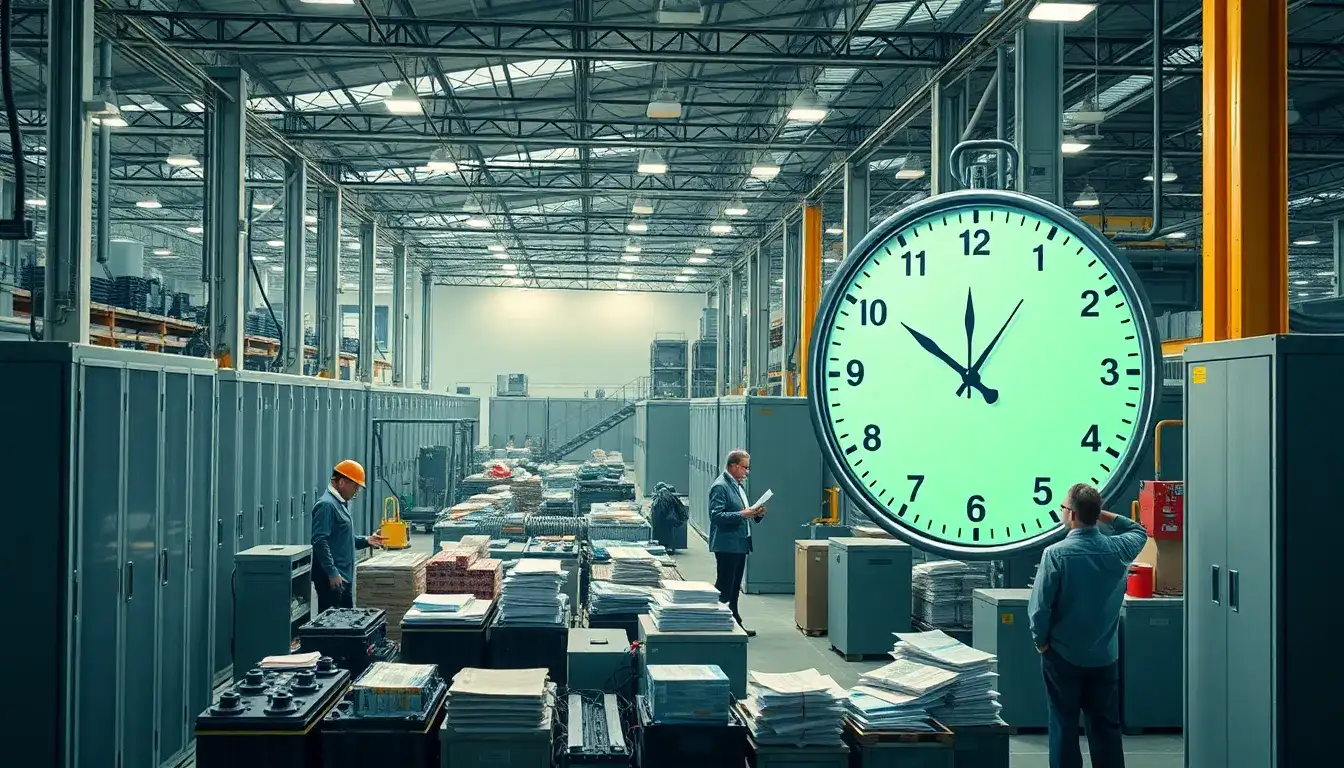
The time is running out for commercial and industrial energy storage equipment manufacturers as they face underwhelming performance and a pressing need for new narratives. The competition is becoming increasingly fierce, with prices continually dropping. Simply selling equipment has become unprofitable, and when operational costs are factored in, many companies find themselves at a loss. A sales representative from a commercial energy storage system integration company mentioned at a recent exhibition that the gross profit from several pieces of equipment could quickly be consumed by just a few additional site visits from maintenance personnel. This scenario is not an isolated case; it is becoming a widespread issue across the entire commercial energy storage sector.
On one hand, the domestic commercial energy storage market is in intense competition, with prices spiraling downwards – there is no bottom in sight, as prices have now entered the 0.4 yuan/Wh era. During the recently concluded ESIE 2025, several commercial energy storage system integrators continued to promote their pricing strategies. On the other hand, the overall growth of the commercial energy storage market in 2024 has not met the expectations of system integration companies, leading to disappointing development outcomes. Many investors are tightening their purse strings regarding commercial energy storage projects, with some even declaring that they will no longer invest in this sector.
Consequently, an increasing number of commercial energy storage system integrators are choosing to abandon their roles as mere equipment suppliers, aiming instead to position themselves at the core of energy storage operations. They are looking to develop a dual-core model of “equipment + operations.” This shift is both a necessary response to market pressures and an urgent requirement for survival. For example, Jiangsu Beiren, which entered the commercial energy storage market, has proposed an integrated business model that encompasses product design, production line research and development, supply chain management, large-scale manufacturing, asset ownership, and asset operations.
The time for pure commercial energy storage equipment manufacturers is running out. They face a dilemma: whether to cling to their positions amidst the price wars or to adapt to the prevailing trends and seek profits in asset operations. Finding new avenues for growth is imperative.
The growth “crisis” facing the commercial energy storage industry chain and system integration companies has been foreshadowed for some time. The most immediate concern is pricing. In 2023, commercial energy storage system prices were still significantly high, reaching 1.5 yuan/Wh, and some companies even quoted 1.8 yuan/Wh. This was largely because there were few players focused on commercial energy storage at that time, creating a seller’s market where clients were not yet clear about applications, scenarios, and returns, allowing for acceptance of high-priced products. However, as more entrants have flooded the market, competition has intensified, and technological advancements have driven system prices down from 1 yuan/Wh at the beginning of 2024 to below 0.6 yuan/Wh by year-end. By 2025, many companies are announcing shockingly low prices below 0.5 yuan/Wh.
In stark contrast to these low prices are the costs associated with commercial energy storage systems. A leading energy storage system integrator recently calculated the BOM (Bill of Materials) cost for commercial energy storage system hardware, finding that the cost is around 0.51-0.53 yuan/Wh, which is close to the overall cost of the equipment. Although recent advances in technology and expanded application scales have contributed to the decline in energy storage costs, fierce market competition and the influx of numerous cross-industry players have led to a prevalence of businesses operating at a loss while still attracting attention.
According to Ma Jinpeng, President of New Energy Storage’s China Division, some companies relying solely on low prices for visibility are unlikely to achieve profitability, which is detrimental to the long-term development of the industry. Yang Xiaoguang, Deputy General Manager of Hongzheng Storage, also emphasized that companies should strive for reasonable gross margins by enhancing the value of their products and services rather than engaging in price wars. The core issue is that commercial energy storage, as the most market-driven segment, primarily relies on local policy subsidies and the price differences between peak and off-peak electricity to generate profits. In this chain, equipment manufacturers find themselves in a relatively weak position, while owners, intermediaries, and operators hold market advantages, capturing most of the profits, leaving the cost pressures to be absorbed by the equipment providers.
It is important to note that the challenges faced by commercial energy storage system integrators are not due to lack of effort. Research from High-Tech Energy Storage indicates that many companies have focused on reducing costs and improving efficiency since last year, whether through technological iterations, supply chain optimization, or internal cost-cutting measures. In fact, they have nearly reached the “extreme” in cost reduction. Alongside this, commercial energy storage companies are actively exploring new application scenarios and higher-margin overseas markets to enhance profitability. However, due to various constraints, the results have not been as significant as desired.
In summary, the declining profitability of commercial energy storage system integrators points to a core contradiction within the industry: it still heavily relies on equipment sales as the main driver, which yields little value. Therefore, the path forward for these companies is clear: they must seek more robust growth engines by extending their reach from the low-margin manufacturing end of the industry chain to the higher-margin operational end.
Looking ahead to 2025, the potential for commercial energy storage operations is significant. Historically, equipment manufacturers participating in operations is not unprecedented. However, the current focus on commercial energy storage system integration companies is driven by the changing demands of commercial energy storage scenarios and the evolution of the industry chain ecosystem. Notably, the issuance of Document No. 136 by the National Development and Reform Commission and the National Energy Administration, which removes mandatory configurations and fully opens the market for new energy, indicates a rapid transition from “policy-driven storage” to “value-driven storage.” Commercial energy storage stands at the forefront of exploring diversified revenue streams.
As the power market shifts towards spot trading, the revenue streams for commercial energy storage will expand from the currently dominant peak-valley arbitrage to demand response, spot trading, and ancillary services. Participation in operations is undoubtedly a crucial foundation for this exploration. Feng Anhua, Chairman of Hongzheng Storage, noted in an interview that the future landscape of commercial energy is likely to evolve from price competition to capability competition, especially as the push for market-oriented electricity increases the demands on system capabilities.
Research indicates that Hongzheng Storage is already assisting several partners in constructing virtual power plant aggregations and platforms (VPP). The company plans to first act as a load aggregator to enhance equipment aggregation capabilities and ensure precise device parameters, enabling rapid response and dispatch capabilities, eventually transitioning from invitation-based demand response to spot market and ancillary service markets. Ma Jinpeng also revealed that New Energy Storage is currently participating in asset operations through alliances and may further delve into operational aspects in the future. High-Tech Energy Storage has found that Qidian Energy is also applying to participate in virtual power plant trading as a secondary aggregator in the Jiangsu and Zhejiang regions.
Ronghe Yuanchu, the top five commercial energy storage system supplier by shipments in 2024, has adopted “to be the most operation-savvy energy storage service provider” as its core philosophy. By the end of 2024, its operational asset scale had surpassed 5.5 GWh. At the recent ESIE 2025, Ronghe Yuanchu’s AI-enabled smart trading and VPP operation platform was officially upgraded and launched, providing full lifecycle services for energy storage from solutions to delivery and grid connection to asset operations.
Jingkong Energy’s Deputy General Manager, Wang Chenqi, told High-Tech Energy Storage that the next step for the company is to transition to an energy aggregator. However, even with the recognition of the operational value of commercial energy storage, it does not guarantee that all equipment manufacturers will successfully seize operational opportunities. A critical question remains: how should commercial energy storage companies with varying development philosophies, technological backgrounds, and scales manage to excel in operations and capture growth opportunities? Undoubtedly, the time for pure commercial energy storage equipment companies is indeed running short.
Original article by NenPower, If reposted, please credit the source: https://nenpower.com/blog/time-is-running-out-for-commercial-energy-storage-equipment-suppliers-as-industry-faces-profitability-challenges/

