

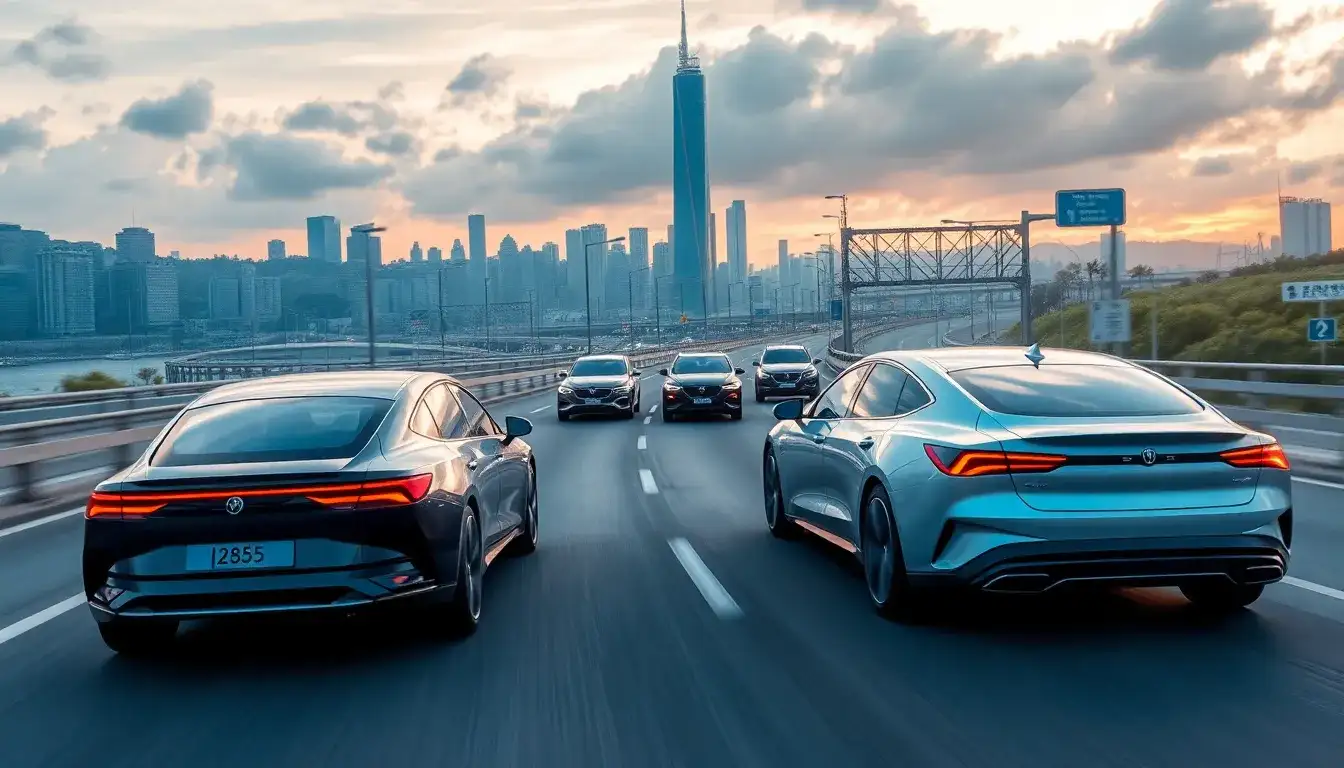
The Global Expansion of China’s Intelligent Vehicles
China’s intelligent vehicles are quietly making their mark on the international stage, encompassing the direct export of autonomous driving technology and smart driving products, the physical establishment of intelligent manufacturing, and the globalization of automotive cloud services.
As Chinese automotive companies pursue their global ambitions, they have successfully achieved a global presence in technology, manufacturing, and services, thus enhancing their competitiveness.
However, the international expansion of China’s intelligent vehicles still faces numerous challenges, including differences in international regulations and standards, geopolitical risks, trade friction, and the need to build brand trust.
To overcome these obstacles, Chinese automotive companies must remain persistent and innovative, striving to cross both technological and geographical barriers to reach global markets.
When discussing the overseas expansion of China’s new energy vehicles, the focus often lies on electric technologies such as power batteries and motor control systems. Brands like BYD, NIO, and Xpeng have rapidly expanded into foreign markets, earning China a reputation as a leader in electric vehicles. Yet, a profound and lesser-known transformation is taking place: as competition in the new energy vehicle sector intensifies, driven by pressures from new regulations and policies, China’s intelligent vehicles are also entering the global market.
In the bustling commercial districts of Dubai, autonomous driving fleets like ‘LuoBo Kuaipao’ navigate seamlessly. In Thailand’s Rayong industrial park, BYD’s factory operates around the clock, supplying smart electric vehicles to Southeast Asia. Meanwhile, in Frankfurt, Germany, Huawei Cloud’s servers process vast amounts of data from European vehicles, providing cloud support for brands thousands of miles away. Unlike the visible electric technologies, the capabilities of intelligent vehicles resemble an iceberg—massive yet largely hidden beneath the surface.
First Wave: Intelligent Driving Technology Goes Global
The first wave of China’s intelligent vehicle export focuses on the overseas deployment of autonomous driving technologies and smart driving products. Early entrants like Xpeng and NIO initially positioned intelligent driving as a unique selling point in foreign markets, which has since evolved into a diverse array of smart products, including Robotaxi services.
On one front, the commercial model of autonomous taxis has flourished internationally. ‘LuoBo Kuaipao,’ derived from Baidu Apollo’s driverless vehicle project, has gradually expanded its services in cities like Singapore and Dubai. In March 2025, ‘LuoBo Kuaipao’ announced the deployment of 1,000 autonomous vehicles in Dubai, marking Baidu’s first large-scale overseas testing and service initiative—a clear indication of their ambition for global expansion. According to Baidu’s Q1 2025 financial report, ‘LuoBo Kuaipao’ has completed over 140 million autonomous driving orders, providing a total of over 1.1 billion rides.
Xiaoma Zhixing has partnered with international giants like Uber to conduct road tests and launch their seventh-generation automotive-grade autonomous driving system in regions such as the Middle East and Europe. The seventh-generation Robotaxi has achieved full-scene, all-weather L4 autonomous driving on automotive-grade chips, with three times the inference optimization and a total cost reduction of 70%. By Q1 2025, Xiaoma Zhixing’s Robotaxi service revenue surged from 4.8% the previous year to 12.1%, with plans to expand their fleet to 1,000 vehicles and gradually enter North America and Southeast Asia.
On another front, vehicles equipped with intelligent driving capabilities are also making strides. Zeekr, focusing on the European premium car market, has collaborated with Qualcomm to develop future-oriented smart cabins using the Qualcomm 8295 smart cockpit computing platform. They also partnered with NVIDIA to launch the world’s first mass-produced self-developed NVIDIA DRIVE AGX Thor intelligent driving domain controller platform. Additionally, in collaboration with Waymo, Zeekr is set to deliver the world’s first mass-produced native autonomous vehicle, the Zeekr RT.
As of the end of 2024, Zeekr has entered over 40 countries and regions, including Sweden, Australia, the UAE, Singapore, Mexico, and Egypt, establishing a global sales network.
The first wave of exports has highlighted a clear market segmentation: in the European premium market, Chinese automotive companies focus on advanced autonomous driving and luxury smart cabin experiences, while in emerging markets like Southeast Asia, the emphasis is on cost-effective basic intelligent connectivity features.
As intelligent driving pioneers venture abroad, Chinese intelligent vehicle manufacturers are also taking action.
Second Wave: Manufacturing Plants Expand Internationally
If the first wave represents a virtual expedition into technology, the second wave signifies the physical march of intelligent manufacturing. Chinese automotive companies are no longer content with merely selling products abroad; they are establishing entire intelligent factories in foreign countries.
In July 2024, BYD’s factory in Rayong, Thailand officially commenced operations, with a total investment exceeding 35 billion Thai Baht (approximately 6.98 billion RMB) over an area of 65,000 square meters, and an annual production capacity planned for 150,000 vehicles. From inception to production, the factory was completed in just 16 months, setting a record for the fastest investment return by a Chinese automotive company in Thailand. This facility encompasses stamping, welding, painting, and assembly processes, integrating the production of core components such as batteries, motors, and electronic controls to achieve localized production across the entire supply chain.
In support of this overseas expansion, BYD has also developed its own fleet. On April 22, the world’s largest car transport ship, the ‘Shenzhen,’ officially set sail, marking BYD’s fourth specialized vehicle transport vessel. In the marketplace, BYD’s performance has been impressive, achieving a market share of 30%. In Thailand, for every three electric vehicles sold, one is a BYD. The projected 2024 gross profit margin in overseas markets is an impressive 28.87%, significantly surpassing domestic levels.
BYD’s overseas factory strategy has effectively capitalized on the opportune moment, constructing bridges to global markets. By 2025, BYD had established and brought into operation two factories in Thailand and Uzbekistan, with ongoing construction of four additional plants in Brazil, Hungary, Turkey, and Indonesia, and plans to advance site selection for facilities in Mexico and Cambodia. By situating intelligent factories in Thailand and similar markets, Chinese automotive companies have achieved several critical objectives: avoiding trade barriers and benefiting from regional free trade agreements.
Vehicles manufactured in Thailand can be exported to ASEAN countries with zero tariffs. By establishing a presence in Thailand, BYD can leverage these policy benefits to reduce export costs, creating regional supply capabilities to serve Southeast Asia, the Middle East, and even Europe.
After establishing intelligent manufacturing plants in Thailand, Chinese automotive companies can utilize Thailand as a base to develop strong regional supply capabilities. Models such as BYD’s right-hand-drive Seal EV not only meet the demands of the Thai market but can also be exported to ASEAN countries, Australia, and the Middle East.
The establishment of local production for components promotes the globalization of China’s automotive parts system. As Chinese automotive companies build and operate intelligent factories overseas, an increasing number of Chinese auto parts manufacturers are following suit and investing in factories in Thailand. Localized production of components not only reduces transportation costs but also enhances the stability of the supply chain.
As Chinese automotive companies transfer both their intelligent vehicles and manufacturing capabilities abroad, a more critical question arises: where will the massive amounts of driving data generated by autonomous vehicles go each day? What will support the upgrades of the intelligent driving systems in countless vehicles?
Third Wave: Autonomous Driving Demands Cloud Services
As the trends of intelligent driving technology and manufacturing plant expansion gain momentum, a third wave has quietly emerged: the globalization of automotive cloud services. Why is cloud technology critical for this expansion? Numerous intelligent vehicles located overseas require cloud connectivity for data processing and intelligent driving upgrades.
A single L4 autonomous vehicle generates between 10 to 20 TB of data daily, encompassing crucial information such as high-definition map updates, traffic scenario learning, and user behavior analysis, equivalent to 5,000 hours of high-definition video. Without cloud support, the processing of data, algorithm iterations, and user experience upgrades for intelligent vehicles abroad would be bottlenecked, stifling their evolutionary potential.
Consequently, Chinese cloud service providers like Huawei Cloud and Alibaba Cloud are strategically developing global digital infrastructure for Chinese automotive companies venturing overseas. Huawei Cloud offers a comprehensive range of services, including autonomous driving algorithm training, vehicle network data processing, and industrial internet platforms for intelligent manufacturing, delivering full-stack digital capabilities and one-stop solutions. With local data centers established in Singapore, Germany, and the UK, Huawei Cloud ensures that data remains within borders while reducing latencies between any two global nodes to under 50 milliseconds.
Currently, Huawei Cloud covers 96 available zones across 33 geographical regions worldwide, boasting over 170 service centers and collaborating with more than 3,000 local ecosystem partners to provide 24/7 cloud computing services for international automotive enterprises. In 2024, Huawei Cloud’s overseas revenue grew by over 50%, serving 140 global operators and 500 financial clients, with over 90% of the top 30 Chinese automotive companies choosing Huawei Cloud.
The significance of the cloud service expansion goes beyond surface-level observations. The digital bridges constructed by cloud providers for overseas enterprises not only offer computing power and storage but also create a digital ecosystem connecting vehicles, users, services, and infrastructure. From training autonomous driving algorithms to processing vehicle network data and supporting industrial internet platforms, the cloud provides a comprehensive solution for automotive companies, allowing them to compete effectively globally under a ‘software-defined vehicle’ model.
Conclusion
As China’s new energy sector enters its next phase, the international expansion of intelligent vehicles is surging forward. The three waves of China’s intelligent vehicle export are not isolated events but rather mutually supportive and collaborative advancements. The first wave of intelligent driving technology serves as a vanguard, with autonomous taxis and intelligent vehicles establishing a presence abroad and enhancing China’s reputation in intelligent driving. The second wave of manufacturing plant expansion replicates China’s production and supply chain advantages internationally, creating a multifaceted competitive edge of ‘technology + manufacturing.’ The third wave of automotive cloud services constructs a global data network and service ecosystem.
Chinese automotive companies can now analyze global market demands in real-time, swiftly adjust products and services, and transition from merely selling products to providing comprehensive solutions.
However, the journey is not without its challenges. The international expansion of China’s intelligent vehicles continues to face various hurdles, including differences in regulations and standards, geopolitical risks, and the need for brand trust. Only through persistence and continuous research can Chinese automotive companies navigate the technological mountains and seas, reaching distant shores and the ends of the earth.
Original article by NenPower, If reposted, please credit the source: https://nenpower.com/blog/the-three-waves-of-chinas-smart-automotive-expansion-abroad/

