

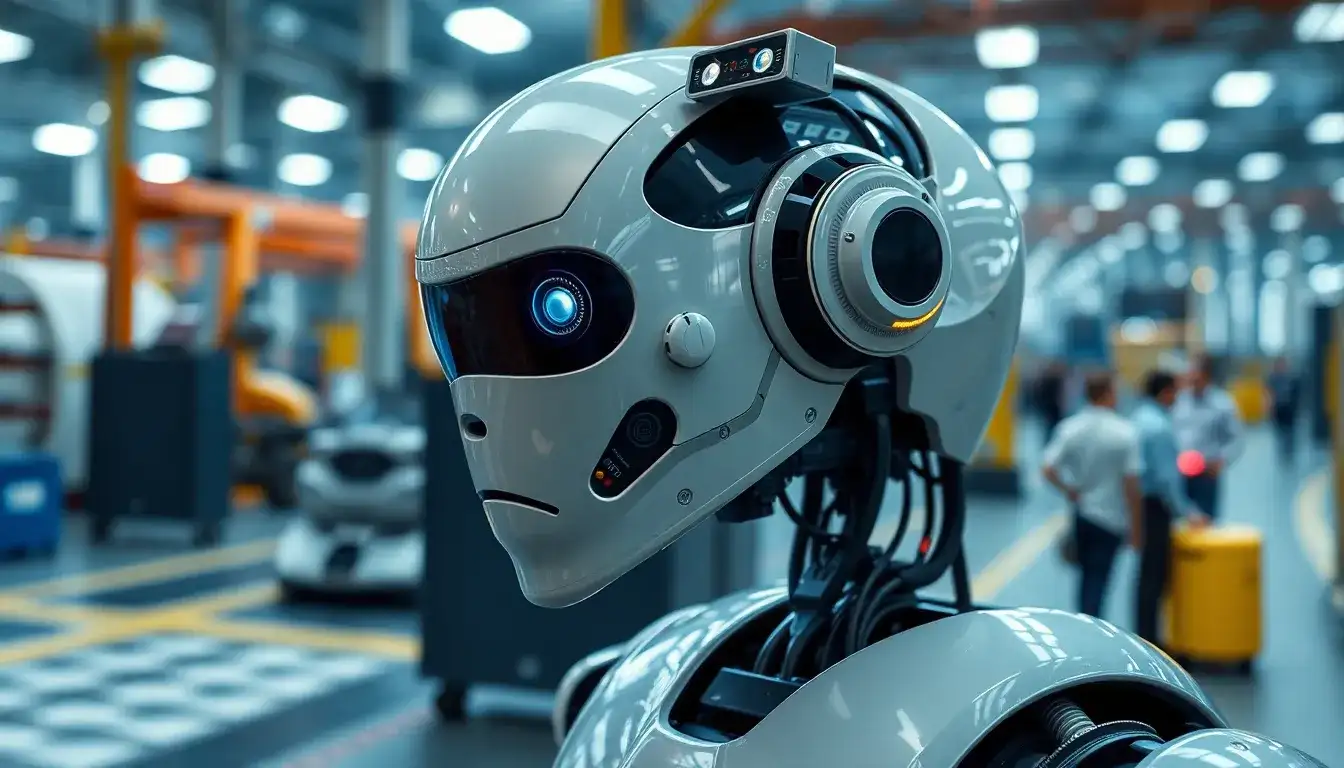
Applications of Visual Recognition in Robotics
As automation technology continues to advance, visual recognition has become a crucial capability within robotic systems. For robots to effectively perform tasks such as positioning, judgment, grasping, sorting, and inspections, they must be able to perceive and analyze their external environment. Compared to robots that execute single actions, those equipped with visual recognition can respond more flexibly to target objects, spatial positions, and environmental changes. This flexibility opens up broader applications for robots in manufacturing, warehousing, logistics, and service scenarios.
Enhancement of Environmental Perception
The core function of robotic visual recognition is to assist devices in “seeing” and “understanding” their surroundings. Utilizing cameras, image sensors, and algorithmic systems, robots can identify information such as the shape, color, size, and position of objects, which allows them to execute subsequent actions. For instance, in sorting operations, robots can quickly differentiate between various items based on image features. In inspection scenarios, they can recognize the surface conditions of equipment and changes in areas, thereby improving the accuracy and continuity of operations.
This perceptual ability enables robots to move beyond fixed programs and make dynamic adjustments based on real-time conditions. In complex environments with variable targets, the integration of visual recognition significantly enhances the adaptability of robots and increases the overall practical value of the system.
Deeper Applications in Industrial Production
In industrial settings, machine vision has been widely adopted for tasks such as positioning guidance, product inspection, assembly assistance, and material sorting. Traditional automation equipment often relies on fixed trajectories and pre-set rules; however, with the addition of visual recognition, robots can adjust their action paths based on real-time image information, facilitating more flexible operations. Particularly in cases where product specifications vary and placement positions are not fixed, visual systems enable robots to quickly identify and match items, thereby enhancing production pace.
Additionally, visual recognition can assist robotic arms in making grasping decisions. By identifying target edges, angles, and spatial coordinates, robots can perform actions like picking and placing more stably. This capability is significant for improving operational consistency and reducing human intervention, which propels the advancement of intelligent manufacturing towards greater efficiency.
Clear Advantages in Warehousing, Logistics, and Service Scenarios
Beyond industrial manufacturing, visual recognition is increasingly common in warehousing logistics and service robots. In warehouses, robots can use visual systems to identify the locations of goods, aisle information, and floor markings, enabling them to navigate autonomously, locate targets, and transport items. In delivery, guidance, and reception scenarios, visual recognition aids robots in recognizing paths, obstacles, and interaction targets, improving operational fluidity.
For robots that operate in dynamic environments, visual systems are not only tools for “seeing” but also essential foundations for autonomous decision-making. They help robots process fluctuating information, minimizing execution deviations caused by environmental changes, and allowing devices to perform more stably in practical applications.
Driving Continuous Upgrades in Robot Technology
From a technological development perspective, robotic visual recognition is evolving towards higher precision, faster response times, and stronger integration capabilities. In the future, visual systems will collaborate more closely with navigation, control, and perception modules, enabling robots to possess more comprehensive judgment capabilities in complex tasks. For businesses, prioritizing the application of visual recognition technology will not only optimize operational processes but also expand the adaptability of robotic solutions.
Visual recognition has become a vital component of robotic technology upgrades. Whether in industrial manufacturing, warehousing, transportation, or service applications, it continually extends the capabilities of robots. As related technologies continue to improve, visual recognition will play an increasingly significant role across various fields, opening up richer developmental possibilities for robot applications.
Original article by NenPower, If reposted, please credit the source: https://nenpower.com/blog/the-role-of-visual-recognition-in-robotics-applications/

