

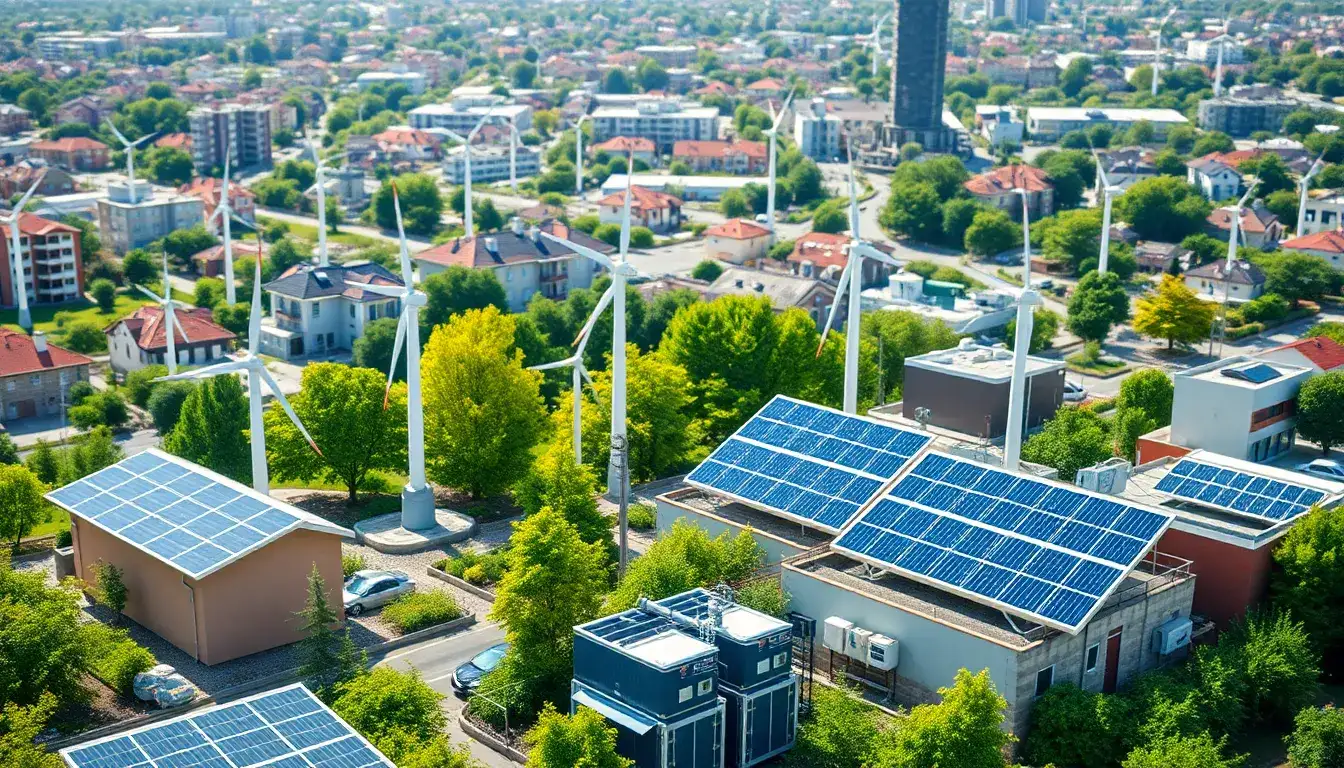
The Smart Microgrid Enters a Golden Decade!
As we look toward the future of modern energy systems, traditional power grids function like wide “arteries,” allowing energy to flow in one direction—stable, yet somewhat cumbersome. However, when faced with extreme weather or equipment failures, the entire system can be disrupted, leading to widespread outages. The rapid development of renewable energy sources, particularly distributed wind and solar power, has caused the traditional grid to struggle with integration, thus creating the necessity for microgrids. These microgrids are compact power distribution systems that integrate distributed power sources, storage devices, energy conversion devices, loads, monitoring, and protection systems. They are primarily focused on providing local areas with self-sufficient and reliable electricity, featuring clear physical boundaries and relatively independent operational management systems.
From the perspective of the grid, a microgrid can be considered a controllable component: it can supply energy to the grid as a controllable power source or absorb power from the grid as a regular load. For users, microgrids represent a highly flexible and reliable power supply system capable of meeting diverse electricity needs.
Four Key Functions of Microgrids
- Supply Assurance: Microgrids provide reliable electricity supply in specific areas, particularly in remote or underserved regions, effectively compensating for the shortcomings of the main grid. In case of a failure in the main grid, a microgrid’s ability to operate in isolation ensures that critical facilities continue to receive power, thereby minimizing losses associated with outages.
- Utilization of Renewable Energy: Microgrids can fully harness local renewable resources such as solar and wind energy, increasing their utilization rate and promoting the development of clean energy. They achieve this through smart control systems that optimize the generation and consumption of renewable energy.
- Cost Efficiency: By employing intelligent energy management systems, microgrids can monitor and optimize energy usage in real-time. This optimization reduces energy consumption and operating costs, leading to more economical electricity supply.
- Emissions Reduction: The deployment of microgrids contributes to decreased reliance on fossil fuels and lowers greenhouse gas emissions, aiding in the transition to a greener energy structure and achieving environmental and carbon reduction goals. For instance, the use of photovoltaic storage systems for self-consumption in industrial parks significantly enhances emission reduction benefits.
In traditional models, grid dispatch systems must manage all entities within the microgrid, including renewable energy sources and users, leading to complicated transaction and dispatch management. However, smart microgrids can participate in transactions and dispatch management as new operational entities, simplifying the process and enhancing the efficiency of power system dispatch, thus allowing for more flexible and efficient allocation of resources.
It is important to note that in scenarios where supply reliability is crucial, the design of smart microgrids can ensure the capability for isolated operation. In other situations, such capabilities can be flexibly configured based on actual conditions and needs.
Policy Support Accelerating Development
As a critical component of the new power system, renewable energy microgrids have garnered significant attention and support from both national and local governments, resulting in a series of policies aimed at promoting their development. In July 2015, the National Energy Administration issued guidelines for advancing the construction of renewable energy microgrid demonstration projects, emphasizing the exploration of microgrid technologies and operational management systems suitable for renewable energy development, promoting market innovation, and forming a comprehensive technical system for renewable energy microgrids.
In July 2017, the National Development and Reform Commission and the National Energy Administration proposed measures to promote the construction of grid-connected microgrids, advocating for structural reforms on the energy supply side and facilitating the healthy development of microgrids. The aim is to guide the local consumption of distributed energy sources and renewable energy, establishing a diverse, interactive, and efficient energy system.
In January 2022, the National Development and Reform Commission and the National Energy Administration outlined plans for the modern energy system during the 14th Five-Year Plan, actively promoting the development of smart microgrids that prioritize the integration of renewable energy. In subsequent months, various policies have been released to encourage the establishment of green energy industrial parks and the development of industrial green microgrids.
These policies provide a robust foundation for the development of microgrids, streamlining regulations and incentivizing the construction of projects that can effectively integrate renewable energy sources into local networks.
Forecast for Microgrid Capacity and Growth
Despite China’s late start in the microgrid sector, the rapid expansion of distributed solar photovoltaic and energy storage systems has accelerated the growth of the microgrid market. Currently, the application scenarios for microgrids have expanded from initial phases, such as providing electricity to remote areas or islands, to urban distribution network upgrades, industrial park energy management, and electric vehicle charging stations. The trend toward intelligent microgrids is also driving their penetration into urban communities.
In the urban distribution network upgrades, microgrids play a crucial role in supplying electricity in high-density load areas. For instance, the dual-petal network structure in Hangzhou provides double power supply guarantees for data centers. In industrial parks, such as the Mulinsen Industrial Park in Jiangxi, customized microgrids can optimize energy efficiency, with projections indicating that by 2030, over 50% of industrial parks will be standard equipped with smart microgrid systems.
According to statistics from the CESA Energy Storage Application Branch, from 2024 to the first quarter of 2025, there are a total of 210 microgrid projects connected to the grid in China, with a total scale of 599.6 MW/1597.54 MWh. Among these, 174 new projects related to solar energy storage and distributed photovoltaic systems were added in 2024, with a total installed capacity of 485.01 MW/1284.62 MWh and total investment exceeding 2.713 billion yuan.
As user demand for clean energy continues to rise, coupled with technological advancements and decreasing costs, the microgrid market in China is expected to maintain rapid growth throughout 2025.
Provincial and Regional Analysis
In 2024, Inner Mongolia led in new installed capacity for solar energy storage/distributed photovoltaic microgrid projects, reaching 94.05 MW/371.1 MWh, accounting for 28.89% of the total capacity. Xinjiang followed with 87.7 MW/275.43 MWh, comprising 21.44%. Jiangsu introduced 24 new projects with a total of 46.79 MW/97.07 MWh, representing 7.56% of the total.
According to the CESA Energy Storage Application Branch, in 2024, the North China region had 18 new projects with a total scale of 116.44 MW/428.78 MWh, leading the nation with a capacity share of 33.38%. The Northwest region added 10 microgrid projects, including 4 exceeding 30 MWh, with a total scale of 125.16 MW/351.24 MWh. Eastern China reported 83 new projects, totaling 116.15 MW/238.34 MWh, with a capacity share of 18.55%.
In summary, the growth of microgrid projects is diverse, with significant contributions from various provinces and regions, reflecting the expanding role of this technology in the energy landscape.
Conclusion: The Future of Microgrids
The International Energy Agency (IEA) highlights that microgrids are a key solution for addressing the electricity needs of 700 million people without access to power globally, especially in remote areas and developing countries. As the penetration of renewable energy continues to rise, the microgrid market is poised for greater growth opportunities. The integration of Internet of Things (IoT), big data, and AI algorithms will further enhance the intelligence of microgrids, enabling smarter monitoring, dispatch, and management, thereby improving energy distribution efficiency and reinforcing the stability and reliability of power systems.
In the next ten years, microgrid construction will focus on three main scenarios: establishing smart microgrid projects that integrate wind, solar, and storage solutions in areas underserved by the grid, promoting renewable energy utilization in regions with abundant resources, and enhancing the local consumption of renewable energy in industrial enterprises and parks.
As we move into this golden decade for smart microgrids, the need for technology iteration, policy cooperation, market mechanism improvement, and global collaboration will be paramount in achieving energy security, economic viability, and sustainability.
Original article by NenPower, If reposted, please credit the source: https://nenpower.com/blog/the-rise-of-smart-microgrids-a-decade-of-opportunities-in-renewable-energy/

