

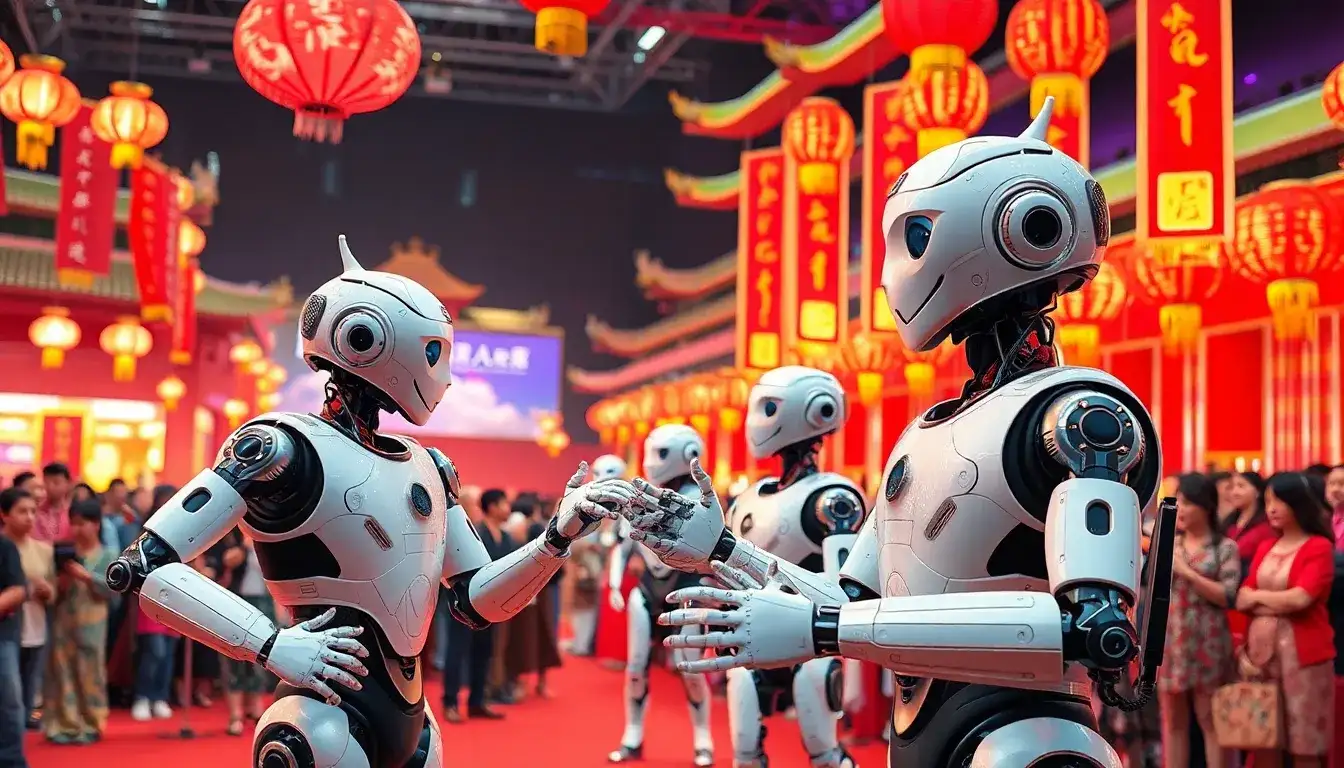
This year’s Spring Festival Gala featured a remarkable highlight: the “King of Sales” emerged from Yibin, showcasing the potential of robotics in real-world applications. The 2026 Spring Festival Gala has been humorously dubbed the one with the “lowest human content,” prompting deeper questions about the robotics industry. As robots entered the public eye in unprecedented numbers, it begs the question: what historical milestone has the industry reached?
Over the past two years, the field of embodied intelligence has experienced a whirlwind of funding, rapid prototyping, and concept proliferation. However, the exuberance of capital does not automatically translate to orders, and flashy demonstrations do not necessarily become marketable products. A pressing question arises as the initial excitement fades: what lasting contributions will robots make to the industry? The answers are not found under the spotlight on stage.
As the only robotics company to perform three times at the gala, Magic Atom provided a clear response through three actions: scooping noodles, serving meals, and pouring drinks. This succinctly encapsulates a shift in industry logic: after performing, robots must get to work. These six words signify not just a change in perspective but also a visual representation of a new productive force.
When robots enter real-world scenarios and assume genuine responsibilities, they transition from being mere “technological mascots” on stage to becoming “units of productivity” embedded in national strategic frameworks.
In Yibin’s sub-venue, the 501 Wine Culture Landmark, the MagicBot Gen1 was tasked with operational functions like scooping noodles and pouring drinks, while the MagicBot Z1 handled mobility and delivery. This multi-form humanoid robotics collaboration marked the first time humanoid robots appeared as “performers” in the gala’s history. There was no exaggerated technological flair, just a seamless service chain.
This seemingly ordinary scene actually represents a pivotal shift in the industry. The focus of robotic competition is evolving from “can they perform?” to “can they fulfill job roles?” Magic Atom has boldly placed this answer on display. During the noodle-scooping process, the robot must adjust its force output in real-time based on changes in noodle weight and resistance. When pouring drinks, it must dynamically adapt to the varying heights and diameters of different cups. Moreover, in an environment bustling with people, it must execute millisecond-level obstacle avoidance and task transitions. These everyday actions fundamentally test the integrated technical capabilities of robotics—perceptual fusion, full-body control, system stability, and engineering consistency must all be achieved simultaneously, rather than through isolated breakthroughs.
Previously, robots performing on stage made headlines, competing over who could execute the most impressive moves. Now, the competition has escalated to whether they can work effectively and consistently. Wang Xiao, founder of Nine Union Investment, elucidated this change: “In the past, it was newsworthy for robots to perform. Now, with robots collectively showcasing their capabilities at the Spring Festival Gala, the competition has shifted to consistency in mass production, stability in control, and excellence in cost.” What Magic Atom presented was not merely a performance but a public evaluation of a product. The stage became a pressure environment, and the ability to operate in real-world scenarios became the criterion for assessment.
The surge in orders post-gala reflects a clear trend: humanoid robots are rapidly entering real application scenarios. This signifies a market shift from a showcase-driven approach to one centered on scenario-based delivery. The industry is entering a new phase of differentiation: only companies with systematic capabilities for real-world deployment will gain a competitive edge in releasing new productive forces.
Data from JD.com indicates that after the Spring Festival, new orders spanned over 100 cities nationwide, from major metropolitan areas to smaller counties. A distinct signal is emerging: the consumer reach of robots is quickly expanding beyond the tech-savvy circles of Beijing, Shanghai, Guangzhou, and Shenzhen, penetrating the broader mass market.
So, who are the buyers willing to invest substantial sums? The first group is high-net-worth individuals who pay for “symbolic identity” and “emotional companionship.” Following the gala, Magic Atom’s robotic panda sold for 57,527 yuan on JD.com’s auction platform after 68 bids, exemplifying this demographic. Additionally, there’s a notable uptick in the consumer market: a reporter from Jimu News observed a significant increase in inquiries at the Wuhan Wushang Dream Era Robot Experience Store. One family humanoid robot priced at 10,999 yuan received over 200 inquiries daily, with a conversion rate of 15%, resulting in nearly one hundred pre-orders. Such products are primarily intended for elderly care and child companionship. Industry insiders predict that the consumer-grade robot market is set to explode by 2026.
The second group comprises government, enterprises, and institutions willing to pay for “practical applications.” The humanoid robot Z1 from Magic Atom integrates “high-performance reliability, an open AI ecosystem, and diverse application scenarios,” targeting this market segment as well. The needs of government and corporate users vary—ranging from reception in administrative offices to brand launch events and public space services in commercial complexes. These scenarios demand strong interactive capabilities from robots, requiring stable human-machine interaction, environmental perception, and reliable system performance.
Public records indicate that Magic Atom has developed systematic solutions for various scenarios involving humanoid robots. Their smart navigation solution has been implemented in several projects, including the Wuxi North Star Space Information Digital Industrial Demonstration Park and the Wuxi Low-altitude Economic Operation Exhibition Center.
Simultaneously, the rental market is experiencing explosive growth. Industry insiders report that robot rental orders are scheduled through March, with daily rental fees ranging from several hundred to tens of thousands of yuan. Many commercial clients prefer to “experience before purchasing” rather than make direct acquisitions at this stage.
The third group is the overseas market, where orders are demonstrating significant growth. Since initiating its global expansion in 2025, Magic Atom has seen its overseas business account for over 30% of total sales, with monthly transactions reaching up to 60% in some cases. In overseas family scenarios, consumer-grade robotic dogs are being utilized for parent-child interaction, emotional companionship, and commercial interactions.
Magic Atom has established localized operations across key regions, including the United States, Europe, Southeast Asia, and Australia, focusing on research and education, industrial applications, commercial navigation, and inspection. Morgan Stanley’s latest report on the humanoid robotics industry highlights that the key variables determining success in this field over the next 3-5 years will not be isolated algorithm breakthroughs but rather the maturity of manufacturing systems and deployment capabilities. From this perspective, Chinese manufacturers are showing advantages in cost control and engineering advancement, making them attractive to overseas clients.
The ability to deploy robots in real-world scenarios is defining the true value of “Made in China.” As the industry debates the technical pathways for humanoid robots, a more fundamental standard is emerging: the ability to integrate robots into genuine environments and streamline business processes. Those who succeed will set the benchmark for the “value” of this era.
Many first-tier market investors believe that humanoid robots are following a trajectory similar to that of early electric vehicles—shifting from a “technology race” to a “delivery race.” Analyzing the sales side, the fundamental reasons for Magic Atom’s market selection stem from three core capabilities that together form the foundation for “scenario deployment”: first, a comprehensive self-research system that builds a core capability barrier. Magic Atom’s self-research rate exceeds 90%. The dexterous hands used in the noodle scooping tasks at the Spring Festival Gala are among their self-developed products. By mastering core components and control systems, the company has strong systemic synergy in overall product integration, performance optimization, and scenario adaptation, laying the groundwork for continuous product iteration.
Second, their multi-form collaborative capability covers all scenarios. From humanoid robot execution to quadrupedal robot coordination, Magic Atom has a product matrix that spans industrial, commercial, and domestic applications. Humanoid robots can perform detailed service tasks such as scooping noodles and serving drinks while also being utilized in factories for material handling, quality inspection, and guiding customers in commercial spaces.
Third, their mass production and deployment capabilities have been established. The high-density coordination of hundreds of “robotic pandas” at the Yibin sub-venue demonstrated a command transmission delay of under 1.5 milliseconds, with collective action error controlled within 3 milliseconds. This achievement marks the first high-density coordination of quadrupedal robots on a global public stage, proving that Magic Atom possesses the engineering confidence to transition from “isolated breakthroughs” to “scaled replication.” Industry insiders note that such large-scale collaborative scenarios test not only single-machine performance or algorithm metrics but also mass production consistency, system stability, and the engineering capabilities of group control systems—core thresholds currently faced by the industry.
From an investment perspective, embodied intelligence is shifting from “dream narratives” to a “financial assessment phase.” By the end of 2025, K-Scale Labs, a Silicon Valley humanoid robot startup, announced its closure just 18 months after its inception, reflecting a drastic change in capital logic: two years ago, an impressive demo was enough to attract funding; now, investors are more concerned with orders, cash flow, and quantifiable risk management.
Magic Atom exemplifies a clear path forward: grounded in engineering capabilities, focused on productization, and successfully operating in real-world scenarios to complete commercial loops, it is leading the charge for embodied intelligence into a deliverable and replicable industrial stage. When four robotics companies shared the stage, the true outcome had long been determined—the answer lies not under the spotlight but in who can effectively integrate into factories, commercial spaces, and homes, continuously delivering value within real scenarios. The ability to deploy robots in real-world applications is becoming a key variable in defining new productive forces, directly impacting the tangible value of “Made in China.”
Original article by NenPower, If reposted, please credit the source: https://nenpower.com/blog/the-rise-of-robots-transforming-performance-into-practicality-at-the-2026-spring-festival-gala/

