

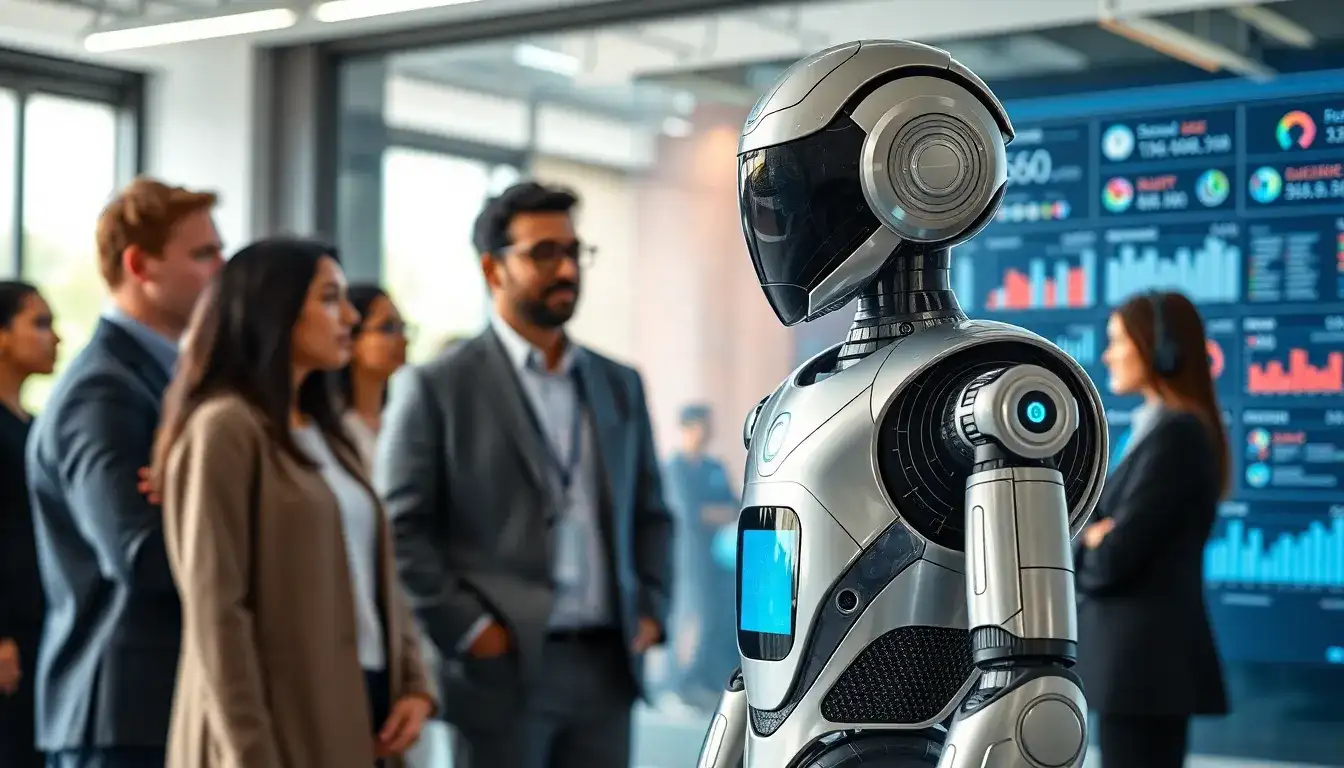
The Rise of Intelligent Outbound Recruitment Robots
With the continuous advancement of artificial intelligence technology, intelligent outbound recruitment robots are becoming increasingly popular among businesses. These robots not only enhance recruitment efficiency but also save significant human resources. This article will delve into the working principles, advantages, and future prospects of intelligent outbound recruitment robots.
Definition and Background of Intelligent Outbound Recruitment Robots
Intelligent outbound recruitment robots are not merely AI assistants that mechanically read scripts and freeze when asked, “What time does your company close?” Instead, they integrate voice interaction, semantic understanding, and recruitment logic to function as a “digital headhunter.” These robots can make calls proactively, understand candidates’ dialects, recognize hidden project management experience in resumes, and even switch to a warm tone when a candidate says, “I’m not considering a job change right now,” responding with, “I completely understand! Let’s add each other on WeChat, and whenever you want to discuss new opportunities, I’ll have coffee ready!”
Their emergence is a response to HR professionals staring at 500 resumes while being pressured by managers asking, “When will we fill this position?” Starting from early IVR (Interactive Voice Response) systems to today’s generative model-driven systems that support multi-turn context dialogues, these robots have quietly evolved from “telephone operators” to “recruitment partners.” With 95% of candidates preferring to respond via WeChat rather than answer unfamiliar calls, and recruitment cycles shrinking to hours, having a robot that is available 24/7, never tires, and learns as it chats is not just a luxury; it’s the essential boost in the HR’s cup of coffee.
How Intelligent Outbound Recruitment Robots Work
Imagine an “AI recruitment officer” brewing coffee in the morning and launching a call with just a click—voila! 500 calls are made simultaneously, without lag or fatigue. This is not magic; it relies on three core technologies: Automatic Speech Recognition (ASR), Natural Language Processing (NLP), and Dialogue Management (DM). ASR acts like a highly skilled stenographer, converting a candidate’s vague statement, “I… just left last week,” into precise text. NLP acts as both a translator and psychologist, interpreting “just left” as “available immediately” and “hesitant tone” as “possibly salary-sensitive.” Meanwhile, DM directs the conversation according to preset recruitment logic (e.g., first confirming educational background, then asking about project experience, and finally inviting for an interview), dynamically adjusting the dialogue and question order. It can even detect when someone says, “I’m in a meeting,” and cheerfully respond, “I’ll call back in three minutes; have a productive meeting!” Even more impressive, all interaction data feeds back to the model in real time, optimizing questions based on previous interactions. Technology here is not just a cold stack of code; it enables machines to understand nuances and respond appropriately.
Advantages of Intelligent Outbound Recruitment Robots
Intelligent outbound recruitment robots are not just AI repeaters that say “Hello” repeatedly—they are efficiency engines for HR teams, cost crushers, and the “gentle recruiters” in candidates’ minds! In traditional recruitment, HR professionals manually dial hundreds of numbers daily, repetitively asking, “Are you available to talk about the position?” This often leads to hoarse voices and diminished enthusiasm while resumes gather dust. In contrast, an intelligent outbound robot operates around the clock, reaching over 3,000 candidates in a day, improving initial screening efficiency by more than five times. For example, a new consumer brand reduced its recruitment cycle from 28 days to just 9 days, cutting labor costs by 42%. More remarkably, using semantic understanding, the robot can actively identify candidates’ interest in “exploring opportunities” or “valuing flexible work arrangements,” transforming cold calls into warm conversations. A tech company in Hangzhou reported a surge in candidate response rates from 17% to 63%, with some candidates commenting, “It’s more patient than the last HR call.” For companies, this not only saves thousands in outsourcing costs but also transforms HR from “dialing workers” into strategic partners—after all, when machines handle screening, humans can design talent maps, defining the future of recruitment.
Challenges and Solutions
Privacy protection? Data security? Technical failures? Don’t worry! While intelligent outbound recruitment robots are smart, they have not reached the level of a super AI equipped with “mind-reading, firewalls, and perpetual motion.” In reality, they may face challenging questions, such as when a candidate answers the call with, “How did you get my number?” This is not just awkward; it’s a compliance alert! Regulations like GDPR and the Personal Information Protection Law are strict. Additionally, ASR may struggle with dialects, accents, and background noise, leading to misinterpretations, while emotion recognition might mistakenly interpret a candidate’s thoughtful silence as impatience, causing the system to terminate the call. Moreover, if vast amounts of resume data are inadequately encrypted, they could become a hacker’s buffet. What’s the solution? A dual approach: technologically, using federated learning to enable “data without moving models” and incorporating real-time dialect adaptive modules into the voice engine; and management-wise, embedding full audit logs and allowing candidates a one-click option to withdraw consent. Some leading HR SaaS companies have implemented “transparent dialogue prompts,” which automatically announce at the beginning of the call, “This call is initiated by an AI assistant, is fully encrypted, and you can request to switch to a human or terminate at any time.” Technology should be warm, demonstrated not just by words but by writing respect into the code.
Future Development Trends and Outlook
The future trajectory of intelligent outbound recruitment robots is shifting from “making calls” to “understanding hearts.” No longer should we think they only read scripts mechanically—the next generation of systems has quietly integrated multimodal emotional engines, capable of interpreting a candidate’s real excitement or forced politeness within a 0.3-second pause or a slight tremor in their tone. Technically, large models combined with real-time text-to-speech synthesis have evolved to mimic the friendly tone of HR managers, while edge computing has reduced outbound call latency to under 80 milliseconds, making conversations flow as smoothly as friendly chats. The application scenarios are no longer limited to initial screenings; these robots are now collaborating with ATS to automatically analyze candidates’ WeChat chat records (with authorization), assess the strength of project verbs in resumes, and even customize “pressure dialogue simulation tests” for sales positions. Even more excitingly, they are transforming into “recruitment strategy advisors,” generating outbound call priority heat maps based on industry turnover rates, salary fluctuations, and competitor dynamics. In the long term, when they learn to joke in dialects and engage in timely banter about overtime when candidates vent, recruitment will evolve from a one-way selection process to a two-way bonding icebreaker. Technology has not replaced HR; it has liberated them from being “operators” to becoming “talent curators.”
Are you still struggling with low recruitment efficiency and high costs? Bai Ren Li employs intelligent algorithms to shorten recruitment cycles by 60%, while social viral models precisely enhance candidate quality, and full-process data visualization helps reduce hiring costs by 30%. As a brand under Bai De Hui, we utilize AI job matching and talent profiling technologies to swiftly recommend quality candidates to over 10,000 companies and serve more than 500,000 job seekers, creating a win-win ecosystem among enterprises, headhunters, and job seekers. Contact your dedicated consultant now for a 2-hour rapid recommendation service and embark on a new experience in efficient recruitment!
Unleash the transformative power of intelligent recruitment today! Call +86 13751107633 or send your requirements to hr@brlzp.com to receive your customized free solution. Our headquarters in Shenzhen and our office in Guiyang are here to support you in redefining the way opportunities connect!
Thank you for taking the time to learn about our AI software solutions. After exploring products such as the AI Boss Robot, AI Selection Recruitment, and AI Bai Ren Li Recruitment System, you may have noticed that our tools are dedicated to bringing real efficiency gains and performance growth through intelligent technology for businesses. Each company has unique needs and challenges, and our strength lies in providing tailored AI solutions that fit your business scenarios. Whether it’s optimizing recruitment efficiency or precisely screening talent, we have mature implementation experience and a professional team to support you.
If you would like to know more about how a specific product can integrate with your business, or if you need to arrange a detailed demonstration and case sharing, our consultants are ready to provide one-on-one consultations. For further inquiries, feel free to scan the WeChat QR code below to contact me.
Original article by NenPower, If reposted, please credit the source: https://nenpower.com/blog/the-rise-of-intelligent-outbound-recruitment-robots-transforming-hiring-efficiency-and-candidate-engagement/

