

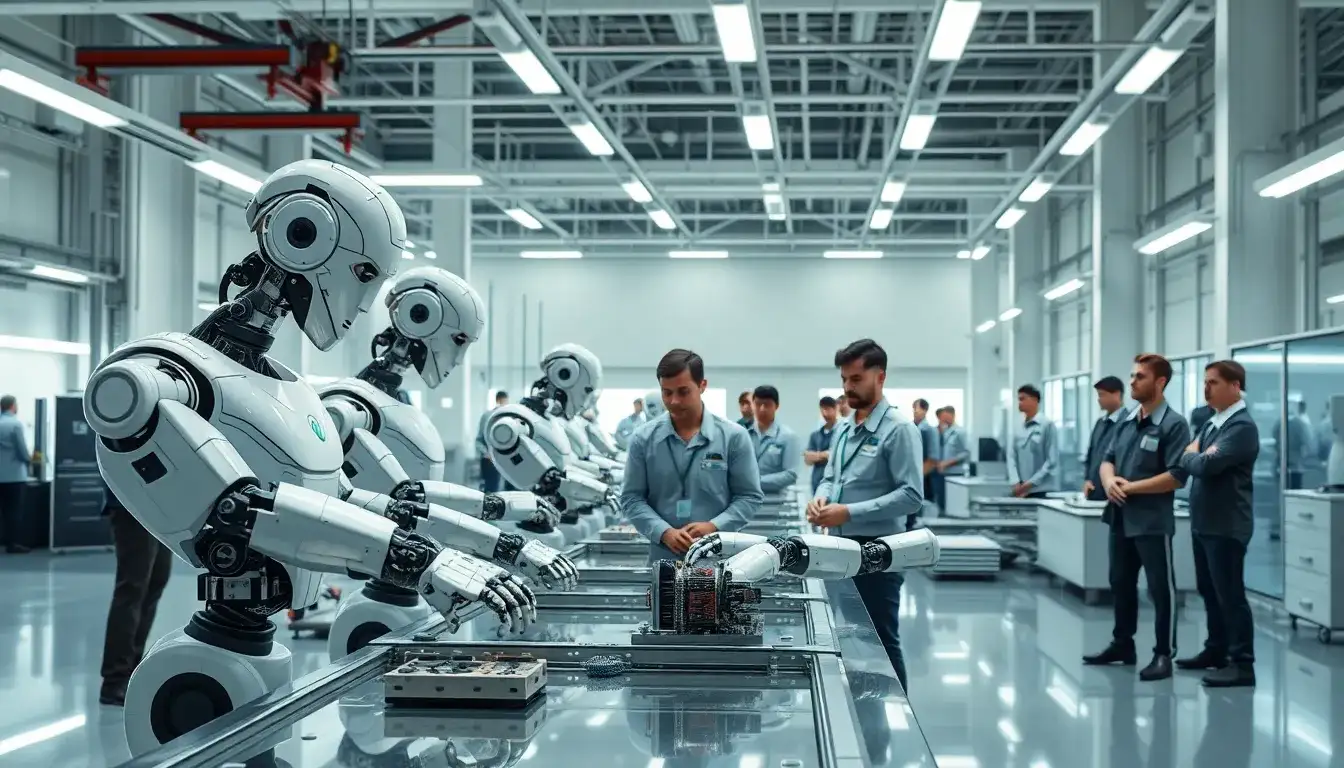
The narrative surrounding humanoid robots is gaining momentum, leading Estun to bet on the next manufacturing revolution.
In 2025, the Chinese industrial robot sector reached a significant milestone. According to Frost & Sullivan, Estun has maintained its position as the leading domestic company in terms of industrial robot shipments in China for several consecutive years. This indicates that domestic robots are no longer merely “substitutes” but are starting to take a dominant role in the market.
At this critical juncture, Nanjing Estun Automation Co., Ltd. is undergoing a Hong Kong Stock Exchange listing process, which may appear to be a capital refinancing effort but is actually a concentrated reflection of changes in the industrial cycle and global competitive landscape.
For over a decade, the industrial robot market has been controlled by foreign giants like Fanuc (Japan), ABB (Switzerland), KUKA (Germany), and Yaskawa Electric (Japan), which have built formidable barriers through technology, branding, and distribution channels. However, domestic companies are now leveraging their systematic capabilities and deeper integration within the supply chain to challenge this seemingly solid structure.
Nonetheless, the victory for domestic robot manufacturers is far from assured. Their real challenge lies not just in surpassing shipment volumes but in navigating cyclical fluctuations and profit pressures to penetrate high-end global markets, transitioning from mere scale expansion to upgrades in technology and business models.
Over the past decade, the power dynamics in China’s robotics industry have shifted. While China has become the world’s largest industrial robot market, it has long faced a structural contradiction: demand exists in China, but profits and technology are largely controlled by foreign entities. Foreign brands, with decades of technological accumulation and established automotive manufacturing client bases, have nearly monopolized high-end applications, while domestic companies have focused on the mid to low-end markets, competing primarily on price and localized services.
This shift in dynamics is not coincidental; it is an inevitable outcome of the evolving manufacturing landscape. With rapid expansions in industries such as new energy vehicles, photovoltaics, and lithium batteries, China’s manufacturing sector is undergoing a wave of significant automation upgrades. Unlike traditional automotive industries, these emerging sectors place a greater emphasis on efficiency and cost-effectiveness, demanding a quicker local response from equipment and a greater willingness to partner deeply with domestic suppliers.
In this context, the competitive logic among robot manufacturers is shifting from brand and technological barriers to a focus on application scenarios and system capabilities. Estun’s rise is a testament to this trend. Unlike many robotics firms, Estun does not solely rely on complete machine sales; instead, it has built a technological foundation around core components like motion control and servo systems. The robot itself is merely a part of the system, with true value deriving from control systems and software algorithms.
Through years of investment, Estun has gradually developed comprehensive capabilities from controllers and servos to complete robotic systems, allowing it to achieve a stable technological premium beyond mere pricing. Furthermore, Estun’s strategic approach aligns more closely with the growth model of “hidden champions” in manufacturing. The company has acquired key technologies and brand assets through global mergers and acquisitions, which, combined with the scale advantages of Chinese manufacturing, create a differentiated competitive edge.
The introduction of brands like TRIO has established a global customer base in the motion control sector, while its overseas manufacturing and service networks help the company reduce reliance on a single market. This model represents a fundamental reconstruction of industrial capabilities. Previously, foreign brands held advantages in technology and globalization, while Chinese companies benefited from cost and market access. However, as the industry chain upgrades, domestic firms are forming a new competitive structure centered around China, establishing a global supply and technology system.
Once this structure matures, it will signify that China is not only the largest demand market but also a center for technology and industrial ecology. In this process, domestic robots have evolved from “single-point breakthroughs” to “system competition.” Companies are no longer just providing robots; they are offering complete production units and intelligent manufacturing solutions. Robotic workstations, production line automation, and digital systems are increasingly merging, with customers focusing on overall efficiency rather than individual equipment.
Estun’s intelligent manufacturing system business has found growth in this trend, and more importantly, this transformation is allowing domestic brands to gradually enter high-end application fields. Once companies master system integration capabilities, they can enter complex scenarios such as automotive and new energy. Foreign brands’ competitive barriers are being weakened as clients increasingly prioritize delivery efficiency and cost optimization over individual equipment performance. This indicates that the industrial robot sector is transitioning from “equipment competition” to “manufacturing ecosystem competition,” with the advantages of domestic companies shifting from price to efficiency and collaborative capabilities.
Despite the optimistic narrative surrounding the industry, the reality remains complex. In terms of performance, for the fiscal years 2022, 2023, 2024, and the nine months ending September 30, 2025, Estun reported revenues of approximately 3.881 billion yuan, 4.652 billion yuan, 4.009 billion yuan, and 3.804 billion yuan respectively. The company has experienced notable revenue fluctuations in recent years, reflecting the cyclical nature inherent in the industrial robot sector.
As a capital-intensive industry, robot manufacturers must continuously invest in research and development while managing inventory, all the while facing fluctuations in downstream industries. The ups and downs in demand for automotive and consumer electronics directly impact order rhythms. Regarding profitability, from 2022 to the first three quarters of 2025, the company recorded profits of approximately 184 million yuan, 134 million yuan, -81.8 million yuan, and 29.7 million yuan. The profit fluctuations in 2024 and goodwill impairments reflect the industry’s adjustment phase.
In recent years, the global manufacturing sector has experienced a surge in automation investments following the pandemic, leading to a contraction in inventory and capital expenditures. The robot industry is transitioning from rapid growth to structural differentiation, revealing the pressures accumulated by domestic companies during their expansion phases. At this time, the core challenges faced by domestic robot firms are evolving. Early competition centered on scale and market share, while today, the focus has shifted to profitability and cash flow stability.
With lower gross margins for complete robots and the lengthy, highly customized cycles of system integration projects, operational fluctuations become evident. How to build high-value-added services and software revenue has become a critical question for the industry. Meanwhile, foreign brands have not exited the market. On the contrary, they are accelerating localization and adjusting pricing strategies in the Chinese market. High-end markets remain the sectors with the deepest technological and brand barriers, indicating that domestic brands must continue investing in research and development to achieve meaningful substitutions.
A significant variable arises from changes in technological paradigms. As artificial intelligence integrates with robotics, humanoid robots are becoming a new narrative. Estun’s launch of Codroid 02 is fundamentally a strategic positioning rather than a short-term commercialization effort. While humanoid robots may reshape automation models in manufacturing and services, both technology and cost remain far from mature. This trend’s impact on the industrial robot sector is analogous to the disruption caused by new energy vehicles to the traditional automotive industry. Companies must balance stabilizing existing operations with exploring future technologies. Over-investment could lead to financial strain, while conservatism may cause them to miss out on the next industrial revolution.
From a capital market perspective, the deeper logic behind Estun’s listing in Hong Kong lies in this context. The Hong Kong market serves not only as a financing platform but also as a global capital pricing system. By accessing international markets, the company can secure longer-term funding and benchmark its valuation against global robotics firms, enhancing its competitiveness in technology investments and global expansion.
Importantly, the capital market is reassessing manufacturing enterprises. Historically, industrial automation companies were viewed as cyclical equipment vendors, but amid the waves of artificial intelligence and digitalization, these firms are being redefined with technological attributes. Industrial robots are not merely manufacturing tools; they are becoming vital infrastructure for future intelligent societies. Thus, Estun’s listing signifies not just the fate of a single company but represents a critical phase in the transition of Chinese manufacturing from cost advantages to technological and systemic advantages.
The domestic robotics industry surpassing foreign brands for the first time is merely the beginning of structural changes. Ultimately, the future will hinge on whether companies can find a new balance amid global competition, technological innovation, and business model upgrades. In this sense, Estun’s story is not merely one of a single victory but the prologue to a longer-term battle.
Original article by NenPower, If reposted, please credit the source: https://nenpower.com/blog/the-rise-of-humanoid-robots-estuns-bet-on-the-next-manufacturing-revolution/

