

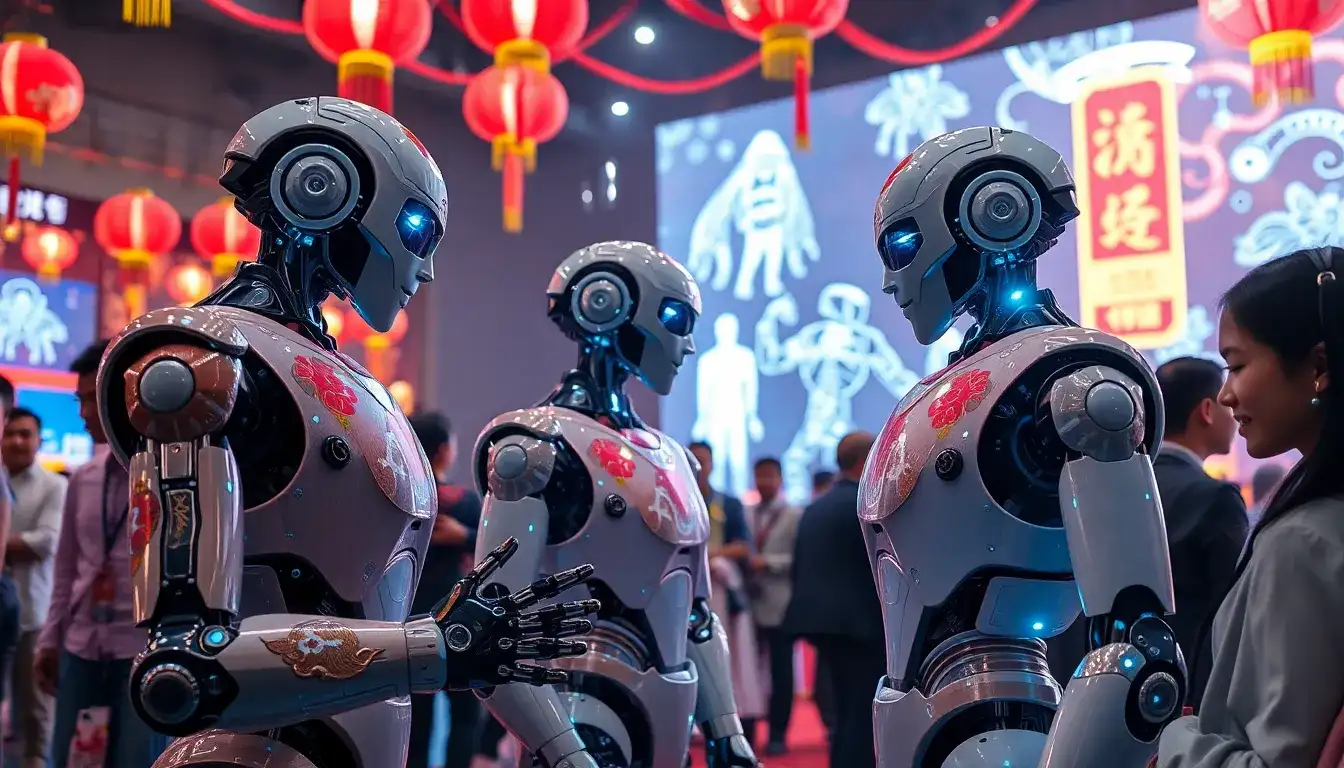
Looking at the Spring Festival Gala, 2025 marks a pivotal year for embodied intelligence, transitioning from mere spectacle to practical application. When discussing robots, many people’s first thought is likely of the Yushu robot that performed at the Spring Festival Gala in 2025. However, compared to Yushu’s standout performance last year, this year’s gala will feature an even greater number of robotic participants. So far, four companies involved in embodied intelligence—Magical Atom, Galaxy General, Yushu Technology, and Zui Mi—have publicly announced their partnership with this year’s event.
The Spring Festival Gala, which attracts an audience of hundreds of millions, is not just an artistic performance; it serves as an excellent window into the dynamics of China’s industries. Each brand that appears on the gala stage typically corresponds to the most expansive industrial development direction of the time, reflecting the growth ambitions of those brands. In an era where physical AI is seen as a necessary step toward achieving AGI, robots naturally carry high expectations.
This year, we can anticipate not only an increase in the number of robotic companies participating in the gala but also a shift in their presentations from simple dance performances to “intelligent interactions.” For instance, Galaxy General has announced that it will showcase its robots’ autonomous decision-making abilities and efficient collaboration in complex environments. This means that viewers will witness not just pre-programmed, repetitive movements but intelligent agents capable of environmental perception, immediate responses, and “warm service” experiences. Zui Mi Technology will also focus on demonstrating interaction and perception capabilities, featuring its smart transportation robots that possess environmental awareness, autonomous decision-making, and precise execution abilities.
The Spring Festival Gala acts as a magnifier for brands, and for the robotics industry, choosing to participate reveals the ambition and anxiety of the entire sector. Companies hope to replicate the phenomenon created by Yushu Technology. Yushu’s rise to fame allowed the general public to experience the presence of robots through their screens. Subsequently, CEO Wang Xing appeared at discussions alongside industry giants like Ma Huateng and Ren Zhengfei, becoming a notable figure in the tech world. This “visibility” directly translates into market application value.
According to an announcement by Yushu Technology on January 22, 2026, the actual shipment of humanoid robots in 2025 surpassed 5,500 units (referring to the number actually sold and shipped to end customers, not just orders, which were higher), with over 6,500 units of the production model rolling off the assembly line. Alongside the commercialization value, there has been a wave of reflection in the primary market regarding “why they missed out on Yushu.” The entire investment community is currently experiencing a FOMO (fear of missing out) mentality, with funds flooding into the sector in search of the next Yushu.
Reports indicate that many investment institutions previously rejected embodied intelligence projects due to concerns over costs and feasibility. However, after the Spring Festival of 2025, decision-makers shifted their stance, not only recognizing the necessity of investment but also reflecting on their previous underfunding. As the consumer and software sectors face capital winter, hot money naturally flows into this promising field, which could be the next significant gateway.
Everyone believes that robots will eventually enter factories and homes, replacing humans and generating value across various industries. This enthusiasm sometimes borders on madness, with many entrepreneurs securing large amounts of funding even without a product. Numerous newly established startups, despite little progress, have completed multiple rounds of substantial funding recently. Data from IT Juzi indicates that in the past year, the sector experienced 304 financing events, with over 37.9 billion yuan flowing in, roughly three to four times that of 2024. This includes large single financing rounds nearing 2 billion yuan and numerous firms competing for star projects.
The industry has seen the emergence of several companies valued at over 10 billion yuan. Currently, Galaxy General leads with a valuation of 20 billion yuan, followed by Zhiyuan at 15 billion yuan, and Yushu Technology at 12 billion yuan. Financing and IPO submissions are progressing simultaneously, with over ten companies, including Yushu Technology, Zhiyuan Robotics, Leju Robotics, Galaxy General, and Yundongchu, accelerating their listing processes.
After the capital frenzy, the question remains: who will stay at the table? Having discussed the reasons for robotic companies’ anticipation of the gala’s exposure, we must now address their anxieties. As mentioned earlier, the FOMO sentiment arises from investors’ consensus on the immense value that robots will inevitably bring to various industries. However, it is essential to recognize that bubbles are common in technological development, especially after a market consensus forms, and the embodied intelligence sector is no exception.
A notable reality is that the robotics sector is still in a developmental phase. At the beginning of 2025, Zhu Xiaohua, a partner at Jinsha River Venture Capital, bluntly pointed out the challenges facing the industry, stating, “Our angel fund has invested in some early-stage embodied intelligence projects in recent years, but we have been exiting in recent months… When I asked several CEOs about their potential clients, I felt they were just imagining them. Who would spend over a hundred thousand yuan on a robot to perform these tasks?” Zhu’s views may seem extreme, but a closer look at the industry reveals noticeable technological advancements over the past year.
At the start of 2025, robots that could run and jump amazed audiences, but by 2026, a new sentiment has emerged: we do not need a million robots that can only dance. More companies are quickly catching up in terms of motion intelligence, leading embodied intelligence enterprises to bet on higher-level planning and decision-making capabilities. Public data shows that among the eleven complete machine companies with valuations exceeding 5 billion yuan, only Yushu and Zhongqing focus on developing large embodied models like VLA, while others prioritize different approaches.
Optimistic figures like Jensen Huang from NVIDIA predict that humanoid robots and the technology to achieve them are just around the corner, even stating, “The ChatGPT moment for the robotics field is approaching.” However, it is important not to celebrate too soon; while technology is advancing, the technical route for large embodied models has yet to converge. This divergence explains why investors can generally be divided into two camps. One group, taking a conservative approach, has begun to pursue order volume, as understanding technological trends is challenging, and quantifiable commercialization capabilities are the safest narrative during the “calculation phase.” The other group, with a more idealistic outlook, is willing to bet on the future, focusing on breakthroughs in smart technology and scenario adaptability validation.
Whether looking at orders or technology, leading companies have the first-mover advantage, attracting the majority of capital and talent in the sector. Overall, embodied intelligence companies are currently in a phase where the leading firms garner most of the attention. Financing rounds are extending from early to mid-late stages, with the top eleven companies capturing over half of the capital in this sector this year. Presently, the embodied intelligence sector resembles the Age of Exploration, with no one able to predict when the “ChatGPT moment” for large embodied models will arrive. Participants need to stock up on resources to survive, especially with clear policy support.
According to Song Xiaogang, Executive Director and Secretary-General of the China Robot Industry Alliance, during the 14th Five-Year Plan period, China will focus on promoting innovation and application of key products in industrial robots, service robots, and special robots to address industry development and household service demands. This policy support provides companies with the confidence to navigate economic cycles, but to survive until the cycle ends, they must rely on their capabilities.
Without depending on financing, how can they survive until their “iPhone moment”? The future is bright, and opportunities abound. For the players involved, as long as they remain at the table, there is hope. They may eventually witness the arrival of the VLA technology singularity or discover new application scenarios that will ignite commercialization. However, before that, they need strong self-sustaining capabilities to prove their business models are viable in the capital market.
Yudong Power’s founder, Yu Yinan, stated that in the initial stages, achieving mass production of one million units within five years may require an investment of around 10 billion yuan to be at the table. However, this 10 billion yuan cannot come solely from financing; there must be products that can create revenue. Understanding this is key to grasping why everyone is vying for visibility at the Spring Festival Gala. Once featured on the gala, the industry will inevitably reach new heights in public opinion and capital, setting a more positive tone for the embodied intelligence market in 2026.
Magical Atom’s Gu Shitao has explicitly stated that 2026 will be a crucial turning point for the company’s large-scale deployment, with all product lines targeting “thousands of units” in shipments. In addition to complete machine products, the company’s data collection equipment and solutions are also being shipped, providing services for other algorithm companies that require real scene data and continuously expanding their commercial boundaries. Meanwhile, Galaxy General, which has secured multiple thousand-unit orders, hopes to leverage the Spring Festival Gala to elevate its commercialization capabilities to new heights. More advantageously, Galaxy General has already secured thousand-unit mass production orders from companies like Baida Precision Engineering. This is a significant numerical milestone, indicating stricter requirements for reliability, consistency, and cost control, involving multiple aspects of supply chain management, production, and testing. Given this context, for companies like Galaxy General that are ahead in commercialization, exposure at the Spring Festival Gala aims to widen the gap and further solidify their leading position.
This industry still has a long way to go. Fortunately, a consensus has been reached; it is only a matter of time. As Zhang Ying of Matrix Partners openly stated, “The robotics field is thriving, with a vast market and diverse opportunities. It is entirely normal for there to be some bubbles along the way. Over time, the humanoid robotics sector will undoubtedly give rise to major companies.” Post-90s investor Cui Kedi believes that this generation will birth a number of great artificial intelligence companies, most likely between 2023 and 2026. He prefers to compare founders in the embodied intelligence field to captains whose sense of direction comes from continuous trial and error and recalibration. Investors and entrepreneurs are navigating one adventure after another, moving further along the treasure map. Currently, both capital and industry stakeholders are filled with positive and optimistic expectations, eagerly awaiting the arrival of the embodied intelligence “iPhone moment.” Historical experience tells us that firms with core technologies and scenario adaptability will eventually navigate through cycles, revealing their true value after the bubbles burst.
Original article by NenPower, If reposted, please credit the source: https://nenpower.com/blog/the-rise-of-embodied-intelligence-key-developments-in-robotics-at-the-2025-spring-festival-gala/

