

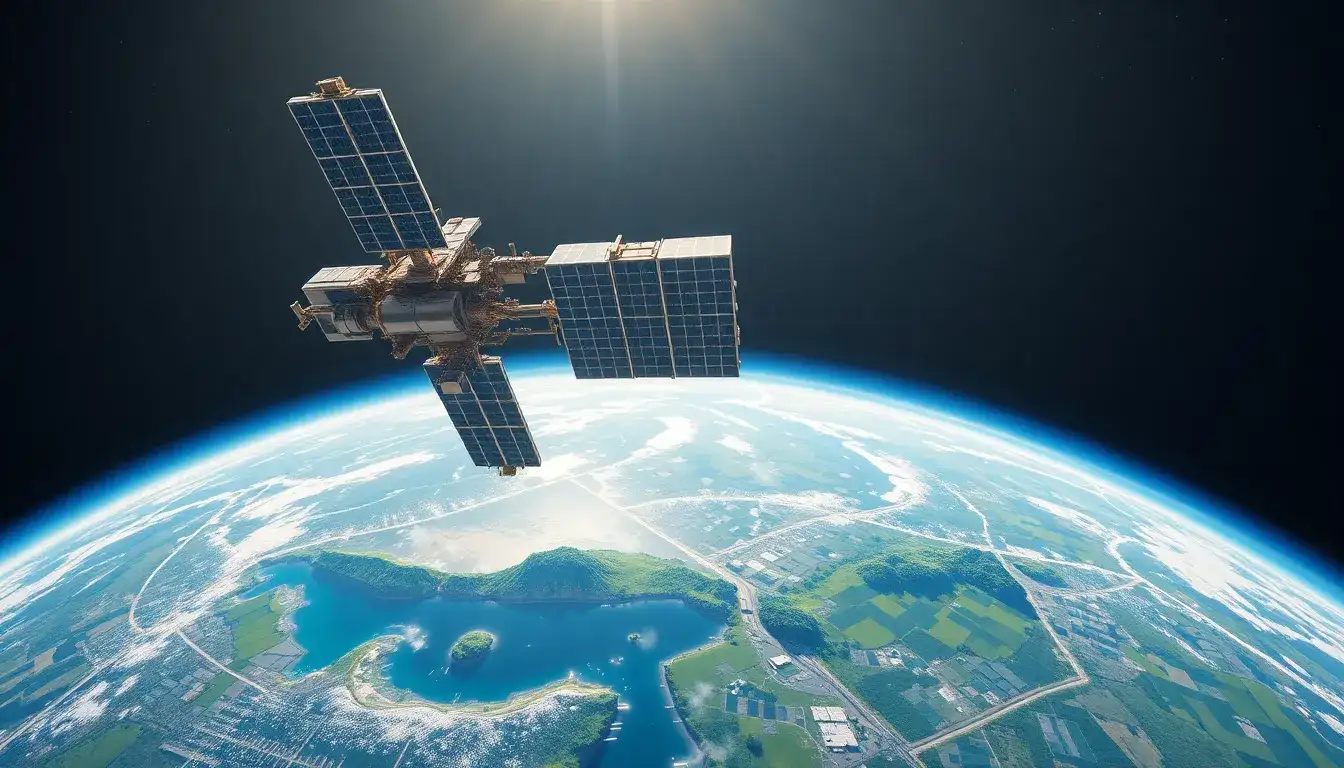
Is Space-Based Solar Power the Next Big Thing in Space?
===============================================
The innovative method of extracting solar power wirelessly via satellites has not received significant attention in recent years. However, recent investments and government-supported initiatives have rekindled interest in the realization of this technology. Startups, government grants, and large-scale projects have increased enthusiasm for space-based solar power (SBSP), though skepticism still exists within the industry as market leaders await positive outcomes and investor backing.
### Pioneering Innovations
In October of last year, Space Solar, a British SBSP startup established in 2022, announced a partnership with Transition Labs to supply Iceland’s Reykjavik Energy with power from orbit. This new satellite power plant, aimed for operational status by 2030, will initially have a capacity of 30 megawatts. A launch via a SpaceX Starship is planned for 2029, with future expansions expected to scale up to 15 gigawatts by the mid-2040s.
Sam Adlan, Co-CEO of Space Solar, stated, “Expect to see further customer and international developments, a growing team, and contracts for developing some of the early power-beaming applications.” He emphasized that realizing SBSP technology in the UK will require both public and private investment. “The financing system is not well set up to support the development of infrastructure businesses, and timelines start when funding is raised. … but [these solutions will deliver] strong returns and economic benefits to all types of investors.”
Adlan referenced four funded startups working on laser and reflector-based SBSP concepts:
– Aetherflux, founded by Baiju Bhatt, former CEO of Robinhood, based in California
– Overview Energy, located in Washington D.C. and backed by venture capital
– Reflect Orbital, also from California, which raised $6.5 million in a seed round in 2024
– Volta Space, based in Montreal and specializing in directing energy to the moon, which emerged from stealth last October
While laser solutions offer smaller products and simpler financing, Adlan explained that microwave technology is crucial for scaling solutions and providing baseload energy. Other startups include Solaren, based in California, which faced challenges in securing financing to meet their 2018 deadline, and the Caltech Solar Power Project, led by scientists who first demonstrated ultralight satellite power transmission. California-based Orbital Composites is also working on a solution backed by a $1.7 million award from the US Space Force, in collaboration with Axiom Space, Northrop Grumman, and the Southwest Research Institute.
“For SBSP, the market is there, and strong power revenues can be delivered within five years, with additional benefits for governments and spin-off products for investors along the way,” Adlan stated. Space Solar’s technology is supported by £5 million in engineering research.
### Understanding Space-Based Solar Power
The concept of generating solar energy in the optimal conditions of space and transmitting it via microwaves to Earth was first proposed in 1968. Although initially seen as far-fetched, the idea gained traction as people recognized its potential. With continuous access to sunlight and no atmospheric interference, solar panels in orbit could be up to ten times more efficient than ground-based systems, with the added advantage of beaming power directly to where it’s needed. The challenge lies in the wireless transmission from orbit.
Harry Atwater, a professor at Caltech who leads the university’s Space Solar Power Project, estimated that in 2023, approximately 5-12% of energy transmitted from a solar satellite would reach Earth, making it roughly 40% as efficient as terrestrial solar. Improving the efficiency of power transmission from orbit could dramatically alter the landscape, offering a renewable energy solution that requires significantly less land than traditional solar arrays.
A 2021 independent study commissioned by the British Department for Energy Security and Net Zero estimated that SBSP could generate “up to ten gigawatts of electricity by 2050,” accounting for a quarter of the UK’s current electricity demand and creating 143,000 jobs in a multi-billion-pound industry. In 2023, the government allocated funding to various universities and R&D groups to develop technologies that would enhance the UK’s capabilities in satellite solar energy. A government spokesperson noted, “Space-based solar power is an exciting area of research that could support our acceleration to net zero by 2050,” highlighting the £5.5 million joint innovation program involving eight leading UK universities and tech companies.
### Public Perception Challenges
Given the public hysteria surrounding advancements like 5G and nuclear power, it is understandable that there may be concerns about transmitting gigawatts of energy via microwaves through Earth’s atmosphere. Adlan addressed these fears, stating, “In many ways, it is not much different from communication signals, and by design, it is inherently safe and cannot be weaponized, with a maximum intensity less than a quarter of the midday sun.” He added that outside the receiving antenna, the power density remains below long-term microwave background exposure limits, levels deemed safe for continuous human exposure.
Studies by NASA and The Royal Society have reported positive safety results. However, the Frazor-Nash Consultancy issued a 2022 report on SBSP indicating that safety will depend on regulations regarding safe microwave power limits and safeguards against beam misalignment. If power transmission rates increase to rival those of traditional power stations, safety concerns surrounding the beams could arise.
With timelines extending into the 2040s and 2050s, the future of satellite solar transmission remains uncertain. In a few decades, dynamic baseload power allocation via satellites could become a cornerstone of net-zero energy assurance, or SBSP may prove to be environmentally unsuitable. Regardless, this fascinating technology is one to keep an eye on.
Original article by NenPower, If reposted, please credit the source: https://nenpower.com/blog/the-resurgence-of-space-based-solar-power-a-game-changer-for-renewable-energy/

