

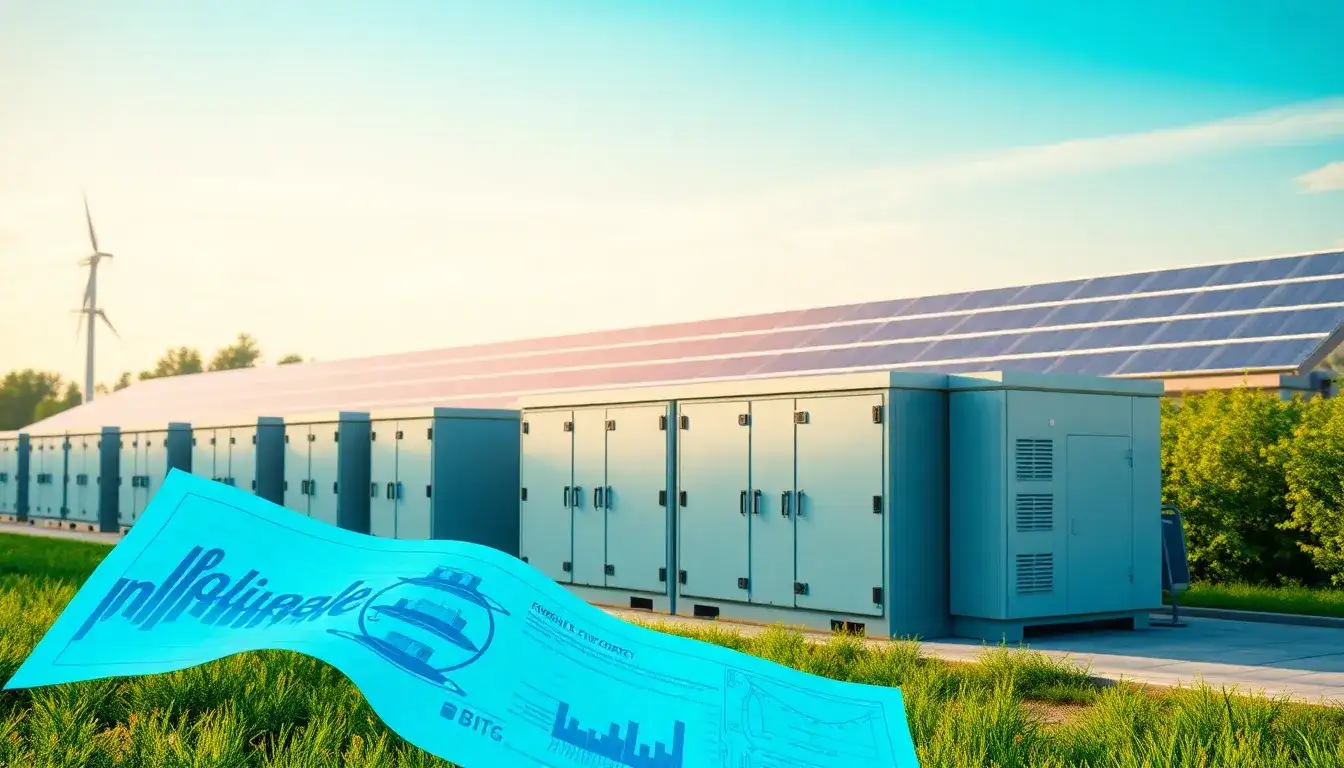
The Battery Boom: How Policy and Tech Are Fueling Renewable Storage’s Golden Age
The global transition to renewable energy relies heavily on a crucial challenge: finding efficient ways to store solar energy during cloudy weather and wind energy when conditions are calm. As solar and wind installations reached unprecedented levels in 2024, grid-scale energy storage has become a fundamental component of the clean energy shift. This sector is no longer a niche market; it represents a multitrillion-dollar opportunity, spurred by technological innovations and remarkable policy support. Investors who take action now can secure positions in companies poised to lead this emerging mainstream market.
### Technological Advancements Driving Change
The revolution in energy storage is being accelerated by significant advancements in battery technology. Since 2010, the cost of lithium-ion batteries has dropped by over 90%, making large-scale implementations financially feasible. Companies such as Tesla (TSLA) and China’s CATL are ramping up production of next-generation batteries, while innovations in solid-state and sodium-ion technologies promise enhanced efficiency and safety. Additionally, AI-driven grid management systems are allowing utilities to optimize energy storage in real-time, minimizing waste and improving reliability.
The most groundbreaking development is in long-duration energy storage (LDES) technology, which can store energy for days instead of just hours. Initiatives like the UK’s Long Duration Electricity Storage scheme are encouraging advancements in methods such as molten salt thermal storage and advanced compressed air systems, potentially resolving the issue of seasonal energy storage in areas that rely on intermittent renewable sources. The market for energy storage is expected to grow from $13 billion in 2020 to $45 billion by 2025, with lithium-ion batteries leading the charge, while LDES solutions are gaining ground.
### Supportive Policies Accelerating Growth
Governments around the world are facilitating this transition through various mandates and subsidies. The U.S. Inflation Reduction Act (IRA) and the newly updated Senate tax bill have sparked a surge in storage investments by extending tax credits for projects through 2033—longer than those available for solar or wind energy. These credits, combined with domestic content requirements like the 75% U.S.-Mexico-Canada mineral sourcing rule by 2031, are reshaping supply chains and creating opportunities for companies such as Ambri, which develops liquid metal batteries, and Northvolt, a European leader in lithium-ion technology.
In the European Union, the Net-Zero Industry Act is expediting permits for storage projects, while the Critical Raw Materials Act ensures a consistent supply of lithium and cobalt. The UK’s LDES Cap and Floor Scheme, set to begin accepting applications in mid-2025, guarantees returns for long-duration projects, attracting investment to firms like Connected Energy. Meanwhile, China’s Energy Law 2025 aims for 40 GW of battery storage by the end of the year, boosting demand for companies like CATL and BYD.
### The Investment Opportunity: Act Now or Miss Out
The urgency to invest in this sector is evident. Key deadlines are approaching:
– U.S. residential battery tax credits are set to expire in early 2026, while commercial storage incentives will begin to phase out by 2028.
– EU grid projects must secure funding by 2026 to achieve the 2030 target of 1,500 GW of storage capacity.
– Supply chain bottlenecks, particularly regarding China’s dominance in lithium refining, are being addressed, but companies that comply with domestic content rules (e.g., Ameresco in the U.S.) will have a first-mover advantage.
CATL’s revenue skyrocketed from $2.9 billion in 2018 to $40 billion in 2024, highlighting the rapid growth of this sector.
### Investment Recommendations
1. **Battery Manufacturers:** CATL (China), Tesla (TSLA), and Northvolt (Europe) are expanding production to meet soaring demand.
2. **LDES Innovators:** Companies like Ambri (solid-state) and Gravitricity (gravity storage) are tackling the long-duration energy storage challenge.
3. **Grid Infrastructure Firms:** Siemens Energy and ABB are incorporating storage solutions into smart grids, while NextEra Energy (NEE) is developing utility-scale projects in the U.S.
4. **Recycling Ventures:** Redwood Materials and Li-Cycle are essential for closing the lithium loop and reducing dependence on imports.
### Risks to Consider
– **Supply Chain Volatility:** China’s control over 60% of the lithium refining market introduces geopolitical risks.
– **Policy Uncertainty:** Changes in U.S. tax credits may occur if Congress shifts control in the 2025 elections.
– **Overvaluation Concerns:** Some storage stocks may be trading at high valuations ahead of earnings, necessitating a focus on companies with secured contracts.
### Final Thoughts: Time Is Running Out
The opportunity to invest in the early growth phase of this sector is diminishing. By the end of 2025, significant projects under the IRA and the EU’s COP29 pledge will be established, limiting options for late investors. Ignoring this transition could mean missing out on one of the defining investment opportunities of the next decade. Act now, or risk being left behind as the world shifts toward renewable energy.
Tesla’s energy storage segment has experienced remarkable growth, with revenue increasing from $2.3 billion to $11.5 billion since 2020, surpassing its automotive division’s growth rate.
Original article by NenPower, If reposted, please credit the source: https://nenpower.com/blog/the-renewable-storage-revolution-how-policy-and-technology-are-driving-the-battery-boom/

