

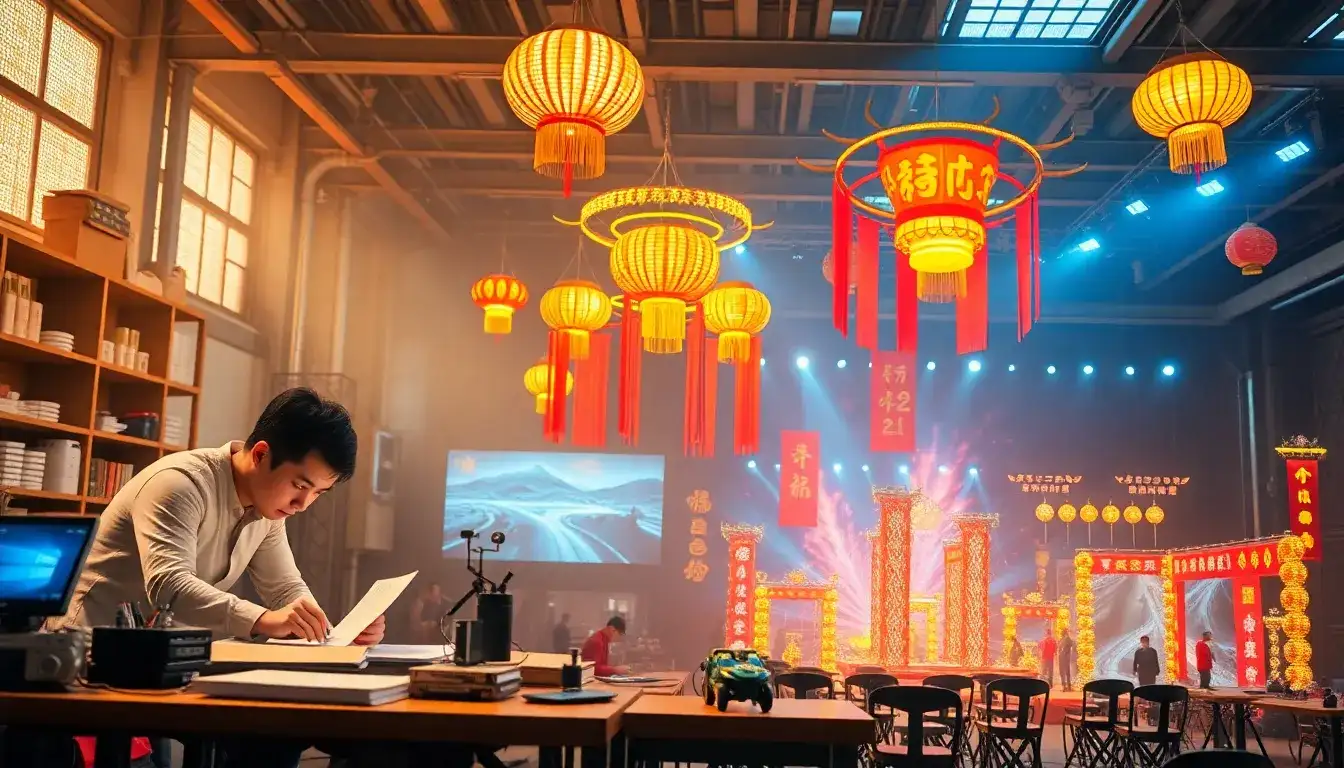
When Cai Ming performed the skit “Grandma’s Favorite” alongside a dynamic robot at the 2026 Spring Festival Gala, few knew that the Songyan Power team achieved this remarkable feat in just over 30 days, transforming their technical design into a flawless performance on stage.
1. Extreme Pressure: Time Constraints Catalyze Technical Breakthroughs
With only about 30 days from receiving the task to the official performance on the Spring Festival Gala stage, the Songyan Power team faced immense pressure. This extreme time limitation became a powerful catalyst for technological iteration. Working in a factory in Changping District without heating, the team was driven by the belief that “time forces progress.” To address issues like motor stalling and system paralysis caused by the robot’s neck extension mechanism, engineers worked overnight to replicate the failure scenarios until they identified and resolved the root causes. Additional demands for stage effects, such as precise control of the robot’s expressions and synchronized laughter movements, were also successfully integrated within this tight timeframe. When the team discovered that two robots were acting out of sync due to differences in motor brands, they adopted a “three-machine parallel testing method,” ultimately identifying the unique performance characteristics of each robot and achieving perfect synchronization through repeated calibration.
2. Total Commitment: Overcoming Obstacles with Resources and Execution
The team made an almost all-in commitment to eliminate all potential obstacles. To simulate the actual stage environment, founder Jiang Zheyuan, born in 1998, decided to personally fund the purchase of the Spring Festival Gala’s performance set, replicating it in their training base in Changping. This crucial move allowed the robots to undergo high-intensity adaptive training in a space identical to the broadcast studio. During the cold December in Beijing, when temperatures often dropped below zero in the factory, engineers endured frostbite on their hands, working until 4 a.m. daily to fine-tune every joint and sensor of the robots. The team adhered to the principle of “problems do not linger overnight.” Even when a “communication failure” occurred during a rehearsal, the technical leads were able to quickly identify the issue as a USB interface problem and fix it immediately. This pragmatic approach, viewing problems as a “necessary path” and embracing iterative testing in real-time (internally referred to as the “break 1,000 machines” philosophy), significantly accelerated the product’s maturity.
3. Super Collaboration: A Flat Structure and Resonance of Shared Understanding
This team, with an average age of under 25, established a decentralized collaboration network. They adopted a lightweight matrix organizational structure, allowing hardware, software, and algorithm groups to operate directly in parallel, eliminating traditional hierarchical approval processes. When they discovered the robots were out of sync, team members could initiate multiple comparative testing plans without needing approval. More importantly, the team established a highly unified cognitive framework: all members could clearly articulate the core goal of “making China’s bionic robots impress the world” in a single sentence and align their individual tasks with it. This shared goal formed the foundation for efficient decision-making and prevented resource wastage due to unclear objectives. As noted in the team’s debugging logs, “All new requirements for the Spring Festival Gala are opportunities to drive breakthroughs in underlying technology.” This belief in technology kept the team highly focused even when faced with setbacks.
4. Beijing’s Innovation Ecosystem: An Invisible Force Behind the Miracle
As a representative of cutting-edge technology in the capital, Songyan Power benefited from unique situational empowerment. Beijing provided not only policy support but also rich real-world application scenarios and industrial chain resources. From testing in sports venues to real-world performance on the Spring Festival stage, the city actively opened “high-pressure environments that allow for failure,” enabling the team to quickly transition laboratory technology into products. The 24-hour uninterrupted testing facilities provided by the Changping Industrial Park, along with the Beijing government’s strategic guidance for innovative companies to “transform stage pressure into technological progress,” established an ecosystem that supports extreme innovation. When the team was troubleshooting communication issues backstage at the Spring Festival Gala, they could instantly access resources from Beijing’s sensor supply chain, completing parts replacement within two hours—this industrial support was crucial to achieving the 30-day miracle.
The Spring Festival Gala achievement by Songyan Power is fundamentally a result of the interplay between technological belief, extreme execution, and an innovative ecosystem. They demonstrated with a unique problem-solving approach that, when a team’s goals are clear enough to require no explanation, resource investment is precise enough to eliminate key bottlenecks, and technical challenges are bravely confronted in real-world tests, 30 days is enough for Chinese manufacturing to make a stunning leap from the laboratory to the world stage. This young team, with frostbitten hands in the Changping factory, embodies the declaration of a new generation of Chinese engineers reshaping industrial logic.
Original article by NenPower, If reposted, please credit the source: https://nenpower.com/blog/the-remarkable-journey-of-songyan-power-from-design-to-spring-festival-stage-in-just-30-days/

