

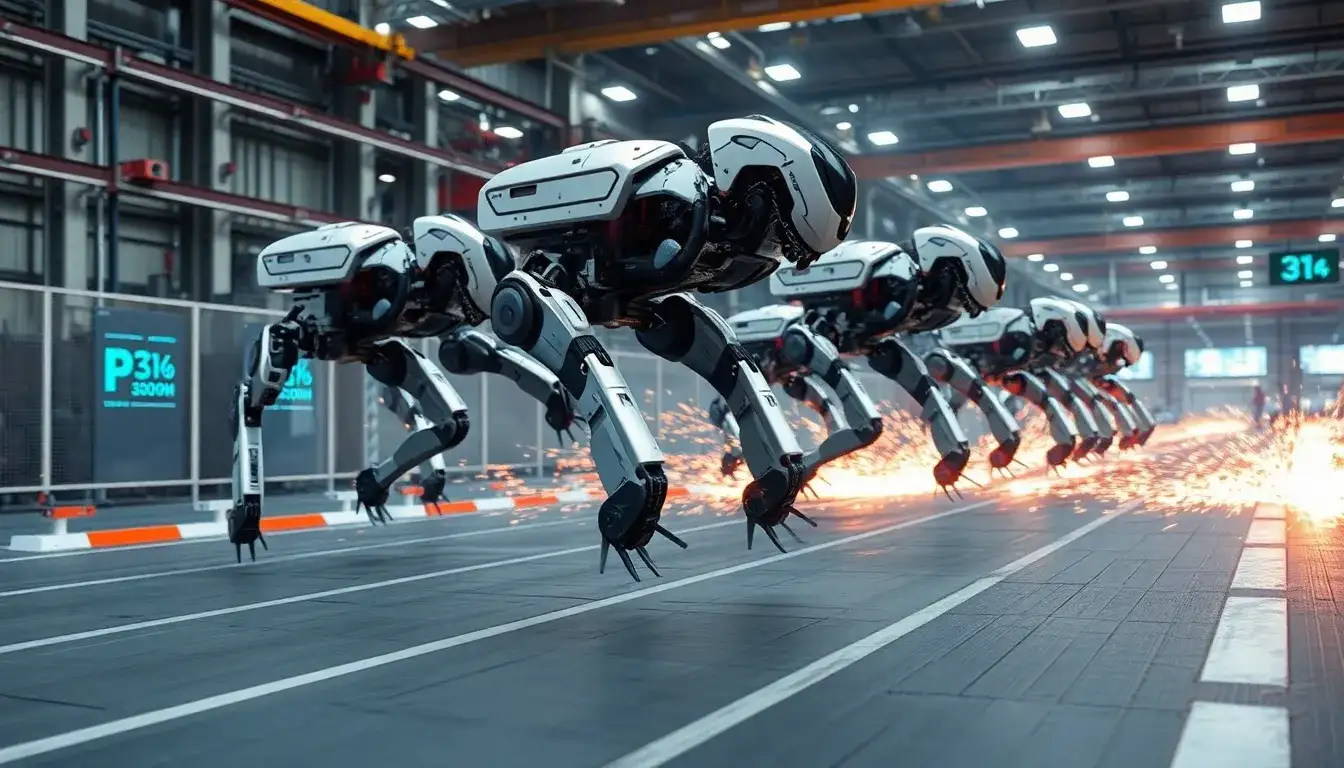
Wang Xingxing made a bold statement at the Yabuli Forum, claiming that by mid-year, China’s humanoid robots will break the 10-second barrier for a 100-meter sprint, surpassing Usain Bolt. While this may sound like a challenge to the limits of physics, it raises a fundamental question: If speed is the only goal, why invest heavily in bipedal robots when wheeled platforms like Automated Guided Vehicles (AGVs) and self-driving cars can easily achieve speeds of several kilometers per hour on flat surfaces? Why challenge Bolt with bipedal robots?
The answer lies in the fact that high-speed bipedal movement is not an end in itself. Instead, it represents the pinnacle of current embodied intelligence technology. The technological capabilities developed in the pursuit of this limit are forming a foundational base that will ultimately support a wide range of applications, from industrial inspections to home services.
This “pinnacle breakthrough followed by gradual descent” technological logic is reshaping the competitive landscape of the humanoid robot industry.
From “Can Run” to “Can Work” – A Technological Funnel
When a robot runs at 10 meters per second (36 kilometers per hour), the time a single foot is in contact with the ground is only about 80 milliseconds. In this brief moment, the control system must predict ground reaction forces in real-time, coordinate the torque of all 31 joints, and adjust the center of mass during flight. This scenario thrusts the robot’s hardware and algorithms into an “extreme testing laboratory”—the motors must respond instantly under a peak torque of 360 N·m, the carbon fiber structure must withstand impact loads exceeding ten times its weight, and the perception-decision-execution loop must operate at a frequency in the kilohertz range.
Wang emphasizes that “mobility is a prerequisite for real work,” referring to the technical system refined under such extreme pressure. When the Yushu H1 completed 1500 meters at a pace of 3.8 meters per second during the 2025 Robot Sports Meet, it validated not only endurance but also robustness in thermal management and control stability in dynamic environments. These capabilities, when scaled down to industrial scenarios at 3-4 meters per second, translate into dynamic balance when crossing cable trenches or navigating obstacles. Further down to home settings at 1-2 meters per second, they manifest as the ability to prevent falls when suddenly bumped by pets.
In other words, the exploration of the limits of bipedal running essentially establishes a “dynamic stability” technical baseline for the entire field of embodied intelligence. While wheeled robots excel on structured surfaces at the cost of environmental adaptability, the speed breakthroughs of bipedal robots aim to demonstrate that they can maintain higher maneuverability than humans on unstructured terrains such as rubble, stairs, and rocky paths.
The Reality of the Speed Race: Not Just a Single Breakthrough, But Systematic Trade-offs
The current global competition in bipedal speed involves various participants not merely in opposition but in search of different balance points within the “speed-stability-generalization” triangle. Yushu Technology has chosen a lightweight, electric-driven aggressive approach. The H1 weighs only 47 kilograms and utilizes the OmniXtreme framework from the Beijing Institute of Technology, combining generative pre-training with reinforcement learning. Thousands of virtual robots have “fallen millions of times” in simulation before being transferred to the physical realm. This path sacrifices some load capacity (the H1 struggles to carry more than 20 kilograms for extended runs) in exchange for high control frequency and response speed. Its record of 3.3 meters per second, achieved in August 2025, was measured on a standard track as an average speed rather than a peak on a treadmill.
On the other hand, Ming Shi Technology has taken a different approach. Its full-sized robot, Bolt, weighs 75 kilograms and achieved a peak speed of 10 meters per second on a treadmill in February 2026. However, this peak speed is strictly defined: it was achieved on a specially designed track, and the ability to maintain this speed on complex terrain is yet to be demonstrated. Ming Shi’s “mimetic jumping mouse calf” optimizes mass distribution, but the strict multi-body dynamic modeling demands high computational power, making it closer to the limits of laboratory exploration.
Zhongqing Robotics T800 is also noteworthy. This 70-kilogram robot showcased a peak speed of 12 kilometers per hour (3.33 meters per second) in 2025, with a knee joint peak torque of 450 N·m, surpassing Yushu’s 350 N·m. Zhongqing emphasizes a balance between high torque bursts and endurance (4-5 hours of operation), targeting practical scenarios in warehouse logistics rather than pure racing. Meanwhile, Tesla’s Optimus and Figure AI represent a more data-driven and pragmatic approach.
Tesla has migrated its end-to-end neural network for autonomous driving to robot control, combining visual SLAM with gait planning via the FSD chip, currently achieving a maximum speed of about 3.8 meters per second (8.5 mph) while emphasizing generalization in factory environments. The Helix model from Figure replaces 100,000 lines of traditional control code with a neural network, although System 0 only handles basic physical instincts while higher-level planning still relies on visual-language models, with current gaits resembling “fast walking” rather than “sprinting.” These paths are not mutually exclusive; they reflect different scene needs: Yushu and Ming Shi explore physical limits to establish technical advantages, Zhongqing seeks the sweet spot between load and speed, while Tesla and Figure test whether large data scale effects can replace traditional physical modeling. The ultimate solution may likely be a fusion—physical models provide fundamental dynamic constraints, neural networks handle high-dimensional perception, and reinforcement learning optimizes specific skills.
Engineering Realities and Hidden Costs of Speed
In the pursuit of “surpassing Bolt,” some fundamental engineering constraints are often overlooked, yet these constraints determine whether technological breakthroughs can move beyond the laboratory. First is the difference in test conditions. Ming Shi’s Bolt achieved 10 meters per second on a treadmill, while Yushu’s H1 recorded an average speed of 3.8 meters per second over a 1500-meter real-world run. These figures cannot be directly compared: treadmills provide consistent friction coefficients and support, while real-world runs must cope with uneven surfaces, wind direction, centrifugal forces during turns, and other variables.
Wang’s prediction of the “10-second 100 meters” requires overcoming engineering challenges such as starting acceleration, gait transitions, and emergency stop buffers to be replicated on a standard athletic track. Secondly, the accuracy of speed calculations must be precise. The Yushu H1’s time in the 1500-meter race was 6 minutes and 34.40 seconds, translating to an average speed of 3.80 meters per second. Such subtle differences have fundamental implications for motor selection and energy consumption calculations in engineering.
Moreover, the hidden costs of energy consumption and reliability cannot be ignored. When bipedal robots run at 10 meters per second, their joint motors operate at peak power output, causing exponential increases in wear and heat generation for gearboxes. Currently, most humanoid robots can only sustain 1-2 hours of high-intensity operation, which is still far from the 8-hour continuous operation required in industrial settings. Wheeled AGVs on flat surfaces currently demonstrate an order of magnitude better energy efficiency (energy consumption per kilometer) than bipedal robots.
Additionally, structural fatigue and maintenance costs are critical. During high-speed running, the cyclic loads on a robot’s leg structure exceed normal operating conditions, necessitating verification of the fatigue lifespan of carbon fiber composites, wear rates of joint bearings, and vibration tolerance of wiring harnesses during extreme testing. These hidden costs are often masked in laboratory demonstrations but can become decisive factors in real-world deployment.
Exploring the Commercial Loop: From Stage Performance to Scene Cultivation
Climbing the technological pyramid requires market support, and the source of this support often determines whether the tower ultimately reaches great heights or collapses. On New Year’s Eve, Yushu sparked public interest with the world’s first fully autonomous cluster martial arts performance—highlighting continuous table-flipping parkour, aerial flips (with heights over 3 meters), consecutive single-leg flips, wall flips after a two-step launch, and Airflare rotations—performed seamlessly by 24 robots in a live broadcast without camera cuts, achieving instantaneous running speeds of 4 meters per second with a synchronization error of less than 0.1 seconds.
Other companies like Galaxy Universal, Magic Atom, and Songyan Power also showcased their skills in dance, skits, and micro-films. This seemingly “flashy” performance was, in fact, a foundational base for China’s industry—through rental models, commercial performance economies, and educational displays, robots have achieved a physical presence and cost dilution before they are ready for factory deployment.
Zhi Yuan has entered the commercial performance market with a light-asset approach through its “Qingtian Rent” platform, while Yushu has opened the G1 to individual developers as a research entry point. These stages not only provide cash flow but also facilitate public awareness and supply chain integration. Compared to Tesla Optimus’s approach of “mass production after maturity,” China’s path has chosen an ecological nurturing logic: allowing robots to gain market support through performances while in a “semi-mature” state, creating a short-term commercial loop that feeds back into long-term technological iteration.
The current question is whether the pyramid base, constructed from performance economies and rental models, is robust enough to support the weight of advancing bipedal running technologies. Currently, humanoid robots are generally priced in the tens of thousands to hundreds of thousands of dollars range. Even if China’s supply chain can cut costs to one-third of similar products in the U.S., a true “ubiquity” is still far off.
The brand endorsement and attention generated by the Spring Festival successfully encouraged local governments, state-owned enterprises, and communities to open their spaces as testing grounds. However, whether this institution-driven demand can be transformed into sustainable market demand remains to be seen. Notably, the transition from performance to application is quietly taking place. Yushu robots have begun pilot projects in electrical inspections and warehouse logistics; Zhi Yuan’s rental platform is expanding from commercial performances to educational, display, and experiential scenarios; and Zhongqing’s T800 has shown unique advantages in heavy-load transport scenarios due to its high torque characteristics. While these explorations are still small in scale, they provide real data feedback and scenario validation for technological implementation.
The key question is not whether “running fast has any utility”—the technology from F1 racing eventually finds its way into civilian vehicles, and extreme exploration has its own value—but whether China can leverage the window period of the performance economy to accelerate the transition from “stage display” to “scene cultivation,” transforming the expansion of the pyramid base and the elevation of the pyramid tip into a synergistic cycle: each expansion of the base will serve as a launching distance for the tip’s upward sprint. As for whether robots can run under 10 seconds on a standard athletics track, Bolt is merely a milestone. What we aim for is to achieve higher, faster, and stronger!
Original article by NenPower, If reposted, please credit the source: https://nenpower.com/blog/the-race-to-build-faster-bipedal-robots-exploring-the-future-of-robotics-and-its-industrial-applications/

