

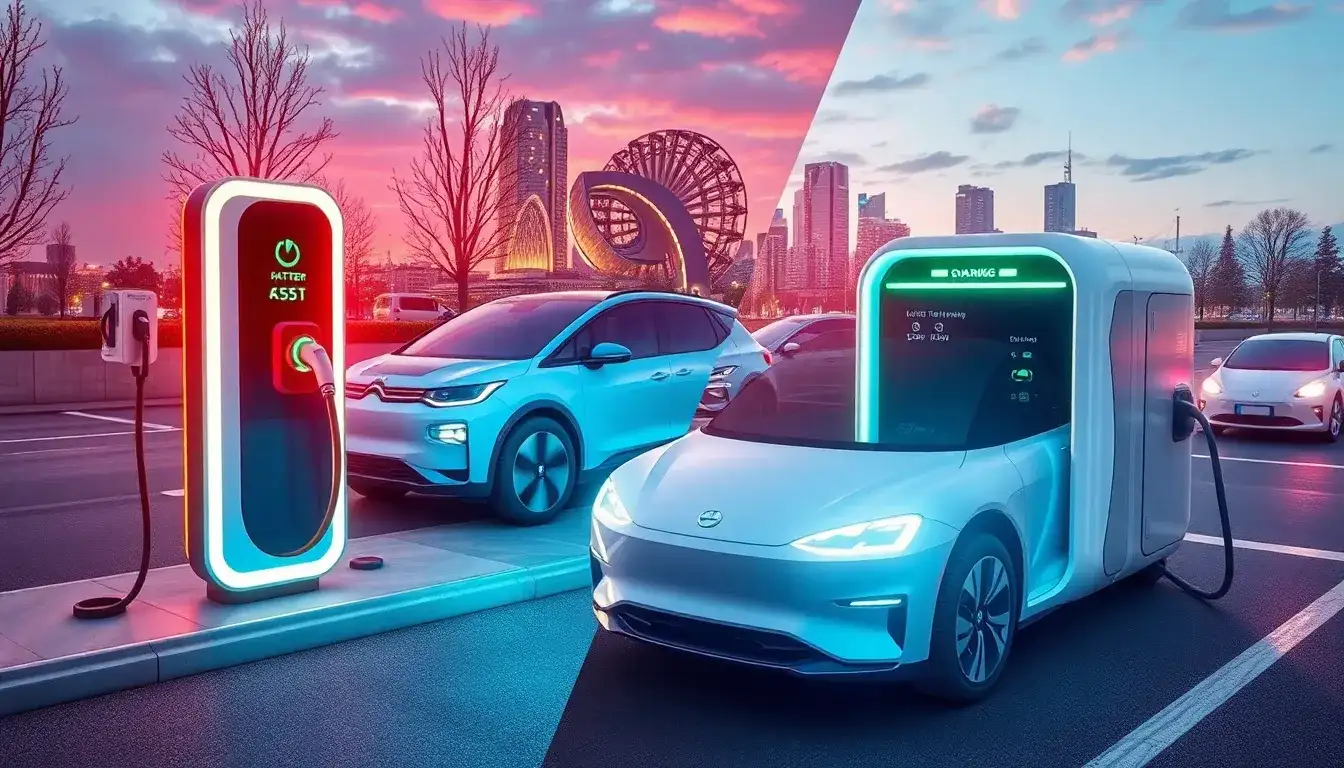
Charging faster than battery swapping? Who can electric vehicle owners rely on?
With a full battery, drivers often feel confident, but charging at service areas can lead to tough decisions. During the recent May Day holiday, highway charging stations once again witnessed the phenomenon of “charging pile snatching.” Lines for charging stretched hundreds of meters, and multiple vehicles charging simultaneously led to insufficient power. Some stations even implemented a food ordering system to manage queues. Such scenarios of charging chaos during holidays have become a hallmark of this era.
As of 2024, China has maintained its position as the world’s largest producer and seller of new energy vehicles for ten consecutive years, with the total number exceeding 30 million. However, the Achilles’ heel of energy replenishment efficiency remains the biggest concern for electric vehicle owners, posing a significant challenge for the industry. The shortcomings of insufficient charging pile numbers and slow charging speeds are particularly pronounced during peak travel times, leading highways to resemble “charging parking lots” and urban commercial areas to witness fierce competition for charging spots. Users are increasingly eager for charging speeds equivalent to those of traditional fuel vehicles.
The anxiety surrounding electric vehicle mileage raises deeper questions. How can this concern be alleviated? Automakers, battery manufacturers, and the industry at large are grappling with this issue. Yet, the longstanding debate between battery swapping and charging has yet to yield a clear winner. At the recently held 2025 Shanghai Auto Show, advocates of both technological approaches showcased their abilities, each trying to prove their solution is the future.
On one side are the rapid charging advocates, with BYD showcasing its “5-minute charge for 400 kilometers of range” fast-charging battery, while Star Charging has rolled out liquid-cooled ultra-fast charging equipment in overseas markets. On the other side, the battery swapping faction, led by CATL, introduced ten battery-swapping models in collaboration with five major automakers and announced a 2.5 billion yuan investment plan for expanding battery swapping stations.
The competition for energy replenishment efficiency boils down to the battle for user experience. Rapid charging proponents aim to reduce charging time to the duration of a coffee break, while battery swapping advocates strive for a refueling process that is even quicker than filling a gas tank. Ultimately, alleviating energy replenishment anxiety is about capturing the discourse surrounding the future of new energy ecosystems.
Charging speed for new energy vehicles has reached a point where it can match traditional refueling. In March of this year, BYD launched the world’s first mass-produced megawatt fast-charging system, which, according to the company, can add 2 kilometers of range in just one second and increase range from 35 kilometers to 407 kilometers in five minutes.
Anyone who has driven an electric vehicle knows that traditional fuel cars typically take 5 to 8 minutes to refuel. BYD’s megawatt fast charging has effectively brought charging speeds to par with traditional refueling during the 10% to 80% battery range. Surprisingly, this isn’t even the peak of current energy replenishment technology. At the Shanghai Auto Show a month later, CATL unveiled its second-generation superfast charging battery, achieving a charging power of 1,300 kilowatts and increasing range to 800 kilometers.
While these two fast-charging technologies only reach these speeds under specific battery states of charge and in standard testing environments, they offer a glimpse of the possibility of charging speeds equivalent to fuel refueling. After all, range anxiety has long plagued electric vehicle owners; early battery technology was immature, making electric vehicles subject to criticism for their limited range and slow charging, earning them the nickname “electric daddies.” In fact, due to insufficient charging piles and peak electricity price disparities, ride-hailing drivers in Beijing have been known to wake up at 4 AM in freezing winter to secure a charging spot just to save 30 yuan.
The leap in fast-charging technology is gradually resolving this predicament. Since Tesla introduced its first V3 supercharging station in China in 2019, the efficiency of electric vehicle energy replenishment has rapidly advanced, moving from 15-minute fast charging to 5-minute ultra-fast charging for 200 kilometers of range, and now to “one second for one kilometer” of fast charging. Improving energy replenishment speed has become the new battleground for automakers.
Furthermore, the number of models supporting 800V fast charging technology has exploded. According to reports, the penetration rate of 800V models was approximately 2% in 2023, rising to 5.8% by January 2024. Currently, fast-charging models are generally able to achieve the goal of “5-minute charging for 200 kilometers of range,” with prices gradually dropping to the range of 200,000 yuan or even 150,000 yuan.
As infrastructure continues to improve, “equal rights for electric and fuel vehicles” are gradually being realized. Data indicates that Guangdong plans to build 274 new supercharging stations by 2025, Beijing aims to complete 1,000 stations by the end of this year, and Shenzhen has already become the first city in the country where the number of supercharging stations exceeds that of gas stations in 2024. Meanwhile, the number of gas stations is sharply declining. The China National Petroleum Corporation’s Economic and Technological Research Institute projects that by 2030, the number of gas stations in China will decrease from the current 110,000 to 90,000, meaning one in every five gas stations will disappear in the next five years.
As one netizen remarked, “The arrival of supercharging has accomplished equal rights for electric and fuel vehicles, almost revolutionizing fuel vehicles.” In the realm of energy replenishment, the struggle continues, and the future remains uncertain. While the traditional fuel vehicle sector appears to be suffering, the electric vehicle energy replenishment domain continues to see a struggle between the two modes of charging and battery swapping.
Previously, battery swapping was more popular due to its efficiency. For instance, NIO’s fourth-generation stations can reduce energy replenishment time to just 2 minutes and 24 seconds. The “separation of vehicle and battery” sales model also lowers the barrier to vehicle ownership. However, as the issues of standardization of battery specifications, communication protocol barriers, and construction and operation costs persist, the rapidly advancing supercharging technology has reignited discussions on the necessity of battery swapping. Some even contend, “Now is the time for battery swapping to exit the stage.”
But is that truly the case? At the recent Shanghai Auto Show, NIO CEO Li Bin became a focal point during a media Q&A session. It is well-known that a battery swap in under 3 minutes is one of NIO’s core selling points. When asked whether NIO was affected by the rise of supercharging, he provided a clear response: “Supercharging and battery swapping are not opposing forces.” Li Bin first highlighted that NIO has built over 26,000 charging piles nationwide, making it one of the companies with the most charging piles in the country. He then pivoted, stating, “No matter how fast supercharging is, it can never be faster than battery swapping.”
Li Bin further argued that frequent use of supercharging could impact battery lifespan. “If owners consistently use supercharging, can automakers guarantee a 15-year, 12-year, or even 10-year warranty on the battery? If they can, I would be impressed!” He also noted that supercharging requires a high power capacity, necessitating the construction of energy storage facilities, which can be costly. Additionally, there are two instances of power loss in the charging process from the grid to the storage device and then to the battery, while battery swapping incurs only one loss, leading to higher energy utilization efficiency.
Li Bin’s points are not without merit. The extensive construction of supercharging stations currently faces a host of technical challenges that need to be addressed. For example, in Chongqing, plans are underway to build supercharging equipment with a total power of 1.9 million kilowatts by 2025. This figure highlights a comparison: in 2023, the city’s peak electricity load was about 26 million kilowatts, meaning that fully operational supercharging equipment would account for 7% of total electricity consumption. Therefore, the power grid must be upgraded in advance, but the revamped equipment remains largely idle during off-peak electricity periods, akin to stations expanded for holidays sitting empty and wasting resources.
Additionally, supercharging exhibits some hidden challenges in various regions and scenarios. For instance, in Black River, where temperatures can drop to minus 40 degrees Celsius, charging ports may freeze, affecting charging efficiency, while battery swapping stations can still complete energy replenishment in three minutes. This characteristic makes battery swapping irreplaceable in northern cold regions and logistics parks.
In the face of increasing energy replenishment anxiety, the contest between charging and battery swapping continues to intensify. Currently, fast charging technology must address the proliferation of charging piles and further enhancements in charging speeds, along with the impact on grid load. In contrast, battery swapping continues to grapple with enduring issues such as costs and standardization.
Taking NIO as an example again, various financial media have reported that the construction costs of its first, second, and third-generation battery swapping stations were 3 million, 2 million, and 1.5 million respectively. By the end of 2024, NIO plans to have over 3,000 battery swapping stations, with the fourth-generation stations theoretically capable of serving up to 480 times a day. According to Li Bin, achieving an average of 60 daily orders at a single battery swapping station can break even. NIO’s Senior Vice President and President of LEV Automotive, Shen Fei, stated in a live broadcast that “in Shanghai, the battery swapping business is nearing 9,000 orders daily, soon approaching 10,000 orders. Currently, as long as battery swapping stations are built in most parts of Shanghai, they are sure to be profitable, very close to the break-even point.”
Optimistically, an average of 60 orders is certainly not an astronomical figure. However, at present, the majority of stations nationwide are still struggling below the break-even line, indicating that battery swapping stations still have a long journey ahead. Despite the speed of battery swapping, the construction costs remain extremely high.
Of course, NIO does not plan to rely solely on itself. Given that the current challenges do not constitute an astronomical figure, a key strategy for breaking through is to form alliances with other automakers to share battery swapping stations. NIO, along with seven other automakers including Changan, Geely, and FAW, has established a battery swapping alliance to share infrastructure and battery asset management, further consolidating its energy replenishment advantages while reducing operational costs.
Another partner, CATL, is collaborating with NIO to advance the chocolate battery swapping block, which is compatible with A0-class to C-class models, enabling inter-brand battery compatibility. Additionally, NIO has announced a patent for a smart battery swapping station that can accommodate multiple battery packs, adaptable to various models within the “battery swapping alliance.”
It is clear that as the user base expands through shared alliances, despite the many challenges, the future of battery swapping remains promising. In fact, battery swapping has long been a topic that the global industry has revisited multiple times. The first company to explore battery swapping, Better Place, ultimately failed; Tesla also withdrew from the concept. Yet, domestic automakers have been increasingly bold in their pursuits in recent years—aside from NIO, major manufacturers like SAIC, Geely, and CATL are all entering the battery swapping arena, many of which are also part of the battery swapping alliance.
Concerns are not without merit, and they are quite evident—whether these new entrants are genuinely optimistic about battery swapping or merely trying to secure a position remains uncertain. Regardless of whether it is fast charging or battery swapping, both ultimately aim to alleviate users’ anxiety about energy replenishment. Li Hongqing, Senior Vice President of Star Charging R&D, mentioned in an interview that fast charging and battery swapping are not mutually exclusive but serve different market demands and scenarios.
Fast charging and battery swapping both contribute to a better travel experience. “Fast charging technology is quick but costly, suitable for users seeking efficient energy replenishment who are less sensitive to price, such as business travelers; battery swapping technology requires battery standardization and is more suitable for daily commuting, focusing on convenience and price sensitivity,” Li Hongqing stated.
From industry trends, compatibility is emerging as a new trend: installing a slow charging pile at home for daily charging, using fast charging when in a hurry, and seeking battery swapping stations for highway travel. Just as some enjoy the thrill of road trips while others prefer the convenience of high-speed trains, automakers do not need to “pick sides” but rather showcase their strengths—NIO opens up battery swapping technology to peers, Tesla aggressively builds supercharging stations, and Li Auto has even created a “dual insurance” system of “supercharging + refueling.” At least for now, with 30 million new energy vehicle owners facing anxiety over energy replenishment, China has ample space to accommodate the development of both supercharging and battery swapping.
Original article by NenPower, If reposted, please credit the source: https://nenpower.com/blog/the-race-for-ev-charging-fast-charging-vs-battery-swapping-solutions/

