

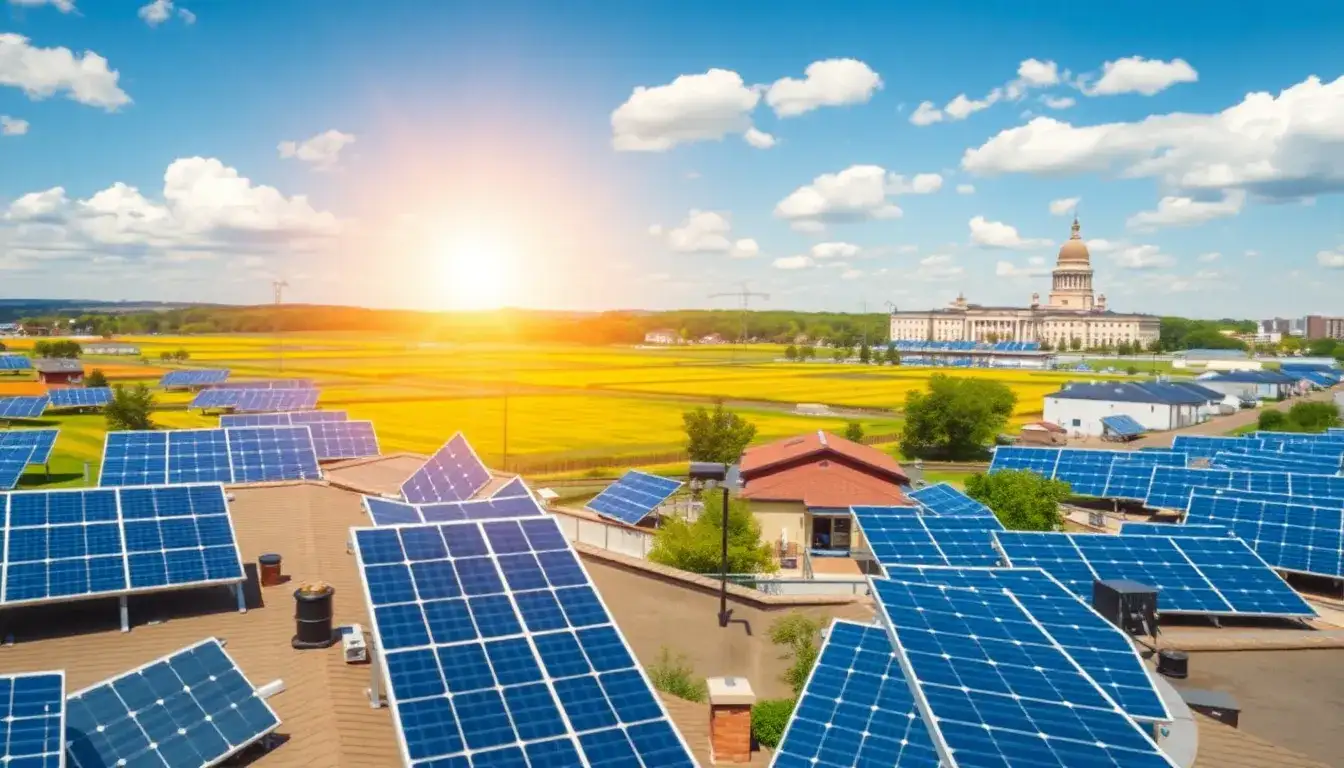
The deadline of April 30th marks a significant turning point for distributed photovoltaic (PV) systems in China. As the deadline approaches, new policies are being implemented across various provinces, reshaping the landscape of distributed PV projects. This article explores the implications of these changes and identifies regions that may still offer opportunities for PV developers.
Earlier this year, the National Energy Administration introduced the Management Measures for the Development and Construction of Distributed Photovoltaic Power Generation, which establishes April 30th as the cutoff for distinguishing between new and existing projects. Any distributed PV projects that come online after this date will be subject to specific regulations set by individual provinces. As of April 17th, provinces including Hubei, Jilin, Ningxia, Guangdong, Jiangsu, Guangxi, Chongqing, Hainan, and Shanxi have released implementation guidelines, with several cities also announcing local policies.
These policies generally adhere to the principles outlined by the National Energy Administration, emphasizing local consumption of distributed energy. Key points include:
- Reiterating that general commercial and industrial distributed PV can only choose between “self-consumption” and “self-consumption with excess fed into the grid.” Large commercial distributed PV systems are primarily allowed only the “full self-consumption” option.
- Imposing limits on the grid connection ratio for distributed PV, with requirements ranging from 20% to 50% for general commercial systems. Exceeding these limits means grid companies will not settle the excess generation.
These regulations impose strict constraints on distributed PV, notably affecting general commercial systems, leading to a significant decrease in installed capacity this year. Companies involved in distributed energy are feeling the impact of these changes, which disrupt the previously favorable conditions.
From the perspective of local economies and industrial policies, there remains a desire for distributed PV projects to thrive locally. However, the capacity of the power system to absorb this energy creates a notable constraint that influences the development of distributed PV systems. Consequently, local governments are striving to balance development with capacity absorption, resulting in a diverse array of policies across regions.
Some provinces have enacted stringent limits on the grid connection ratios, inciting concern within the industry. Notably, Ningxia, Hubei, and Jilin have adopted particularly stringent measures. Ningxia was the first province to release its guidelines on March 17th, stipulating that general commercial distributed PV could adopt either self-consumption or self-consumption with excess fed into the grid, but the annual grid-connected generation must not exceed 30% for public institutions and 50% for commercial buildings. Given Ningxia’s weak absorption capacity, this limitation was anticipated and did not provoke much backlash.
However, when Hubei, possessing a better absorption capacity, announced its policies on March 25th, the entire distributed PV sector reacted strongly. Hubei’s regulations restrict the annual grid-connected generation for general commercial systems to 50% of total generation, effectively limiting future operations in that sector. Following this, Jilin introduced even more stringent measures on April 3rd, capping the annual grid-connected generation for general commercial systems at just 20% of total generation, with large commercial systems banned from connecting excess generation to the grid entirely. This set a new precedent for strict regulatory measures.
Other provinces, such as Guangxi, Chongqing, Hainan, and Shanxi, quickly followed suit, enforcing similar restrictions on the grid connection ratios, which severely limits the options for distributed PV developers. The fear within the industry is that current restrictions on commercial systems could foreshadow similar limitations for residential PV systems in the future.
Conversely, some local governments have opted for a more supportive approach, refraining from imposing strict limits on the grid connection ratios and instead encouraging the development of distributed PV projects. For example, the Development and Reform Commission of Xinyu City in Jiangxi Province issued guidelines on March 18th that prohibited development in non-building sites like agricultural greenhouses, but allowed these projects to be classified under centralized PV management instead. Similar approaches have been adopted in Fujian and Guangdong, allowing projects to operate under more favorable conditions.
Some regions, such as Guangdong and Jiangsu, have boldly stated their commitment to supporting distributed PV without imposing stringent restrictions. Guangdong’s energy bureau announced on March 20th that due to favorable absorption conditions, there would be no mandatory requirements for the grid connection ratios for general commercial distributed PV projects for the time being. Jiangsu followed suit on April 11th, allowing flexibility in the self-consumption ratios for PV projects.
As of the end of 2024, Guangdong’s total installed capacity reached 222.6 million kW, marking a 100% increase, with significant contributions from wind and solar power. Despite a relatively lower penetration rate of 30% for renewable energy, concerns remain about the capacity to absorb increasing volumes of new energy.
In conclusion, the new regulations from the National Energy Administration have resulted in a patchwork of policies at the local level, with some provinces imposing strict limits while others continue to encourage development. Ultimately, enhancing the power system’s capacity to absorb renewable energy is crucial for the future of distributed PV and the broader new energy sector. Without improvements in this area, both restrictive and supportive measures will still leave distributed PV developers facing uncertainty. As the industry evolves, developers must adapt by exploring new opportunities, such as focusing on self-consumption projects or integrating energy storage solutions.
Original article by NenPower, If reposted, please credit the source: https://nenpower.com/blog/the-impact-of-new-regulations-on-distributed-photovoltaics-opportunities-and-challenges-ahead/

