

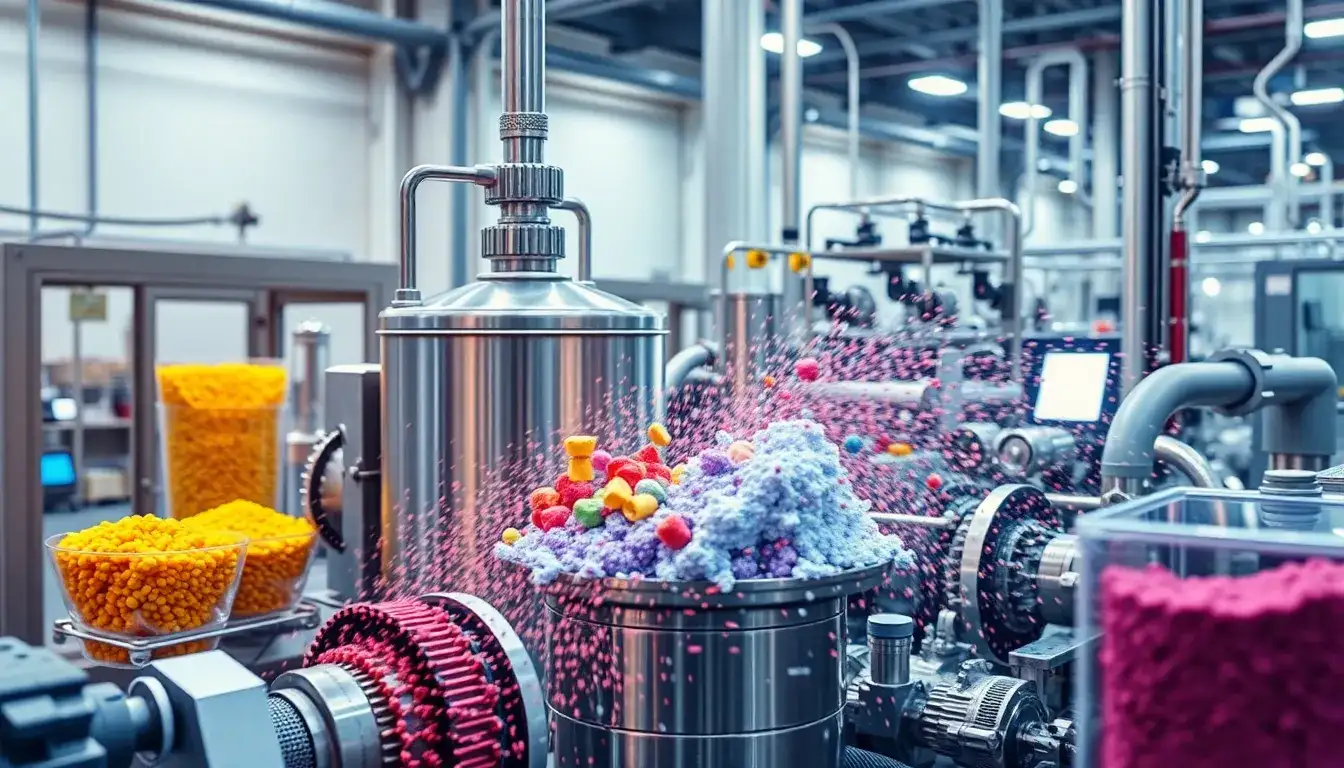
Mixing Intensification is Shaping the Future of Materials Manufacturing
======================================
At the core of every chemical reactor lies an often-overlooked force that drives industrial advancement: mixing. While it may not make headlines like artificial intelligence or quantum computing, efficient mixing is essential for overcoming bottlenecks in the journey toward advanced materials. A recent study published in *Engineering* has provided new insights into this vital process, revealing that intensifying mixing could be the key to accelerating innovations in various fields, including lithium batteries and smart agriculture.
### Unpacking the Science: Macromixing vs. Micromixing
Mixing is not a one-size-fits-all process; it involves two distinct yet interconnected phenomena: macromixing and micromixing. Macromixing occurs on the reactor scale and ensures that components are evenly distributed throughout the vessel. In contrast, micromixing operates at the molecular level, where reactants are dispersed and reactions take place.
A significant challenge in this field is the difficulty in establishing definitive quantitative relationships between mixing and reaction efficiency. To navigate this complexity, researchers employ tools such as tracer experiments and computational fluid dynamics (CFD) for simulating macromixing. Micromixing, on the other hand, is investigated through reaction time measurements and specially designed chemical systems. As co-author Guang-Wen Chu emphasized, “Understanding the subtleties of mixing across scales is pivotal to refining reaction kinetics and ultimately, product quality.”
### Old Techniques Meet New Technology
Traditional methods like telecentric photography and high-speed videography continue to play a crucial role in monitoring fluid behaviors. Additionally, chemical probes can characterize mixing performance without the need for intricate setups. However, the integration of artificial intelligence (AI) marks a significant advancement. Machine learning algorithms, when combined with traditional tools, provide sharper analyses and quicker insights. Despite challenges such as data dependency, the advantages are clear. Chao Yang from the Chinese Academy of Sciences stated, “Integrating AI with experimental measurements offers a new dimension of precision in tracking multiphase flow phenomena.”
### Real-World Impacts: From Batteries to Agriculture
The benefits of enhanced mixing extend beyond theoretical research; they are already transforming entire industries.
**Powering Up Lithium Batteries**: In China’s rapidly expanding lithium battery sector, researchers have combined multiphase CFD, micromixing models, and population balance equations to digitally scale co-precipitation crystallizers. The outcome? Consistently high-quality precursors that enhance battery performance. This advancement has significantly boosted industrial efficiency, enabling manufacturers to meet rising demand without sacrificing quality.
**Precision in Optical Materials**: In optics, rotating packed-bed (RPB) reactors are proving their worth. These high-gravity systems excel at achieving homogeneous micromixing, which is crucial for creating nanocomposites with adjustable optical properties. The result is faster production cycles and improved control over the final product’s performance.
**Smart Solutions in Agriculture**: The agricultural sector is also benefiting. By utilizing RPB reactors, manufacturers have discovered a scalable method to produce hollow silica nanoparticles for targeted pesticide delivery. This innovation addresses a long-standing challenge in nanopesticide production: scaling without losing efficacy. According to Dan Wang, a contributor to the study, “By improving mixing control, we not only enhance efficiency but also unlock new applications across diverse industries.”
### Where Science Meets Strategy
While the findings of the study lay a solid foundation, there are numerous opportunities and challenges ahead. The authors identify four key areas for further exploration:
1. **Advanced Mixing Techniques**: Innovations such as ultrasonic and electric-field-assisted mixing present promising alternatives to mechanical agitation, potentially ushering in a new era of energy-efficient mixing.
2. **Multiscale Simulation**: Merging macro and micro simulations will lead to better predictive modeling of mixing behaviors, especially in complex multiphase systems.
3. **Interdisciplinary Collaboration**: Fostering collaboration between chemists, engineers, and data scientists is essential for driving innovation. Cross-functional teams will be crucial in overcoming current technical challenges.
4. **Industrial Translation**: Transitioning breakthroughs from laboratory settings to industrial applications remains a priority. Accelerating this process could unlock significant commercial and environmental benefits. As co-author Xin Feng aptly noted, “Translating lab-scale innovation into scalable industrial solutions is where the real impact happens.”
### Rethinking Manufacturing Through Mixing
The concept of mixing intensification is no longer limited to niche research; it is becoming a cornerstone of smart, scalable, and sustainable manufacturing. Whether it involves enhancing lithium batteries, refining nanomaterials, or revolutionizing agricultural inputs, the message is clear: to achieve better results, start with improving the mix. In a world increasingly focused on energy transitions and environmental responsibility, mastering the intricacies of mixing may be one of the smartest strategies manufacturers can adopt.
Original article by NenPower, If reposted, please credit the source: https://nenpower.com/blog/the-impact-of-mixing-intensification-on-the-future-of-materials-manufacturing/

