

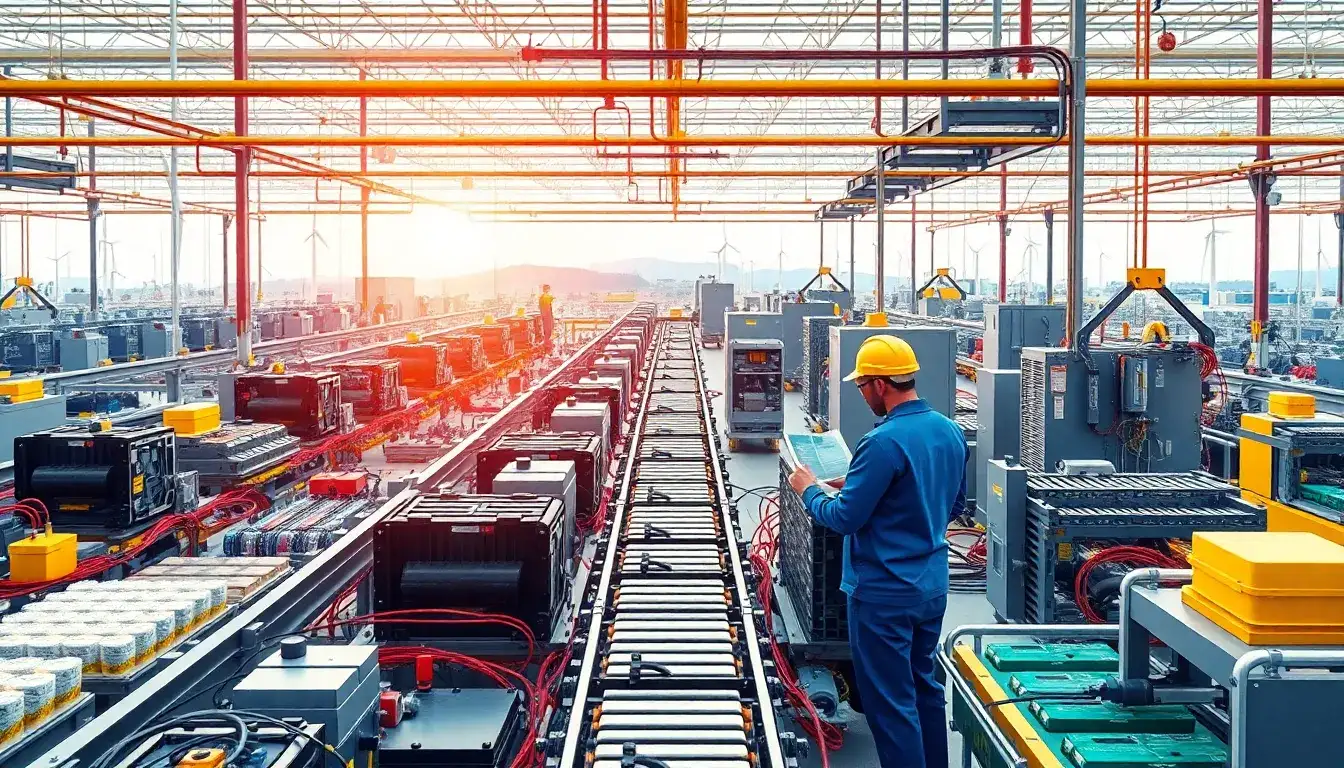
As the world embraces electrification, the countries that dominate the battery supply chain will shape the future of mobility, energy, and economic power. For the United States, the challenge is not only to keep up but to take the lead.
As electric vehicles and renewable energy storage become central to the global energy transition, the demand for batteries is at an all-time high. In 2024, global battery demand exceeded 1 terawatt-hour, enough to power 100 million homes for an hour, according to the International Energy Agency. However, the infrastructure needed to meet this soaring demand, particularly in the U.S., is still lagging behind.
### The U.S. Push for Battery Independence
Historically, the U.S. has depended heavily on foreign sources for battery components and materials. In light of rising geopolitical tensions and ambitious clean energy goals, policymakers are striving to change this dependency. The Inflation Reduction Act (IRA), enacted in 2022, introduced tax credits and incentives aimed at boosting domestic battery production while also imposing restrictions to reduce reliance on adversarial nations.
“These policies, along with support from state and local governments, have significantly accelerated battery manufacturing in the U.S.,” stated Matt McDowell, a professor of mechanical engineering and materials science at Georgia Tech and the Carter N. Paden Jr. Distinguished Chair for Innovation in Material Science and Metals Processing. “However, we are still in the early stages of developing a truly resilient supply chain.”
Gleb Yushin, a professor at Georgia Tech and the chief technical officer of the battery materials company Sila, shares this sentiment. “The IRA’s FEOC restrictions provided a timely and necessary market signal to boost demand for battery materials produced outside of China, thereby encouraging cell makers to invest in local suppliers,” he explained.
Nonetheless, reshoring production presents considerable challenges. “It’s encouraging to see increased domestic production of graphite and other components,” McDowell noted. “This will lead to a more robust battery supply and lower prices in the long run.”
### How New Materials Are Changing the Game
While policy changes are crucial, innovation also plays a vital role. For decades, graphite has been the primary material used for battery anodes. However, researchers have long been exploring silicon as a potentially superior alternative, capable of storing up to ten times more charge.
The challenge lies in silicon’s tendency to swell significantly during charging, which can damage the battery. “It expands by 300%,” Yushin clarified, in contrast to graphite’s mere 7% expansion.
After years of research, Sila has developed Titan Silicon™, a silicon-carbon composite that addresses the swelling issue. “It offers 25–35% more energy density, charges over two times faster, and can be integrated into any production line,” Yushin said. “The next hurdle is scaling this technology for mass production while staying ahead of market demands.”
Solid-state and lithium-sulfur batteries are also being recognized for their potential to enhance safety and performance. While McDowell is optimistic about these technologies, he cautions that they are not yet ready for widespread adoption. “A crucial focus is on developing scalable manufacturing processes to compete with lithium-ion batteries,” he stated.
Yushin expresses skepticism about the advantages of solid-state batteries. “They require entirely new supply chains and infrastructures,” he remarked. “Silicon, on the other hand, is a perfect substitute for lithium metal — it is stable, reversible, and compatible with existing systems.”
### What It Will Take to Compete and Lead
The IRA initially spurred over $115 billion in clean energy investments, with $69 billion of that allocated for battery manufacturing. However, with parts of the legislation now facing potential repeal, the future remains uncertain.
“Given that most of the IRA is at risk of being repealed, we will see if a tariff strategy can yield similar results,” Yushin said. “There is substantial capital waiting on the sidelines, but without long-term stability, it’s challenging to justify the risk.”
He also highlighted deeper structural issues. “Capital intensity and borrowing costs are significant barriers to investment,” he noted. “Firm commitments to purchasing goods are essential for securing financing, but uncertainty surrounding tax credits has dampened demand for local supply.”
McDowell believes that a comprehensive strategy is necessary. “We must invest in workforce development, research, and infrastructure,” he stated. “This effort goes beyond just batteries; it involves creating an entire ecosystem.”
Original article by NenPower, If reposted, please credit the source: https://nenpower.com/blog/the-global-battery-boom-navigating-supply-chain-challenges-and-innovations-in-the-race-for-energy-independence/

