

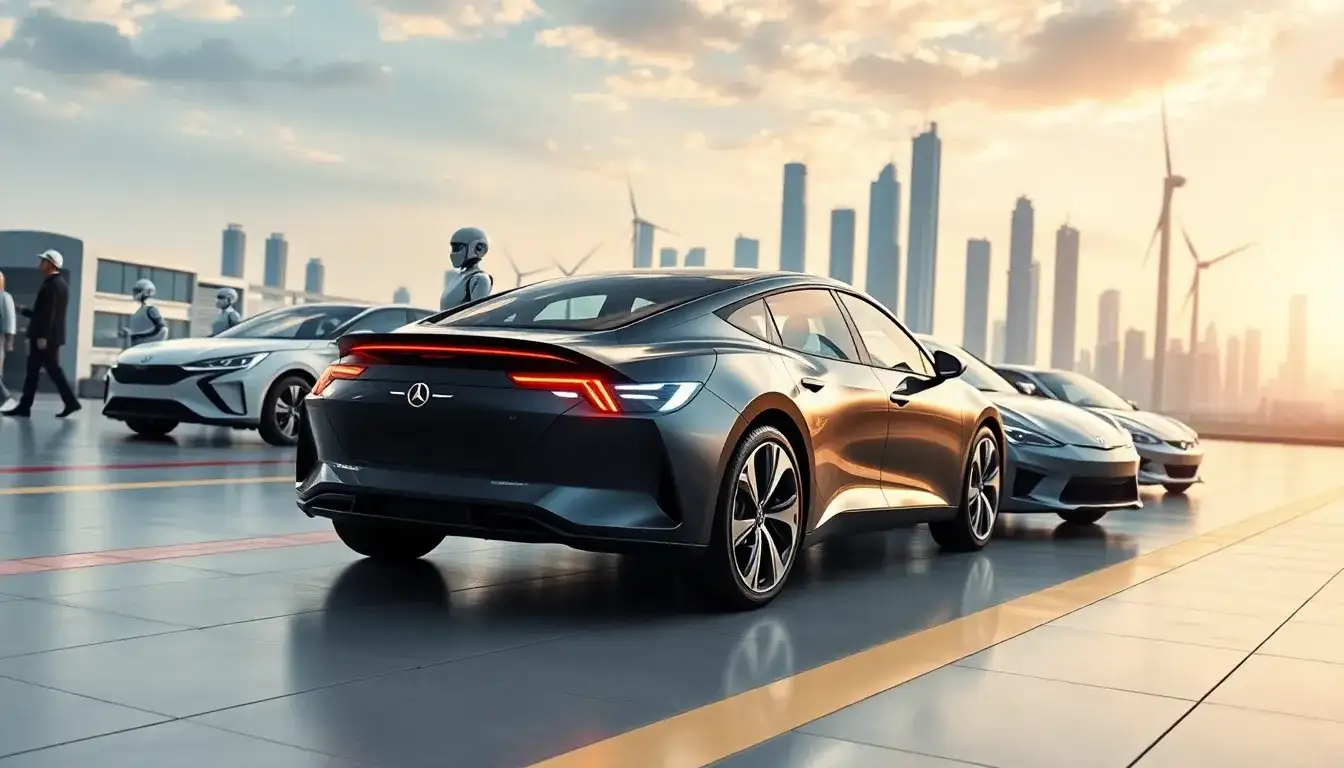
The Chinese automotive market is undergoing an unprecedented structural transformation in 2025. As domestic brands surpass joint venture brands in sales due to their advancements in new energy vehicles, joint venture companies that once relied on “exchanging market access for technology” are now seeking partnerships with local enterprises. This shift signals the emergence of a new era focused on the “reconstruction of joint venture vehicle value.” Celebrating its 20th anniversary, Changan Mazda aims to provide its own insights through a joint venture 2.0 model and a suite of new energy products.
Reflecting on the history of joint venture vehicle development in China, it began in 1984 when Beijing Automotive Group partnered with Chrysler to establish the first joint venture. Foreign brands quickly opened the Chinese market by introducing mature models and technologies. This “exchanging market for technology” approach, known as the 1.0 model, propelled rapid growth in the automotive industry. However, this model has shown signs of fatigue amid the new energy vehicle wave. As electrification becomes the primary focus of the Chinese market, foreign brands have lagged behind local market demands, while Chinese automakers have built leading research and development capabilities in the field of intelligent technology.
According to Changan Mazda, the essence of joint venture 2.0 is the mutual infusion of core advantages from both parent companies into the joint venture, rather than a one-way transfer of technology. This concept is vividly demonstrated in the MAZDA EZ-6 model. The engineering team at Changan Mazda’s Chongqing factory is practicing a unique development philosophy—using Changan’s EPA1 pure electric platform as a foundation while deeply integrating Mazda’s patented G-Vectoring control system, which maintains 0.9G lateral stability during cornering at 60 km/h. This technological synergy preserves Mazda’s “driver-centric” handling characteristics while incorporating localized intelligent features.
Design details of the EZ-6 showcase this integration: the “light wing” front design, inspired by Mazda’s Kodo design philosophy, features an innovative breathing light language; the intelligent cockpit system is deeply integrated with Tencent’s ecosystem, capable of recognizing dialect commands and providing personalized services based on context. This collaboration breaks away from the traditional division of “foreign technology, local market” in joint ventures, and through resource complementarity and cultural resonance, is reshaping the innovation paradigm of joint venture automakers.
The transition from one-way technology transfer to a two-way fusion of advantages in the joint venture 2.0 model signals a new logic for cooperation in the automotive industry. As Chinese automakers achieve technological advancements in electrification and intelligence, joint venture collaborations have evolved into a new battleground for optimizing global resource allocation. Foreign brands must leverage their core technologies and brand heritage, merging them with the innovative momentum of local partners to sustain their legendary status in a fiercely competitive market.
This deep integration is evident not only in technical specifications but also permeates every detail of the product philosophy, indicating that the Chinese automotive industry is entering a more vibrant new phase.
At Changan Mazda’s Nanjing R&D center, the engineering team has developed a “continuously variable range + super pure electric” dual-mode technology solution for the MAZDA EZ-6. This powertrain features a 1.5L Atkinson cycle engine with a thermal efficiency of up to 43%, paired with a 160kW permanent magnet synchronous motor, achieving a pure electric range of 200 km and a total range exceeding 1200 km under CLTC conditions. Notably, its innovative chassis technology—via the self-developed “Electric Fun Control System”—allows the vehicle to accurately simulate the linear acceleration characteristics of fuel vehicles in sport mode, effectively addressing the common discomfort associated with electric vehicle acceleration.
Moreover, the MAZDA EZ-6 represents a new interpretation of Mazda’s sporty gene in the era of electrification. It features a front double wishbone and rear H-arm multi-link suspension, achieving a perfect 50:50 weight distribution, which garnered an impressive 75 km/h result in the moose test. In terms of vehicle safety, the proportion of ultra-high-strength steel at 1500 MPa reaches 86%, and the battery pack has passed over 30 rigorous tests, including exposure to flames at 200°C and immersion in one meter of water. This trajectory of technological evolution reflects Changan Mazda’s localized innovation path within the joint venture model.
The core “Skyactiv” technology of the brand has now reached its third generation, utilizing cutting-edge technologies such as variable compression ratios and Miller cycles to achieve fuel vehicle thermal efficiencies exceeding 45%. In the new energy sector, the jointly developed “Qiji Battery” with CATL features a CTP module-free design, enhancing volume utilization by 15% and reducing fast charging time to just 28 minutes. From groundbreaking innovations in the powertrain to deep integration of the three electric technologies, the MAZDA EZ-6 series is setting a new benchmark for the value of joint venture new energy models.
According to the latest research by renowned consulting firm McKinsey, there is a clear polarization in the consumption of new energy vehicles in China: on one end is the price-sensitive entry-level market, where consumers seek the best cost-performance ratio; on the other end, the high-end market emphasizes brand heritage and experiential innovation, with users willing to pay a premium for differentiated value. Changan Mazda has keenly captured this trend by positioning the MAZDA EZ-6 within the 200,000 to 300,000 RMB price range, cleverly avoiding direct competition with domestic brands while precisely filling the gap in the joint venture brand sector in this market segment.
As the market share of domestic brands approaches 70%, the survival space for joint venture automakers is being redefined. They can either emulate Mazda by deeply engaging in the driving experience through the electrification evolution of the “Jinma Integration” philosophy to create an “Electric Fun Control” system—utilizing simulated engine sounds and dynamic damping adjustments to allow drivers to enjoy the quietness of electric vehicles while relishing the handling pleasure of traditional fuel cars—or follow Volkswagen’s ID series in creating a unique brand identity through design language innovation. Changan Mazda has clearly chosen the former, with engineers in the Chongqing R&D center calibrating steering response, torque distribution, and other parameters millions of times to restore that “car as an extension of oneself” driving sensation.
Behind this value reconstruction lies a profound exploration of industry chain collaboration within the joint venture 2.0 model. Changan Mazda’s partnerships with local tech companies like Huawei and Tencent have transcended mere technology procurement. The Tencent TAI 4.0 system, customized for the EZ-6, combines environmental perception with intelligent route recommendations; meanwhile, the Huawei DriveONE electric drive system, after recalibration by Mazda engineers, achieves a 15% increase in power response speed, localizing performance parameter optimization. On the flexible production line at the Nanjing factory, these technology modules can be flexibly assembled like building blocks, ensuring the technical legacy of the joint venture brand while injecting the agility of local innovation.
As Changan Mazda stands on the threshold of its 20th anniversary, it offers an enlightening perspective on the transformation of joint venture vehicles in China through its joint venture 2.0 model and new energy product matrix. As the automotive market enters the era of “chain competition,” joint venture companies must combine the technological legacies of foreign brands with the innovative momentum of local enterprises to discover new value coordinates. The story of Changan Mazda may well be the prologue to this transformation—it proves that joint venture vehicles can not only “survive” but also “thrive brilliantly.”
Original article by NenPower, If reposted, please credit the source: https://nenpower.com/blog/the-future-of-joint-ventures-in-chinas-evolving-auto-market/

