

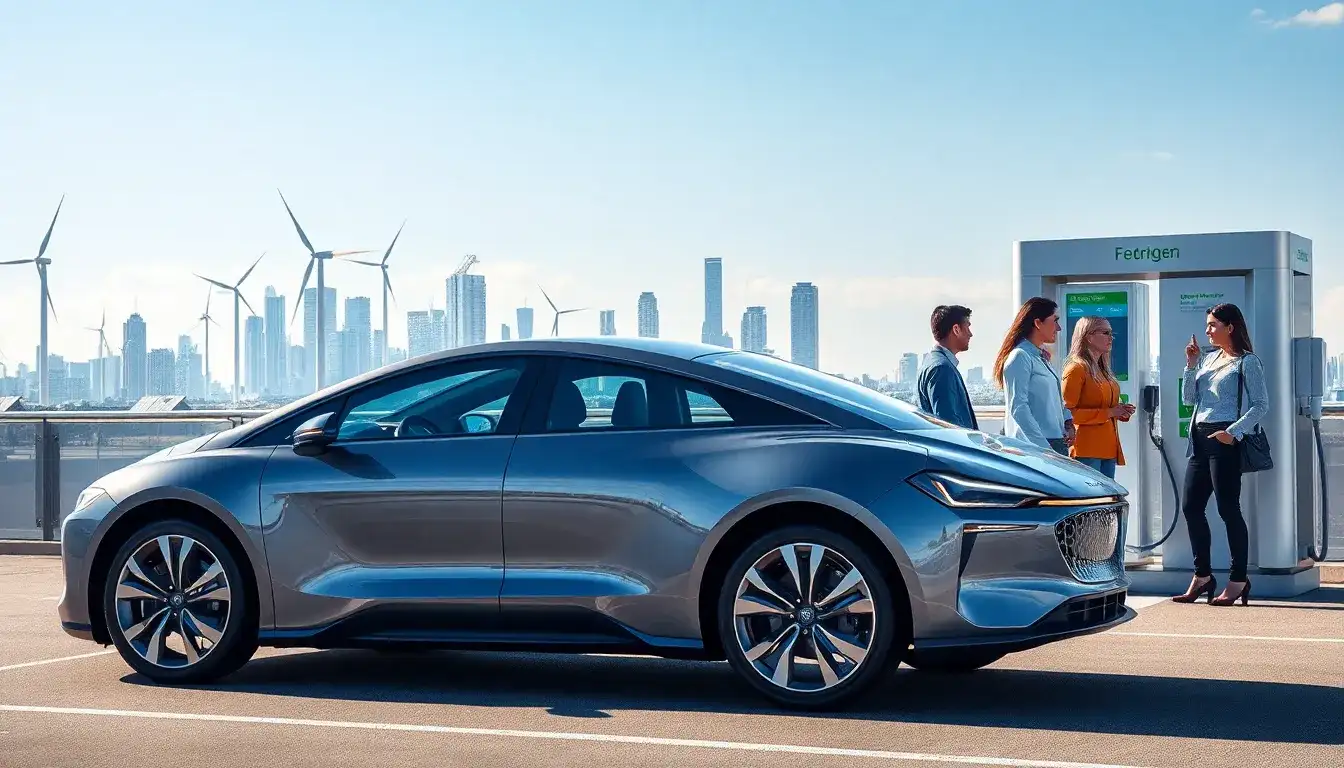
Hydrogen Fuel Vehicles: A Crash or a New Scenario?
“Hydrogen fuel vehicles perfectly solve the issues of conventional cars being prone to explosions and electric vehicles (EVs) lacking sound.” This comment frequently appears on social media whenever hydrogen fuel vehicles are mentioned, indicating that some consumers are not enthusiastic about the adoption of this technology. Recently, the National Energy Administration released the “2025 Energy Work Guideline,” which explicitly states the suggestion to “steadily promote the pilot application of fuel cell vehicles.” This implies that hydrogen fuel cell vehicles remain an important industry supported by the government; however, the emphasis on “steadily” suggests a return to stability in policy. Some interpretations also point out that the absence of a dedicated hydrogen energy section in the 2025 government work report indicates underlying issues.
According to data from the China Association of Automobile Manufacturers (CAAM), the production and sales figures for fuel cell vehicles in 2024 are projected to be 5,548 units and 5,405 units, respectively, representing year-on-year declines of 10.4% and 12.6%. This marks the end of the growth trend in year-on-year production and sales of fuel cell vehicles that had persisted since 2021. Globally, the outlook is even less optimistic. SNE Research, a South Korean research firm, has warned that the market for hydrogen fuel cell electric vehicles (FCEVs) is undergoing a “structural transformation,” gradually heading towards decline. The firm’s data indicates that in the first three months of this year, sales in the U.S., Europe, and Japan saw significant drops, with over half of the sales (just over 1,000 units) occurring in China, primarily in the commercial vehicle sector. For instance, in South Korea, FCEV sales in Q1 2024 plummeted by 70%, while battery electric vehicle (BEV) sales surged by 124.9%. Meanwhile, the U.S. and Europe have clearly positioned BEVs as the main development path through the Inflation Reduction Act and carbon emission regulations. The technological and economic feasibility of FCEV passenger vehicles has fallen far behind that of BEVs, coupled with infrastructure that remains severely underdeveloped.
Incidents such as the explosion of a hydrogen storage tank in Gangneung, South Korea, and accidents at hydrogen refueling stations in Norway have raised public concerns about hydrogen safety, further intensifying resistance to infrastructure development. With existing markets failing to thrive, the anticipated business logic collapses, and the hydrogen energy sector faces ongoing losses without a strong policy focus. Major companies like Toyota and Hyundai, which have heavily invested in hydrogen technology, are now shifting their focus to commercial vehicles in localized closed-loop scenarios to recover their substantial investments. On April 25, China National Heavy Duty Truck Group signed a cooperation agreement with Toyota to develop hydrogen fuel commercial vehicles; on April 26, Meijin Energy and ZTO Express Group strategically signed to gradually deploy 20,000 hydrogen vehicles in the express delivery sector. This indicates that with weakened policy support, the focus of hydrogen vehicles is shifting towards commercial applications. Given the current lack of internal momentum and the priority on commercial ventures, what does the future hold for hydrogen fuel vehicle technology in the eyes of suppliers?
From trunk logistics to hydrogen corridors, hydrogen energy not only has a short refueling time but is also lighter in weight and less affected by battery degradation in low-temperature environments, making it well-suited for long-haul logistics. Pan Feng, General Manager of Frey’s Hydrogen Energy China Division, believes, “In the commercial vehicle sector, hydrogen energy has two highly promising application directions: long-haul logistics and hydrogen corridors.” For long-range travel needs of 700-800 kilometers, hydrogen energy provides clear advantages. For example, Tesla’s Semi truck is available with 600 kWh and 1,000 kWh battery packs. While the official claims state it can achieve a range of 300 miles (approximately 482 kilometers) and 500 miles (approximately 804 kilometers) under EPA conditions, real-world testing shows that to achieve such a range, the cargo weight must be limited to 10.5 tons, with a speed not exceeding 62 miles per hour (100 kilometers per hour). It can be imagined that with a full load of 40 tons, the range of a pure electric truck would suffer significantly.
In May 2025, the Beijing-Shanghai Hydrogen Corridor officially launched, featuring a 49-ton hydrogen fuel heavy truck that can achieve a single refueling range exceeding 600 kilometers. For a 1,200-kilometer long-haul transport, only one hydrogen refueling station needs to be set up along the route to enable zero-carbon transportation across the entire line. Moreover, the refueling time for hydrogen fuel heavy trucks is just 10-15 minutes, which is a significant advantage compared to the 3-4 hours required for electric truck charging. Over the past two years, the government has introduced policies to encourage hydrogen energy applications in trunk logistics. From last year to now, regions such as Hubei, Sichuan, Shaanxi, and Shandong have implemented free highway policies for hydrogen energy. A month ago, at the Electric Vehicle 100 People Meeting, Wan Gang, chairman of the China Association for Science and Technology, also proposed two important application scenarios: the hydrogen corridor and hydrogen energy highways along the Yangtze River Economic Belt. Moving forward, both heavy trucks and cold chain logistics vehicles will have lightweight requirements, and Frey is currently developing a large IV-type hydrogen storage system with a volume of 400 liters and a storage pressure of 70 MPa, which is expected to complete certification by the end of this year.
However, the current application scenarios for hydrogen fuel heavy trucks in China are still primarily short-distance. For instance, the largest market order Frey received last year involved approximately 500 hydrogen fuel heavy truck projects, applied in a steel plant in Tangshan, Hebei. In such cases, hydrogen is a byproduct of steel production, and if not utilized, it would be burned off, leading to waste. Thus, the steel plant using hydrogen fuel incurs virtually zero costs. By the end of 2024, China’s total hydrogen production capacity is expected to surpass 50 million tons per year, with an annual growth rate of approximately 1.6%. In terms of supply structure, there has been significant expansion in industrial byproduct hydrogen capacity, which has increased to 10.7 million tons per year, a year-on-year growth of 5.3%. This indicates that the application prospects for hydrogen energy in short-distance transport are quite broad, and the low operating costs have attracted considerable attention from heavy industrial enterprises. The gas storage cylinders used in the project are produced at Frey’s Shenyang factory, while the hydrogen storage system is completed in collaboration with partners in Shanghai. In this project, 40 kilograms of hydrogen can achieve a range of nearly 400 kilometers, making it highly favored by domestic steel companies. Meanwhile, hydrogen energy can also serve as a storage medium for other renewable energies such as wind and solar power, presenting a new profit opportunity. Xu Lu, President of Frey’s Green Mobility Division in China and Chairman of Frey Hydrogen Energy in China, explains: “In the future, hydrogen energy will likely be an indispensable part of green electricity, with potential in various application scenarios.”
In simple terms, wind and solar energy produce electricity that is unstable, and the cost of energy storage is extremely high. If the electricity generated from wind and solar energy can be stored in the form of hydrogen through a simple electrolysis reaction, and even be used directly, this could be more economically viable than other storage methods. However, the current energy conversion efficiency of the entire “electric-hydrogen-electric” process is less than 40%, and when considering systemic losses during storage and transportation, the overall energy efficiency is even lower. Thus, large-scale adoption may still require breakthroughs in technology.
Addressing Lifespan/Cost Issues with Technology
In terms of driving and riding experience, hydrogen fuel vehicles are nearly indistinguishable from electric vehicles. The difference lies in that the power for hydrogen fuel vehicles comes from fuel cells rather than power batteries. Under standard conditions (273.15 K, 101325 Pa), the theoretical voltage of a single hydrogen fuel cell (known as the Nernst voltage) is 1.23V. By connecting dozens or even hundreds of individual cells in series, a high voltage of several hundred volts can be achieved to drive the motor and propel the vehicle forward. For example, the Toyota fuel cell vehicle Mirai’s battery stack consists of 370 individual cells connected in series, capable of achieving a maximum output power of 114 kW and a power density of 3.1 kW/L. If hydrogen energy storage and range are directly related, then the power of hydrogen energy is closely tied to performance.
At the recently concluded 2025 Shanghai Auto Show, EKPO showcased three different fuel cell platforms: 1. The NM5-evo is the smallest fuel cell platform, covering a power range from 16 kW to 76 kW, primarily for passenger cars, light trucks, small plug-in vehicles, and transport vehicles. 2. The NM12 platform includes single-stack (fuel cell module) and dual-stack (fuel cell system) configurations, covering a power range from 120 kW to 205 kW, suitable for buses, heavy commercial vehicles, non-road (mobile) machinery, rail transport, and marine machinery. 3. The NM20 is the latest generation of fuel cell platforms developed in Germany for long-haul logistics, with a maximum rated power of up to 400 kW. It is currently applied in heavy long-haul logistics vehicles, heavy non-road models, and light power generation projects. According to Michael, Director of Strategy at EKPO, the company currently has an annual production capacity of 10,000 units in Germany and holds over 330 patents globally. Similar to Frey, EKPO’s clients are primarily focused on two scenarios: logistics companies and internal factory operations. They are highly sensitive to the lifespan and pricing of hydrogen fuel stacks.
Chinese Academy of Sciences academician and Chairman of the International Hydrogen Energy and Fuel Cell Association, Ouyang Minggao, has put forward the following viewpoints: 1. The cost of fuel cell systems is rapidly decreasing and is expected to drop to 500 yuan by 2030, allowing for competition with traditional internal combustion engines. 2. The current lifespan of hydrogen fuel cell systems is around 20,000 hours. By 2030, there is hope to reach 30,000 to 35,000 hours, but further technological development is needed. The newly developed fuel cell products by EKPO align perfectly with the trend towards low-cost, long-lifespan hydrogen fuel technology. A year ago, EKPO signed a supply cooperation contract with China FAW Group, specifying that the “NM12-Single” fuel cell module would be used in FAW’s new generation of hydrogen fuel cell vehicles under its high-end brand “Hongqi.” Notably, during the 2022 Beijing Winter Olympics, Hongqi vehicles already utilized EKPO’s fuel cell stacks and passed tests under extreme weather conditions. Interestingly, in addition to converting chemical energy into electrical energy through fuel cells, hydrogen and carbon dioxide can also be converted into methanol.
Conclusion
According to data from the “Hydrogen Energy Database,” as of the end of 2024, a total of 28,247 hydrogen fuel cell vehicles have been deployed in China. Based on China’s “Medium- and Long-term Hydrogen Energy Industry Development Plan (2021-2035),” which aims for a target of about 50,000 fuel cell vehicles by 2025, there is still a gap of over 20,000 vehicles. While production and sales of hydrogen fuel cell vehicles continue to grow, the overall scale remains small, making explosive growth unlikely in the short term. This market capacity, in turn, constrains investments in infrastructure and the industry chain. Nevertheless, there remains potential for localized breakthroughs in hydrogen fuel cell vehicles, particularly in long-distance transport, engineering, and industrial commercial sectors. As such, countries like China and those in the Middle East continue to view hydrogen energy as a core option for decarbonizing heavy industry, with closed-loop commercial vehicles being pivotal for overcoming barriers. Ouyang Minggao has pointed out that the widespread adoption of hydrogen fuel cell vehicles requires overcoming the “cost gap” and the “valley of death for infrastructure.” However, in relatively closed-loop scenarios, it is possible to optimize cost-effectiveness through multidimensional cost reductions and frequent usage of minimal infrastructure.
Original article by NenPower, If reposted, please credit the source: https://nenpower.com/blog/the-future-of-hydrogen-fuel-vehicles-challenges-and-opportunities-in-commercial-applications/

