

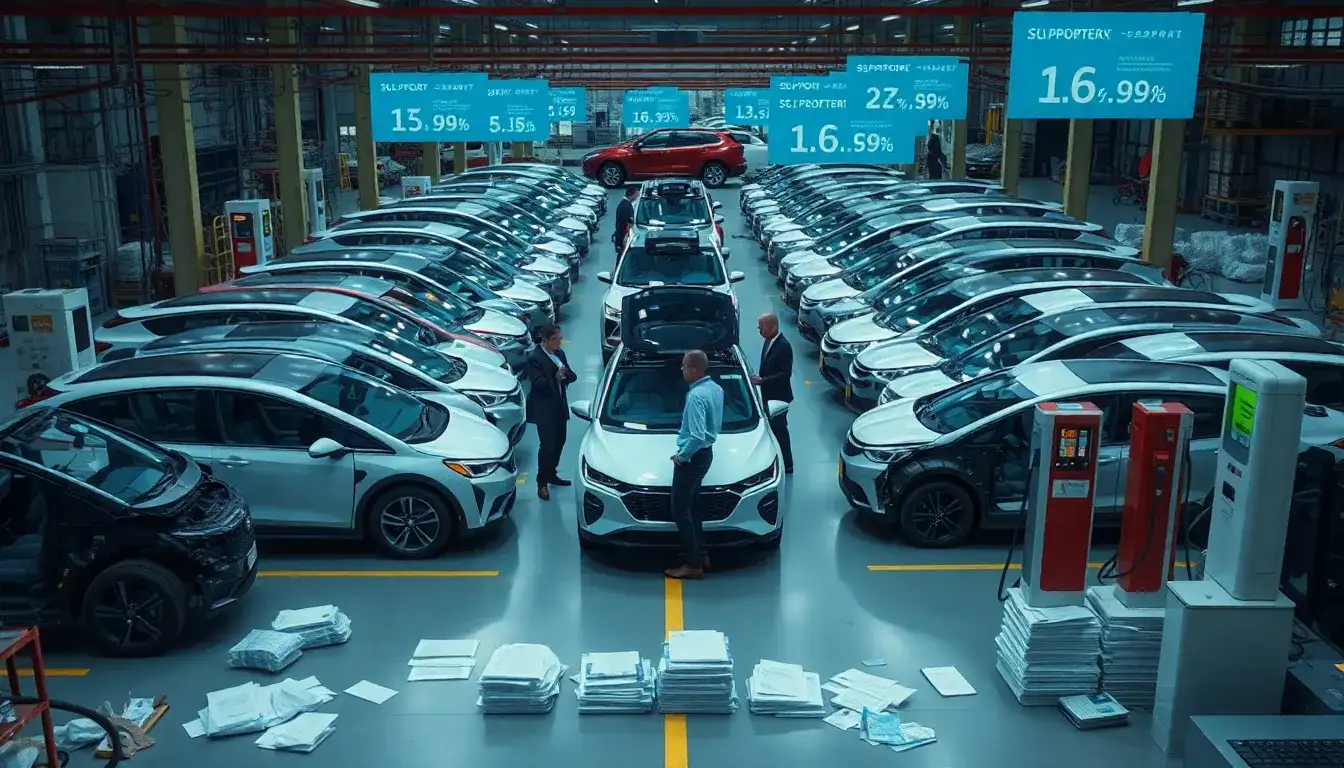
Millions of New Energy “Abandoned Cars”: Who Should Be Responsible for Warranty?
Once a sales champion among new energy vehicles, Neta Auto has left nearly 500,000 car owners in distress. Recently, many Neta owners received a mass message from Hozon Auto (Neta’s parent company), informing them that due to Lenovo’s unilateral refusal to fulfill the “Internet of Vehicles Service Agreement,” the vehicle internet data service would gradually be discontinued. Owners were instructed to purchase data through Lenovo’s official WeChat account. In fact, many owners had already experienced a loss of internet connectivity days before receiving the message, severely affecting their driving experience.
On the same afternoon, Lenovo issued an official statement explaining that the service suspension was due to Hozon’s prolonged failure to pay service fees, which led to a legal and contractual shutdown process after months of unsuccessful negotiations. Neta is not an isolated case; other brands like WM Motor, HiPhi, and Leap Motor have also caused significant distress for their owners. According to incomplete statistics, the collapse of new energy vehicle companies over the past decade has affected millions of car owners. These once-promising “smart vehicles” have now mostly turned into “abandoned cars” with expired warranties and obstructed maintenance services.
From “Finding a Treasure” to “Self-Repair”
“I was instantly attracted to the beauty and spaciousness of WM Motor, and it had all the features, including L2-level assisted driving. Back in 2020, the cost-performance ratio was truly unbeatable,” recalls Mr. Guo, a WM Motor owner in Beijing. He ordered the vehicle with two colleagues and was excited to take advantage of the new dealership’s opening promotions, believing he had found a “hidden gem.” However, this satisfaction did not last long.
In 2022, after-sales issues began to surface quietly. First, the electronic fan made strange noises when the air conditioning was on. When Mr. Guo reported it for repair, he was told, “No parts, please wait for notification.” This waiting period lasted six months, with no parts in sight. To make matters worse, the “8-year/200,000-kilometer extended warranty” he had paid over 5,000 yuan for became worthless as the after-sales system collapsed. The promised warranty service even stopped returning calls. Now, the only remaining WM repair station in Beijing is located far away in Chaoyang North Road, and even for special parts, they are still unavailable.
As a professional in automatic transmission repairs, Mr. Guo has managed to “self-rescue” to some extent: when the vehicle’s internet went down, he purchased a 700 yuan replacement module; when the brake pads wore out, he replaced them himself; for minor issues, he sought help from a small shop run by a former WM employee. Despite these efforts, software updates and some function failures remain unresolved. “The car’s quality is actually fine, but these minor issues do accumulate and affect the driving experience,” he reflects. When considering the recent wave of collapses in the new energy sector, Mr. Guo is now more cautious: “Not every brand can succeed in new energy; genuine capability and strong backing are essential.” Nevertheless, he still recognizes the practicality of electric vehicles, particularly for his daily 60-kilometer commute, where the cost advantages are evident. However, he is now more aware that any future vehicle must come from a reputable brand with substantial backing, avoiding smaller brands.
Warranty Promises Fall Short, Repairs Require “Connections”
Similarly, Mr. Zhu, a WM owner in Shanghai, shares his experience. “In 2020, I chose WM partly because of the Shanghai license plate policies and partly due to its high cost-performance ratio.” He admits that in Shanghai, purchasing a fuel vehicle meant waiting for a license plate, while buying a new energy vehicle came with immediate license benefits. However, the after-sales issues soon became a headache.
In the second year after buying his car, the shortcomings of the after-sales service began to show. “When I contacted customer service with issues, they could never provide precise answers, leading to a poor experience. The 4S dealerships were chaotic; some said certain maintenance tasks were free, while others charged for them, and the standards varied widely between stores.” After WM’s collapse, things worsened. The promised lifetime free basic maintenance from the 4S store vanished along with the after-sales service. Mr. Zhu’s car battery developed an imbalance issue that should have been addressed under warranty, but with no after-sales support, he was left to pay out of pocket for repairs at a third-party service center.
Mr. Zhu told reporters from China Automobile News that unlike Beijing, where only one repair outlet remains, Shanghai has no formal WM repair points left. Now, repairs can only be done through previous dealerships by leveraging personal connections. “Some shops can handle minor issues, but without the original factory’s support, finding parts is challenging, and deep maintenance requires decoding that cannot be done.” Fortunately, the car’s quality remains decent, so he hasn’t faced the need for critical component replacements yet. However, the potential risks remain, leaving owners uneasy.
Reflecting on the state of new energy vehicles, Mr. Zhu believes, “The series of collapses among various brands in the new energy sector is a painful period of natural selection within the industry. The government is now focusing on high-quality development to avoid excessive competition. I hope that the after-sales platform for new energy vehicles can be as robust as that for fuel vehicles, with third-party options available, such as chains like Tuhu and JD Auto Care, so owners won’t have to rely on personal connections for repairs.”
HiPhi and Leap Motor Owners: “Passionate about Niche Brands” but Facing After-Sales Challenges
Mr. Han Rongkai, a car owner from Dongying, Shandong, is quite fond of his vehicles and owns several new energy models, but his preference for niche brands has led him to purchase two models that have since collapsed. He is among the few HiPhi owners and an early adopter of Leap Motor. “I bought a new energy vehicle primarily for its cutting-edge design and practical use cases.” For Mr. Han, experiences like watching cartoons with his child in the car and robust long-distance driving made him appreciate both models’ capabilities. “The HiPhi I purchased for over 600,000 yuan can now sell for around 300,000 yuan; the resale value of niche cars has exceeded expectations.” However, with the brand’s collapse, the after-sales challenges became unavoidable. After HiPhi’s service ceased, Mr. Han noticed that the previously available on-site services were gone. Though there was no 4S store in Dongying, the brand used to send representatives quarterly for maintenance checks. Now he must travel to Jinan’s direct service center to get repairs done. “Fortunately, I’ve become friends with the after-sales technician, so when I go, I bring an air filter, and he checks it for free. However, waiting for parts can take a long time; once, I waited nearly a month for a new 360-degree camera.” Leap Motor’s after-sales service has been transferred to current Lynk & Co dealers, which, while providing a safety net, has reduced the quality of service. “Some shops accept my maintenance coupons, while others do not, and I have to call Lynk’s customer service to resolve issues.” Despite these challenges, Mr. Han remains committed to new energy vehicles. He had a battery replacement for his Leap Motor free of charge before the brand’s collapse and managed to resolve a dashcam issue himself. “Car companies inevitably face problems, but as long as after-sales service isn’t completely cut off, minor issues are acceptable.” As an entrepreneur, he understands the industry’s difficulties: “HiPhi didn’t secure funding at the right time, and Leap Motor was hindered by shareholder strategic adjustments, but the products themselves were not fundamentally flawed.” He, too, looks forward to a future where after-sales support for new energy vehicles is as accessible as that for fuel vehicles. “Many companies currently lock their technology, preventing third-party repairs. If they could adopt a more open approach like Tesla, even if a brand collapses, third-party repairs would offer solutions, alleviating owners’ worries. The industry is evolving and improving, and eventually, these after-sales issues will be resolved.”
Brand Failures Are Normal, but Consumers Shouldn’t Bear the Cost
So, who should car owners turn to for warranty claims regarding the millions of “abandoned” new energy vehicles? Wang Hao, founder and CEO of Pola Automotive Consulting Services (Qingdao), believes that the lack of accountability for maintenance and warranty in new energy vehicles reflects the early developmental stages of the industry, characterized by inadequate service systems, insufficient support, and challenges in regulatory enforcement. If such incidents continue to escalate, they could have severe negative impacts on the new energy vehicle industry, even hindering its future growth.
“I believe that in the current landscape where most new energy vehicle companies have incomplete after-sales channels, insufficient capabilities, and low operational efficiency, government departments need to promote an independent after-sales service market as a supplementary solution to address the shortcomings of single-company service channels and provide users with more convenient and comprehensive after-sales guarantees.” Senior after-sales expert Wang Ligang also asserts that while company failures are a normal market phenomenon, consumers should not bear the cost. The development of the automotive industry in China has been on a “fast track,” but relevant laws and regulations must keep pace, if not lead, to prevent consumer sacrifices.
After-sales service is a crucial component of the automotive market and is one of the core factors that affect the future of automotive brands and the industry as a whole. If trust continues to be eroded, the damage will extend beyond individual brands to the entire image of China’s new energy vehicles. Thus, he recommends that regulatory authorities establish clear laws and regulations defining after-sales responsibilities after bankruptcy, including how to continue repair services, provide parts, and ensure access to maintenance technical information, with specific plans that are both reported to supervisory departments and made public to society, ensuring consumers are informed.
“Chinese new energy brands, at any stage, should have the capability, responsibility, and awareness to create an after-sales service system that can continuously provide high-quality support and eliminate concerns about after-sales service even if a brand goes bankrupt. Only then can we continuously enhance the brand strength of China’s new energy vehicles and reinforce consumer confidence,” concludes Wang Ligang.
Original article by NenPower, If reposted, please credit the source: https://nenpower.com/blog/the-crisis-of-warranty-and-support-for-millions-of-incomplete-new-energy-vehicles-in-china/

