

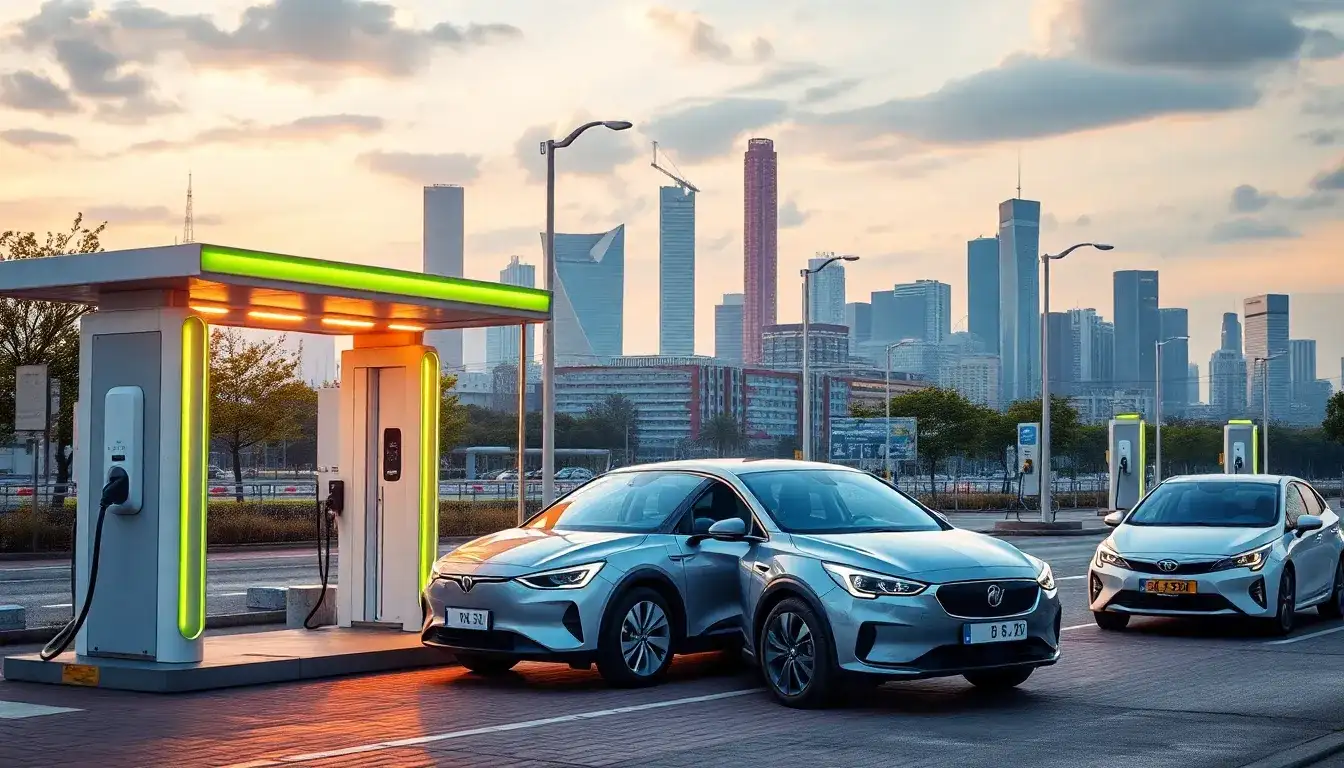
The charging market is experiencing both prosperity and concerns as it moves towards a trillion-dollar scale. The enthusiasm for charging stations can be observed from traditional energy companies, often referred to as the “three barrels of oil,” who have begun to aggressively secure charging spots offline. According to recent data, the total number of charging infrastructure units in China is expected to exceed 10 million for the first time in 2024, reaching 12.818 million units, compared to just 1.68 million five years ago. In tandem, the number of new energy vehicles has skyrocketed from 120,000 in 2014 to 31.4 million in 2024. With 568,000 enterprises related to charging stations vying for a piece of this billion-dollar market, the expansion rate is on track to reach one million units annually. However, the persistent issue of charging anxiety remains: Is it still a concern?
<b>Structural Contradictions Behind Prosperity</b>
<p>Mr. Chen, who works in Hangzhou, Zhejiang, reflects on his daily commute, where there seems to be a charging station every kilometer. Yet, the thought of a 1,000-kilometer trip back home during holidays causes him to worry about running out of charge. As a result, he has opted for a hybrid vehicle that offers the flexibility of both electric and gasoline power, striking a balance between cost-effectiveness and practicality. He is not alone in his anxiety over charging. In 2024, the sales of hybrid passenger cars in China reached 2.485 million units, accounting for 40% of the new energy vehicle market. This hybrid option is clearly advantageous, showcasing lower energy consumption compared to gasoline vehicles, while eliminating the range anxiety associated with fully electric cars.

<p>By the end of 2024, with 12.818 million charging stations and 31.4 million new energy vehicles, the vehicle-to-charger ratio stands at 2.45:1. At first glance, this may seem adequate, but a deeper analysis reveals hidden issues. More than 70% of the 12.818 million charging stations are private chargers, with public stations accounting for less than 30%. When considering only public charging stations, the ratio is approximately eight vehicles per public charger. This demand gap becomes particularly evident during peak travel periods, such as the Spring Festival.

<p>Geographical disparities are also significant. According to the EVCIPA's report on the operational status of electric vehicle charging infrastructure in October 2024, the distribution of public charging stations in China shows an abundance in the south and east compared to the north and west. For instance, the provinces of Guangdong, Zhejiang, and Jiangsu account for 35% of the nation's public charging stations. In Mr. Chen's hometown, a fourth-tier city in central China, public charging stations are sparse. The situation is even more pronounced in rural areas where the penetration rate of new energy vehicles remains low.

<p>In recent years, high-voltage ultra-fast charging technology, operating at 800V to 1,000V, has attempted to alleviate owners' charging anxiety by improving charge times. However, a significant imbalance persists between fast and slow charging stations. According to the latest "China Electric Vehicle User Charging Behavior Research Report," most users of public chargers are sensitive to charging times, with a demand ratio for fast versus slow chargers exceeding 9:1. Yet, the current supply of public chargers is approximately 4:6 in favor of slow chargers, which deviates significantly from user requirements.

<b>Charging Anxiety in Specific Contexts</b>
<p>In one of the busiest areas of Hangzhou, the Qiu Shi Elevated Road sees electric vehicles accounting for 47% of the traffic during weekdays. Didi driver Mr. Pang rushes to finish his last morning ride before heading to a public charging station. "Electricity prices are particularly low during lunch hours, which is peak time for ride-hailing drivers, making it difficult to secure a charging spot," he explains. "Sometimes, I encounter situations where gasoline vehicles occupy charging spots, making it even more frustrating for electric vehicle drivers."

<b>Long-Term Business Challenges</b>
<p>Cost remains the primary constraint for many charging station operators as they face these structural contradictions. From a business perspective, the seemingly thriving charging station market is not a quick-profit venture. The cost of establishing ten standard fast-charging stations ranges from 800,000 to 1.2 million yuan. In contrast, the investment for ultra-fast charging stations can be twice that of fast charging and over twenty times that of slow charging stations. According to Li Liang, head of operations at State Grid Zhejiang Electric Vehicle Service Co., Ltd., the payback period for popular urban charging points can take three to four years on average, but in rural markets, it may take at least twice as long. This scenario tests the patience of companies in the industry.

<p>Major charging operators like Teld and State Grid have undergone long periods of losses. For instance, Teld, which entered the market in 2015, only achieved profitability in early 2023, and faced losses again in the first half of 2024. The difficulty of turning a profit exacerbates structural contradictions in the market: while the most lucrative urban charging opportunities are dwindling, many charging stations still choose to operate in high-traffic urban areas, thereby competing in a saturated market. Conversely, the rural market offers vast potential, yet the scattered nature of the installations leads to smaller operations with high maintenance costs and longer payback periods, discouraging enterprises from making proactive investments.

<p>In the context of new infrastructure development, the process is akin to the chicken-and-egg dilemma, where the egg must come first. The incubation of this "egg" requires supportive policies. In Zhejiang, which has established the second-largest provincial charging service market and infrastructure network in the country, various levels of government are promoting policies to accelerate the deployment of charging networks. In July 2023, the "Zhejiang Province Plan for Improving High-Quality Charging Infrastructure Network and Promoting New Energy Vehicles in Rural Areas (2023-2025)" set ambitious targets: by 2025, the province aims to construct over 2.3 million charging stations (with no less than 900,000 in rural areas) and 120,000 public charging stations (with at least 20,000 in rural areas), creating a charging circle within five minutes in cities and half an hour between urban and rural areas.

<p>On January 1, 2024, Zhejiang further focused on reducing charging prices for new energy vehicles by implementing new electricity pricing policies for charging and swapping facilities, which optimized peak and off-peak pricing and pushed down average electricity costs by 10% to 15%. Subsidies have also been tailored to local needs. In Hangzhou, urban charging stations receive a maximum subsidy of 200 yuan per kilowatt, while rural projects are eligible for double that amount. Ningbo offers a special subsidy of 240 yuan per kilowatt for newly constructed public charging stations in rural areas and highway service areas, with nearly 25 million yuan allocated for subsidies over two years. Jiaxing encourages villages to implement temporary rent reductions for charging facility sites, amounting to an annual rent reduction of about 3 million yuan.

<p>Enhancing rural power distribution networks is a prerequisite for accelerating the "incubation" of charging stations. From 2023 to 2025, Zhejiang plans to invest no less than 10 billion yuan annually in rural distribution networks, increasing the access capacity for low-voltage charging facilities to 160 kVA, and appropriately reserving power supply capabilities for charging facilities. By 2024, the number of users connecting to rural power networks is projected to reach 547,000 (including individuals), representing a year-on-year increase of 63.5%. A series of favorable policies are encouraging more market participants to engage.

<p>In recent years, many companies have also turned their attention to the rural market, accelerating the development of a charging network primarily focused on fast charging, supported by slow charging. Beyond state-owned enterprises, Zhejiang now boasts over 1,200 operators, large and small, establishing charging stations in rural areas. According to statistics, by early 2025, 100% coverage of public charging facilities will be achieved in 87 counties and districts, and 97% coverage in 1,240 towns throughout Zhejiang. Many early investors in high-quality rural sites, such as county enterprises, service areas along highways, and key tourist villages, are already seeing modest profits.

<p>"At this stage, policy subsidies can somewhat alleviate the profitability challenges for charging operators and guide optimized layouts. However, from a competitive standpoint, players will ultimately compete on the utilization rates of charging stations, economies of scale, ancillary services, and funding advantages," Li Liang explains. The mechanism of natural selection is gradually improving. In 2024, Hangzhou will introduce the first evaluation mechanism for charging facility construction and operation companies in Zhejiang, implementing dynamic assessments based on various dimensions, including company size, operational efficiency, and service quality. Incentive policies such as increased subsidy funds will guide companies to expand their construction scales, optimize service experiences, and accelerate the application of new technologies.

<p>It is challenging to sustain in this market without a long-term perspective. Many charging station operators share this sentiment, transitioning from a phase of rapid growth to one of refined operations and deep engagement is necessary for any industry. New profit possibilities are emerging as some charging station operators begin to recognize their evolving roles as new business entities. In 2023, the "Implementation Opinions on Strengthening the Interaction between New Energy Vehicles and the Power Grid" highlighted that electric vehicles can connect with the power supply network through charging and swapping facilities, effectively utilizing the flexibility of battery storage as controllable loads or mobile energy storage.

<p>The following year, the state released the "Basic Rules for Power Market Operations" for the first time in 19 years, recognizing new business entities such as energy storage companies, virtual power plants, and load aggregators as new members of the electricity market. "Charging station operators, especially those capable of scheduling large numbers of charging resources, naturally qualify as excellent load aggregators," claims Li Xudong, a prominent figure in the new energy sector. This means they can profit not only from users but also gain some revenue from the power grid.

<b>Innovative Technological Pathways</b>
<p>The technical pathways from "0 to 1" have been established. Interaction modes such as "invitation for valley charging," "V2G reverse discharging," and "smart orderly charging" are being piloted across the country. In Zhejiang, for example, since 2020, State Grid Zhejiang has constructed or upgraded thousands of smart orderly charging stations, establishing 17 V2G (bidirectional charging and discharging) demonstration stations in the province, achieving peak load reductions of over 115,300 kW across various markets.

<p>However, challenges remain in the implementation of vehicle-to-grid interactions, including battery cycle counts being depleted, high retrofitting costs for charging stations, an immature electricity trading market, and difficulty balancing vehicle and grid needs. "Progressing from 1 to 100 requires comprehensive consideration of various interests. It is expected that by 2030, vehicle-grid interactions will achieve scaled applications," Li Xudong predicts.

<p>Another route involves the integration of solar energy storage and charging. Some charging companies are exploring the installation of solar power generation and energy storage facilities at their stations, creating a "virtual power plant" model deeply integrated with the power grid. During periods of low electricity prices, they store energy, and during peak periods, they can sell the stored energy back to the grid or charge it to users, profiting from the price difference between peak and off-peak rates. When the income from generation can cover charging costs, it theoretically achieves free charging.

<p>To build high-quality development, the focus should not only be on current fast charging but also on future charging networks, energy trading, and interactions. Teld's chairman, Yu Dexiang, stated in a public interview that the charging industry must adopt an "electricity" mindset, as electricity prices fluctuate much more rapidly than oil prices. Indeed, as China's electricity spot market gradually develops and matures, price volatility will become more frequent and rational. If charging station operators can keenly capture spot market prices and guide users in demand response, they may find greater long-term profitability potential.

<p>"In the future, service fees may only account for 30% of the revenue for charging station operators," a representative from a private charging station operator noted. In balancing current operations and future growth, profit opportunities from spot market arbitrage, auxiliary service revenue, and demand response subsidies are all on the horizon. According to calculations by China Automotive Technology and Research Center, new energy vehicle sales in China are projected to exceed 16 million units by 2025, with a penetration rate of 50%. The charging market is expected to expand in tandem, with the charging station industry scale predicted to surpass 100 billion yuan in the same year. With the Ministry of Industry and Information Technology's goal of achieving a 1:1 vehicle-to-charger ratio by 2030, experts anticipate that cumulative sales of new energy vehicles in China will reach 64.2 million units, driven by multiple factors including policy, technology, and capital, accelerating the charging market towards a trillion-dollar scale. Looking ahead, a true era belonging to charging stations is just beginning.
Original article by NenPower, If reposted, please credit the source: https://nenpower.com/blog/the-charging-markets-growth-and-challenges-on-the-path-to-a-trillion-yuan-industry/

