

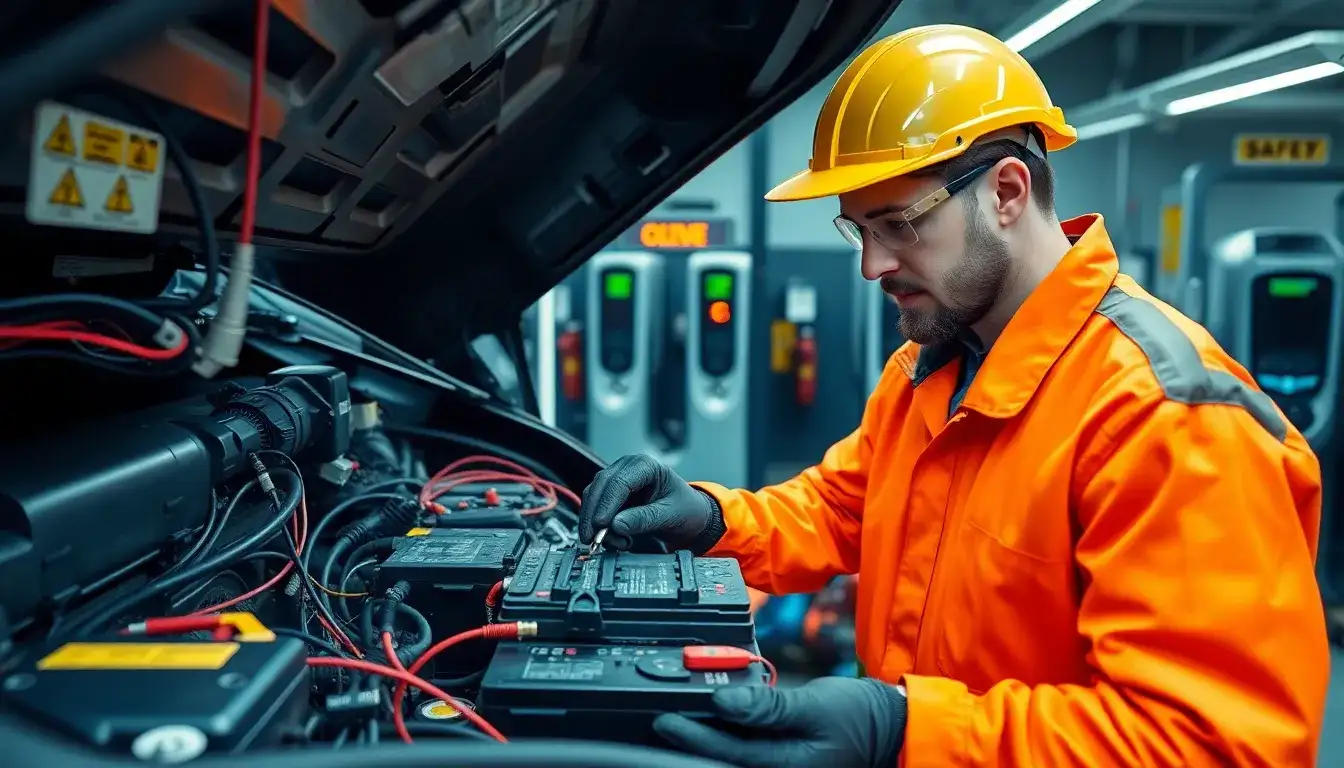
82,000 Shortage: Is It a “High-Risk Profession”?
Recently, popular automotive repair influencer, Long Ge, shifted the focus of his live stream to declare, “Long Ge has lost the lawsuit.” In September, he faced a verdict in a case against an automotive company, requiring him to pay a compensation of 100,000 yuan. Viewers frequently inquire in his streams whether certain brands of new energy vehicles can be repaired. Long Ge’s responses fluctuate between “can be repaired” and “cannot be repaired,” and whenever he impatiently states “cannot be repaired,” audiences interpret it as “dare not repair.” As a well-known automotive repair influencer, Long Ge shares his insights on various brands of new energy vehicles across multiple platforms. He previously revealed that he has been sued by three automotive companies seeking a total of 7 million yuan in damages, branding himself as “the most unfortunate mechanic in 2025.” The public has quickly simplified this ruling to suggest, “A mechanic was sued and lost for repairing new energy vehicles.” Although this is not entirely accurate, it does raise the question of who will repair new energy vehicles.
In a car service company in Hefei, Anhui, a technician is seen repairing the circuit board of a new energy vehicle. The core of Long Ge’s legal issues is not actually about repairing new energy vehicles. On September 12, the legal department of Xpeng Motors disclosed related judgment documents, stating that a company named Manger Electric had used multiple accounts on online platforms such as “Long Teacher Talks about Electric Cars” (formerly “Long Ge Talks about Electric Cars”) and “Long Teacher Manger Electric New Energy Repair Training” to repeatedly publish false statements and malicious slander against Xpeng Motors’ products. BYD is another automotive company that has sued Long Ge. On October 30 last year, BYD’s official Weibo account stated that the self-media “Long Ge Talks about Electric Cars” and its associated accounts have long disseminated false information and defamed BYD’s brand and products across platforms like Douyin and WeChat, seriously damaging BYD’s brand reputation. Although Long Ge was sued due to his statements rather than for repairing new energy vehicles, it resonates with the current sentiment in the automotive repair industry, which considers repairing new energy vehicles a “high-risk profession” in 2025.
What truly concerns the repair industry is a ruling issued by the People’s Court of Jiading District in Shanghai earlier this year. Two brothers, Da Liu and Xiao Liu, engaged in automotive circuit repairs, learned that a company producing new energy vehicles implemented a battery management system that would “lock” the power output of the battery upon detecting a collision signal, in order to prevent potential short circuits and fires. According to standard procedures, the power battery should be “unlocked” only after completing necessary repairs and safety checks. However, the costs and time associated with the conventional “unlocking” process were deemed excessive, leading some vehicle owners to inquire if there were any “shortcuts.” The brothers devised a method to modify the battery management system data using tools like chip programmers and computers, which ultimately resulted in distorted operational data for the batteries sold by this company. Upon discovering this, the company reported the incident to law enforcement. It was found that the brothers had modified the data of two new energy vehicle batteries in this manner, earning an illegal profit of 5,000 yuan. The court sentenced Da Liu to six months in prison with a one-year reprieve and Xiao Liu to six months of detention with a six-month reprieve.
“The repair industry’s reaction to this ruling has been quite intense,” said Cao Xuejun, Vice President and Chief Engineer of the claims adjustment platform service provider Jingyou Technology, in an interview with China News Weekly. This case is quite representative; for automakers, protecting vehicle data is a requirement of the current regulatory system, but it conflicts with user interests. Ensuring the authenticity of collected data is a regulatory requirement. In March 2022, a joint directive was issued by the Ministry of Industry and Information Technology, the Ministry of Public Security, and the Ministry of Transport to further strengthen the safety system of new energy vehicle enterprises, mandating the monitoring of the operational safety status of sold new energy vehicle products and the timely, accurate, and effective uploading of monitoring data according to relevant standards. However, this has sparked controversy regarding the “right to repair”: if a new energy vehicle is involved in a collision and the battery is “locked,” must it be repaired and checked through authorized channels only, leaving no qualification for any third-party channels?
Cao Xuejun believes that gasoline vehicles, primarily mechanical in structure, pose fewer limitations on repair by manufacturers. However, new energy vehicles require connections to the manufacturer’s system, allowing the manufacturer to remotely “lock” them, which limits repair options and leads consumers to feel they have fewer choices for new energy vehicle repairs. “We repair many new energy vehicles, and it’s not a matter of ‘daring not to repair,'” said Li Ming (a pseudonym), head of a third-party repair company in Beijing, in an interview with China News Weekly. After learning about the ruling in Shanghai, he specifically searched for the term “destruction of computer information system,” which made him realize the consequences of “unauthorized unlocking” and left him feeling somewhat apprehensive. While calling the repair of new energy vehicles a “high-risk profession” might be an exaggeration, the fact that new energy vehicle companies tightly control the repair process is evident. The issue is not that they “dare not repair,” but rather that there are simply “no cars to repair.”
According to veteran automotive after-sales industry expert Song Quanye, the more pressing issue may be the lack of vehicles needing repairs. The penetration rate of new energy vehicles has sharply increased in recent years, meaning the proportion of vehicles requiring repairs is still quite small. Car manufacturers generally stipulate in agreements with buyers that any unauthorized repairs by third parties will void warranty services. This gives manufacturers leverage, keeping vehicles still under warranty within their own repair systems. Many manufacturers require users to have repairs and maintenance performed at designated channels. For instance, AITO mandates that repairs involving the Huawei DriveONE electric drive system and onboard systems must be carried out by Huawei-certified engineers; otherwise, warranty services will not be provided. BYD’s “lifetime warranty” clause specifies that if the owner fails to maintain the vehicle at BYD-authorized service centers as per the user manual, or uses non-original parts for repairs, or does not have accident repairs completed at BYD-authorized service points, the lifetime warranty will be voided. Generally, manufacturers provide warranties specifically for the “three electric systems,” but Cao Xuejun has encountered extreme cases where even a simple replacement of a non-original wiper blade led to the manufacturer issuing a warning.
Currently, it is difficult to find third-party repair providers specifically for new energy vehicles in the market; only Tesla’s business is viable. Song Quanye noted that this year has seen the emergence of several so-called third-party new energy vehicle repair companies, primarily targeting Tesla, as the first batches of domestically produced Model 3 and Model Y vehicles have recently passed the four-year or 80,000 km warranty period. Additionally, the large number of Tesla vehicles is sufficient to support the business of repair companies. Most domestic car manufacturers still have their vehicles under warranty, and some even offer lifetime warranties like BYD. Song Quanye believes that manufacturers use clauses about “unauthorized repairs affecting warranty” to prevent a positive cycle from forming in the third-party new energy vehicle repair market. “Automotive repair requires training and practice to accumulate experience, but currently, there are not enough new energy vehicles available for repair. Without sufficient vehicles to ‘practice’ on, the skills learned will become obsolete within one to two years, making early training in new energy vehicle repair quite challenging,” he explained.
Furthermore, compared to gasoline vehicles, new energy vehicles have lower maintenance frequency and costs. For instance, gasoline vehicles require oil changes every 5,000 to 10,000 kilometers, and brake fluid, coolant, spark plugs, etc., must be replaced every 20,000 kilometers, with an average annual maintenance cost of around 2,000 yuan. In contrast, aside from charging, new energy vehicles have minimal other maintenance expenses, and this loss of business makes it even more difficult for third-party new energy vehicle repair markets to survive. The dominance of automotive companies in the new energy vehicle repair market raises concerns, as some emerging automotive companies may initially face shortages in repair capacity. For example, a Xiaomi car owner in Shanghai reported needing to wait half a month for repairs, stating, “It’s harder to get an appointment than to book a visit with a renowned doctor.” However, some companies may authorize certain repair services to third-party repair providers. Yet, becoming part of an automotive manufacturer’s repair system is not easy. Li Ming has been monitoring market changes for two to three years and has sent authorization requests to multiple new energy manufacturers. However, even for those seeking authorization for bodywork and painting services, manufacturers require applicants to possess at least one operational 4S store, preferably a luxury brand. Song Quanye noted that while manufacturers might authorize third-party providers for bodywork and painting, they will not allow outsiders to handle core systems like the “three electric systems,” which account for at least half of a new energy vehicle’s cost and represent the segment with the highest repair profit margins.
Li Ming once assisted a ride-hailing vehicle owner whose car, with a 400-kilometer range, could only travel 70 to 80 kilometers. Since the vehicle had exceeded 300,000 kilometers in four years, it did not meet the manufacturer’s warranty conditions, and the 4S shop proposed a battery pack replacement costing over 80,000 yuan. Ultimately, Li Ming helped the owner replace the damaged battery cells, reducing the cost to around 2,000 yuan. From the perspective of manufacturers, “safety” is a significant consideration. Cao Xuejun stated that an increasing number of new energy vehicles are being repaired through third-party channels, such as ride-hailing vehicles, vehicles out of warranty, and those from manufacturers that have gone bankrupt. However, quality issues arising from third-party repairs are rarely reported, indicating that third parties are indeed capable of repairing new energy vehicles. “Manufacturers want to keep the profits in-house; initially, repairs were done at 4S shops, but third-party vendors will gradually encroach on that business due to cost advantages, a process that gasoline vehicles have already undergone,” Song Quanye remarked.
As more new energy vehicles go out of warranty, an increasing number will inevitably seek third-party repair services; however, this market is evidently unprepared. According to data, by 2025, over 3 million new energy vehicles will no longer be under factory warranty, and it is expected that the maintenance and repair value of new energy vehicles will exceed 80 billion yuan this year. However, the development of the third-party repair market remains sluggish. According to statistics from the China Automotive Maintenance Industry Association, there are approximately 400,000 companies in China related to maintenance and repair of gasoline vehicles, while those specializing in new energy vehicle repairs number only 20,000 to 30,000. Wang Hao, founder and CEO of Bora Automotive Consulting Services (Qingdao) Co., Ltd., has stated that the current demand and supply in the new energy vehicle after-sales market are mismatched, primarily due to the slow progress of new energy vehicle manufacturers and “three electric” suppliers in promoting technology transparency and the circulation of spare parts. Some manufacturers exert strong control over technology, spare parts, and service channels, creating a de facto monopoly and barriers to fair service, thus hindering the establishment of social acceptance for new energy after-sales services. This “barrier” is first reflected in the technical aspect. “Even if a new type of engine is created, mechanics can disassemble and reassemble it, achieving a 100% restoration; there are virtually no technical barriers in gasoline vehicle repairs,” Song Quanye explained. However, for new energy vehicles, particularly the “three electric systems,” many mechanics hesitate even to disassemble them due to inadequate training. Data indicates that there is a shortfall of 824,000 professionals in the after-sales service sector for new energy vehicles in China.
On the other hand, progress in new energy vehicle manufacturers publicly sharing repair technical information has been relatively slow. As early as 2005, the Ministry of Transport and seven other ministries jointly issued the “Implementation Management Measures for the Disclosure of Automotive Repair Technical Information,” mandating that manufacturers provide repair technical information of sold vehicle models to all repair operators and consumers in a non-discriminatory manner, without delay and at reasonable prices. Similar provisions were included in the fifth revision of the “Regulations on Motor Vehicle Maintenance Management” in 2023. However, the implementation of these requirements by manufacturers has not been optimistic. Cao Xuejun candidly stated that despite the relevant requirements, there are still slow updates of repair technical information, cumbersome processes for third-party repair shops to request information from manufacturers, and high costs, all of which restrict the development of the third-party repair market.
In mid-2023, five new energy brands—BYD, Zeekr, Xpeng, Smart, and Leapmotor—faced potential penalties of up to 10 million Australian dollars, equivalent to about 47 million yuan, in Australia for allegedly monopolizing after-sales repair services. According to the country’s “Motor Vehicle Service and Repair Information System” (MVIS) requirements, automotive manufacturers must disclose critical repair data, such as diagnostic software and technical parameters, to independent repair shops. The closed repair system might lead to after-sales costs increasing by 30%. “The penalties imposed on automotive manufacturers in Australia serve as a warning; the EU has similar strict requirements,” Cao Xuejun remarked. He pointed out that there has been no inspection of automotive manufacturers’ compliance with disclosing repair technical information in China, nor has any manufacturer faced penalties for it. “Internally, manufacturers lack specialized departments to promote this matter, as they all want to ensure their repair channels continue to profit.” Another challenge facing the third-party repair market is sourcing parts, especially the “three electric” components. Currently, there is insufficient free circulation of parts in the market. “If a vehicle has a small market scale, third-party parts manufacturers are reluctant to produce components for it. In the gasoline vehicle era, original parts and aftermarket parts existed, which helped lower repair costs. However, if a new energy vehicle only sells a few tens of thousands of units, aftermarket manufacturers naturally lack the incentive to produce parts for it,” shared a representative from an automotive parts manufacturer. Huo Zongqun, co-founder of Chefuning New Energy Parts, has noted that new energy vehicle manufacturers exercise very strict control over parts. For example, Tesla prohibits its original parts from entering the public market and instructs suppliers not to sell parts to the public market. In January of this year, the Financial Regulatory Bureau, the Ministry of Industry and Information Technology, the Ministry of Transport, and the Ministry of Commerce released guidelines to deepen reforms, strengthen regulations, and promote high-quality development of new energy vehicle insurance, emphasizing the need to rationally reduce repair costs. The document also pointed out the importance of enriching the supply channels and types of new energy vehicle repair parts and encouraging new energy vehicle manufacturers and battery suppliers to promote technical openness and support the sale of “three electric system” parts through self-operated or authorized networks to the public. “In the absence of a well-established third-party repair market, it is indeed challenging to reduce the maintenance costs of new energy vehicles,” Li Ming concluded.
Original article by NenPower, If reposted, please credit the source: https://nenpower.com/blog/the-challenges-of-repairing-new-energy-vehicles-a-growing-risk-for-technicians/

